
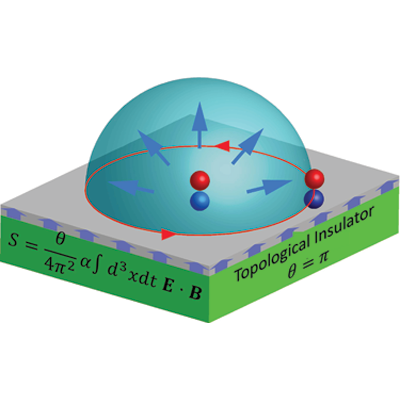
Topological insulators and superconductors
Xiao-Liang Qi and Shou-Cheng Zhang
Rev. Mod. Phys. 83, 1057 (2011)
Xiao-Liang Qi and Shou-Cheng Zhang
Rev. Mod. Phys. 83, 1057 (2011) - Published 14 October, 2011
Topological states of matter, i.e., states that are stabilized by topological properties, have met with tremendous interest recently. The paradigmatic example of a topological state is the quantum Hall state, and the realization that it provides just one example of a whole class of states has spawned a very active field of research. This review gives an overview of the current understanding of both topological insulators, which are similar to quantum Hall states, and topological superconductors.
Dirk Dubbers and Michael G. Schmidt
Rev. Mod. Phys. 83, 1111 (2011) - Published 24 October, 2011
The neutron, a fundamental building block of the atomic nucleus, when free, is an unstable particle that undergoes beta decay with a lifetime of about 15 min. Modern experiments with cold and ultracold neutrons have reached a level of precision such that questions pertaining to scales beyond those of the present standard model of particle physics can be directly addressed. This review discusses these questions, with a focus on the mechanism behind the dominance of matter over antimatter in the Universe, search for deviations from Newton’s gravitational law, delineation of the weak interaction, and the role of neutrons in element formation.
Fred E. Wietfeldt and Geoffrey L. Greene
Rev. Mod. Phys. 83, 1173 (2011) - Published 3 November, 2011
Beta decay of the free neutron is a fundamental process in physics. The Hamiltonian for beta decay was first written down by Fermi in 1934. Experiments and theory later showed that beta decay is governed by vector and axial vector interactions with respective coupling strengths, and a prime motivation for precision measurements of the neutron lifetime is to obtain a highly accurate value for the latter. The neutron lifetime plays a key role in the physics of the early Universe. Furthermore, the lifetime is also an important observable for placing limits on physics beyond the standard model. In this Colloquium the history of neutron decay and the progress made over the years are reviewed, and future measurements are discussed.
M. O. Goerbig
Rev. Mod. Phys. 83, 1193 (2011) - Published 3 November, 2011
Graphene, with its relativistic electron dispersion relation, has led to many interesting developments recently. This review discusses the behavior in strong magnetic fields, and in particular the manifestation of the quantum Hall effect in a pseudorelativistic system. Due to electronic interactions, exotic new phases are expected to underly the observed properties of the integer and fractional quantum Hall effect in these systems.
Marco Durante and Francis A. Cucinotta
Rev. Mod. Phys. 83, 1245 (2011) - Published 8 November, 2011
A major impediment to the human exploration of space is the high level of radiation exposure. The radiation in space is predominantly composed of higher energy and higher charge particles compared to the environment of the Earth, leading to great uncertainty in the radiation health risk. This article reviews the physical basis of radiation protection for space travel, with an emphasis on space radiation transport codes and shielding.
Richard A. Neher and Boris I. Shraiman
Rev. Mod. Phys. 83, 1283 (2011) - Published 10 November, 2011
The analogy between quantitative genetics and thermodynamics has long been noted. Quantitative genetics deals with population-wide averages of traits that emerge from the selection and random drift acting on individuals, and thermodynamics deals with macroscopic states governed by simple laws that emerge due to the self-averaging of microscopic states. This review develops this analogy for the case of evolutionary dynamics of populations with a large number of polymorphic genetic loci, presenting the basic results of the field in the language of statistical physics.
J. A. Mydosh and P. M. Oppeneer
Rev. Mod. Phys. 83, 1301 (2011) - Published 16 November, 2011
Strongly interacting systems, with a large number of degrees of freedom, are characterized by the emergence of different kinds of order, magnetic, superconducting, and hidden, that cannot be easily predicted or explained. Rare-earth and actinide systems are well known for their complexity. In this Colloquium one of the most intriguing and still open cases, namely, the compound is discussed. The hidden order in this material has created intense debate in the literature in the last three decades and still poses a great intellectual challenge in the field of strongly correlated electron systems.
G. Seiden and P. J. Thomas
Rev. Mod. Phys. 83, 1323 (2011) - Published 17 November, 2011
Imagine a world where socks came out of the dryer together, or shirts came out neatly folded. Though the washer and dryer appear to toss, turn, and mix the clothes, is it possible to have an organized structure or pattern emerge from the wash? Pattern formation, demixing, and transport in rotating drums not only demonstrate a rich phenomenology to study and identify, but also are of intense importance in processing and production. This review covers the state of understanding in these simple systems with complex, emergent behavior.
Leonard M. C. Sagis
Rev. Mod. Phys. 83, 1367 (2011) - Published 21 November, 2011
Technology ever more relies on creating and controlling new material properties through the complex combination and mixing of materials with known properties. In multiphase soft solids and fluids different phases meet at interfaces. Often, the interfaces themselves are responsible for novel behaviors and are essential to understand. This review covers state-of-the-art experimental and theoretical techniques to characterize and model the behavior of these interfaces using current notions in thermodynamics, elasticity theory, and rheology. The review concludes with a discussion of the Poisson bracket approach to dynamics and its generalization to dissipative systems.
M. A. Cazalilla, R. Citro, T. Giamarchi, E. Orignac, and M. Rigol
Rev. Mod. Phys. 83, 1405 (2011) - Published 1 December, 2011
One-dimensional quantum systems have long played an important role as a test bed providing exactly solvable models and exotic states. Lately, they have become even more important with the experimental realization of systems that are effectively one dimensional, as well as with the advance of numerical methods. This review gives an overview of the current understanding of bosonic systems in , in particular the Tomonaga-Luttinger state that takes the place of the Bose-Einstein condensate in higher dimensions.
Kris Heyde and John L. Wood
Rev. Mod. Phys. 83, 1467 (2011) - Published 30 November, 2011
The phenomenon of nuclear shape coexistence manifests itself in the presence of close-lying nuclear states with different geometrical arrangements. Examples of coexistence are elongated fission isomers in actinides, alpha cluster structures such as the Hoyle state in carbon essential for the nucleosynthesis of carbon in stars, and deformed states in magic nuclei that provide stringent tests of nuclear paradigms. This review presents an overview of theoretical frameworks, summarizes experimental evidence, and provides guidance for future developments.
Jean Dalibard, Fabrice Gerbier, Gediminas Juzeliūnas, and Patrik Öhberg
Rev. Mod. Phys. 83, 1523 (2011) - Published 30 November, 2011
The capability to simulate and mimic matter under the presence of magnetic fields allows the study of unusual effects which are hard to obtain or study in nature. In this Colloquium article the possibility of creating “pseudo” (or artificial) magnetic fields using lasers and neutral particles is investigated. The developments in this exciting area of research open up new doors to investigate matter under extreme conditions.
V. P. Druzhinin, S. I. Eidelman, S. I. Serednyakov, and E. P. Solodov
Rev. Mod. Phys. 83, 1545 (2011) - Published 6 December, 2011
The process of electron-positron annihilation into hadrons is very fundamental in quantum chromodynamics. This review discusses the existing precise experimental results for center-of-mass energies up to 4.5 GeV obtained using initial state radiation. These data serve, amongst other purposes, as critical input for the determination of the muon magnetic moment for a better understanding of vacuum polarization and energy dependence of the fine structure constant, and for a test of the theory of the conserved vector current. The data are furthermore the basis for future experiments at colliders with higher luminosities.
G. R. Stewart
Rev. Mod. Phys. 83, 1589 (2011) - Published 13 December, 2011
Compounds containing iron are not normally thought of as candidates for superconductivity. Accordingly, the recent discovery of superconductivity in iron pnictides and chalcogenides has spawned much interest. This review gives an overview of the materials in this class known to date, their structures and electronic properties, and the available information about the nature of the electronic pairing.
Michele Campisi, Peter Hänggi, and Peter Talkner
Rev. Mod. Phys. 83, 1653 (2011) - Published 19 December, 2011
Kris Heyde and John L. Wood
Rev. Mod. Phys. 83, 1655 (2011) - Published 23 December, 2011
