

- Open Access
Cavity-Mediated Cross-Cross-Resonance Gate
PRX Quantum 7, 043034 – Published 18 November, 2026
DOI: https://doi.org/10.1103/1nt2-f7gl
Abstract
We propose a cavity-mediated gate between two transmon qubits or other nonlinear superconducting elements. The gate is realized by driving both qubits at a frequency that is near-resonant with the frequency of the cavity. Since both qubits are subject to a cross-resonant drive, we call this gate a cross-cross-resonance gate. In close analogy with gates between trapped-ion qubits, in phase space, the state of the cavity makes a circle whose area depends on the states of the two qubits, thus realizing a controlled-phase gate. We propose two schemes for canceling the dominant error, which is the qubit-cavity dispersive coupling. We also show that this cross-cross-resonance gate allows one to realize simultaneous gates between multiple pairs of qubits coupled via the same metamaterial composed of an array of coupled cavities or other linear mediators.
Physics Subject Headings (PhySH)
Popular Summary
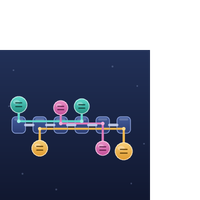
Quantum computers made from superconducting circuits are powerful, but they struggle to link qubits that sit far apart on a chip—exactly the kind of long-range connection that the best error-correcting codes need. We introduce a new way to entangle distant qubits by coupling them to a shared “metamaterial”—a chain of linked microwave resonators that acts as a reconfigurable quantum bus—and driving the qubits with microwave tones so the bus carries quantum information between them and stamps the right entangling operation onto each pair. Because the chain supports many vibrationlike modes, different pairs of faraway qubits can be connected through different modes all at the same time, so a single bus runs many of these operations in parallel. This makes fast, flexible, long-range links practical rather than something that must be hardwired one connection at a time. Capabilities like these are a key step toward building large, error-corrected quantum computers that actually scale.
Article Text
References (120)
- P. Krantz, M. Kjaergaard, F. Yan, T. P. Orlando, S. Gustavsson, and W. D. Oliver, A quantum engineer’s guide to superconducting qubits, Appl. Phys. Rev. 6, 021318 (2019).
- M. Kjaergaard, M. E. Schwartz, J. Braumüller, P. Krantz, J. I. J. Wang, S. Gustavsson, and W. D. Oliver, Superconducting qubits: Current state of play, Annu. Rev. Condens. Matter Phys. 11, 369 (2020).
- A. Blais, A. L. Grimsmo, S. M. Girvin, and A. Wallraff, Circuit quantum electrodynamics, Rev. Mod. Phys. 93, 025005 (2021).
- A. Blais, A. M. Van Den Brink, and A. M. Zagoskin, Tunable coupling of superconducting qubits, Phys. Rev. Lett. 90, 127901 (2003).
- R. C. Bialczak, M. Ansmann, M. Hofheinz, E. Lucero, M. Neeley, A. D. O’Connell, D. Sank, H. Wang, J. Wenner, M. Steffen, A. N. Cleland, and J. M. Martinis, Quantum process tomography of a universal entangling gate implemented with Josephson phase qubits, Nat. Phys. 6, 409 (2010).
- A. Dewes, F. R. Ong, V. Schmitt, R. Lauro, N. Boulant, P. Bertet, D. Vion, and D. Esteve, Characterization of a two-transmon processor with individual single-shot qubit readout, Phys. Rev. Lett. 108, 057002 (2012).
- R. Barends et al., Superconducting quantum circuits at the surface code threshold for fault tolerance, Nature (London) 508, 500 (2014).
- Y. Chen et al., Qubit architecture with high coherence and fast tunable coupling, Phys. Rev. Lett. 113, 220502 (2014).
- F. Yan, P. Krantz, Y. Sung, M. Kjaergaard, D. Campbell, J. I. J. Wang, T. P. Orlando, S. Gustavsson, and W. D. Oliver, Tunable coupling scheme for implementing high-fidelity two-qubit gates, Phys. Rev. Appl. 10, 054062 (2018).
- F. Arute et al., Quantum supremacy using a programmable superconducting processor, Nature (London) 574, 505 (2019).
- J. Majer, J. M. Chow, J. M. Gambetta, J. Koch, B. R. Johnson, J. A. Schreier, L. Frunzio, D. I. Schuster, A. A. Houck, A. Wallraff, A. Blais, M. H. Devoret, S. M. Girvin, and R. J. Schoelkopf, Coupling superconducting qubits via a cavity bus, Nature (London) 449, 443 (2007).
- J. M. Gambetta, A. A. Houck, and A. Blais, Superconducting qubit with Purcell protection and tunable coupling, Phys. Rev. Lett. 106, 030502 (2011).
- S. J. Srinivasan, A. J. Hoffman, J. M. Gambetta, and A. A. Houck, Tunable coupling in circuit quantum electrodynamics using a superconducting charge qubit with a V-shaped energy level diagram, Phys. Rev. Lett. 106, 083601 (2011).
- L. DiCarlo, J. M. Chow, J. M. Gambetta, L. S. Bishop, B. R. Johnson, D. I. Schuster, J. Majer, A. Blais, L. Frunzio, S. M. Girvin, and R. J. Schoelkopf, Demonstration of two-qubit algorithms with a superconducting quantum processor, Nature (London) 460, 240 (2009).
- F. W. Strauch, P. R. Johnson, A. J. Dragt, C. J. Lobb, J. R. Anderson, and F. C. Wellstood, Quantum logic gates for coupled superconducting phase qubits, Phys. Rev. Lett. 91, 167005 (2003).
- L. DiCarlo, M. D. Reed, L. Sun, B. R. Johnson, J. M. Chow, J. M. Gambetta, L. Frunzio, S. M. Girvin, M. H. Devoret, and R. J. Schoelkopf, Preparation and measurement of three-qubit entanglement in a superconducting circuit, Nature (London) 467, 574 (2010).
- T. Yamamoto, M. Neeley, E. Lucero, R. C. Bialczak, J. Kelly, M. Lenander, M. Mariantoni, A. D. O’Connell, D. Sank, H. Wang, M. Weides, J. Wenner, Y. Yin, A. N. Cleland, and J. M. Martinis, Quantum process tomography of two-qubit controlled-Z and controlled-NOT gates using superconducting phase qubits, Phys. Rev. B 82, 184515 (2010).
- V. Negîrneac, H. Ali, N. Muthusubramanian, F. Battistel, R. Sagastizabal, M. S. Moreira, J. F. Marques, W. J. Vlothuizen, M. Beekman, C. Zachariadis, N. Haider, A. Bruno, and L. DiCarlo, High-fidelity controlled-Z gate with maximal intermediate leakage operating at the speed limit in a superconducting quantum processor, Phys. Rev. Lett. 126, 220502 (2021).
- G. S. Paraoanu, Microwave-induced coupling of superconducting qubits, Phys. Rev. B 74, 140504(R) (2006).
- C. Rigetti and M. Devoret, Fully microwave-tunable universal gates in superconducting qubits with linear couplings and fixed transition frequencies, Phys. Rev. B 81, 134507 (2010).
- A. W. Cross and J. M. Gambetta, Optimized pulse shapes for a resonator-induced phase gate, Phys. Rev. A 91, 032325 (2015).
- S. Puri and A. Blais, High-fidelity resonator-induced phase gate with single-mode squeezing, Phys. Rev. Lett. 116, 180501 (2016).
- H. Paik, A. Mezzacapo, M. Sandberg, D. T. McClure, B. Abdo, A. D. Córcoles, O. Dial, D. F. Bogorin, B. L. T. Plourde, M. Steffen, A. W. Cross, J. M. Gambetta, and J. M. Chow, Experimental demonstration of a resonator-induced phase gate in a multiqubit circuit-QED system, Phys. Rev. Lett. 117, 250502 (2016).
- M. Malekakhlagh, W. Shanks, and H. Paik, Optimization of the resonator-induced phase gate for superconducting qubits, Phys. Rev. A 105, 022607 (2022).
- M. Kumph, J. Raftery, A. Finck, J. Blair, A. Carniol, S. Carnevale, G. A. Keefe, V. Arena, S. Hall, D. McKay, and G. Stehlik, Demonstration of RIP gates in a quantum processor with negligible transverse coupling, arXiv:2406.11770.
- Z. Huang, T. Kim, T. Roy, Y. Lu, A. Romanenko, S. Zhu, and A. Grassellino, Fast ZZ-free entangling gates for superconducting qubits assisted by a driven resonator, Phys. Rev. Appl. 22, 034007 (2024).
- P. J. Leek, S. Filipp, P. Maurer, M. Baur, R. Bianchetti, J. M. Fink, M. Göppl, L. Steffen, and A. Wallraff, Using sideband transitions for two-qubit operations in superconducting circuits, Phys. Rev. B 79, 180511(R) (2009).
- S. Poletto, J. M. Gambetta, S. T. Merkel, J. A. Smolin, J. M. Chow, A. D. Córcoles, G. A. Keefe, M. B. Rothwell, J. R. Rozen, D. W. Abraham, C. Rigetti, and M. Steffen, Entanglement of Two Superconducting Qubits in a Waveguide Cavity via Monochromatic Two-Photon Excitation, Phys. Rev. Lett. 109, 240505 (2012).
- J. M. Chow, J. M. Gambetta, A. W. Cross, S. T. Merkel, C. Rigetti, and M. Steffen, Microwave-activated conditional-phase gate for superconducting qubits, New J. Phys. 15, 115012 (2013).
- S. Zeytinoğlu, M. Pechal, S. Berger, A. A. Abdumalikov, A. Wallraff, and S. Filipp, Microwave-induced amplitude- and phase-tunable qubit-resonator coupling in circuit quantum electrodynamics, Phys. Rev. A 91, 043846 (2015).
- D. J. Egger, M. Ganzhorn, G. Salis, A. Fuhrer, P. Müller, P. K. Barkoutsos, N. Moll, I. Tavernelli, and S. Filipp, Entanglement generation in superconducting qubits using holonomic operations, Phys. Rev. Appl. 11, 014017 (2019).
- P. Bertet, C. J. P. M. Harmans, and J. E. Mooij, Parametric coupling for superconducting qubits, Phys. Rev. B 73, 064512 (2006).
- A. O. Niskanen, Y. Nakamura, and J.-S. Tsai, Tunable coupling scheme for flux qubits at the optimal point, Phys. Rev. B 73, 094506 (2006).
- Y.-X. Liu, L. F. Wei, J. R. Johansson, J. S. Tsai, and F. Nori, Superconducting qubits can be coupled and addressed as trapped ions, Phys. Rev. B 76, 144518 (2007).
- A. O. Niskanen, K. Harrabi, F. Yoshihara, Y. Nakamura, S. Lloyd, and J. S. Tsai, Quantum coherent tunable coupling of superconducting qubits, Science 316, 723 (2007).
- Félix Beaudoin, M. P. da Silva, Z. Dutton, and A. Blais, First-order sidebands in circuit QED using qubit frequency modulation, Phys. Rev. A 86, 022305 (2012).
- J. D. Strand, M. Ware, Félix Beaudoin, T. A. Ohki, B. R. Johnson, A. Blais, and B. L. T. Plourde, First-order sideband transitions with flux-driven asymmetric transmon qubits, Phys. Rev. B 87, 220505(R) (2013).
- E. Kapit, Universal two-qubit interactions, measurement, and cooling for quantum simulation and computing, Phys. Rev. A 92, 012302 (2015).
- A. J. Sirois, M. A. Castellanos-Beltran, M. P. DeFeo, L. Ranzani, F. Lecocq, R. W. Simmonds, J. D. Teufel, and J. Aumentado, Coherent-state storage and retrieval between superconducting cavities using parametric frequency conversion, Appl. Phys. Lett. 106, 172603 (2015).
- D. C. McKay, S. Filipp, A. Mezzacapo, E. Magesan, J. M. Chow, and J. M. Gambetta, Universal gate for fixed-frequency qubits via a tunable bus, Phys. Rev. Appl. 6, 064007 (2016).
- R. K. Naik, N. Leung, S. Chakram, P. Groszkowski, Y. Lu, N. Earnest, D. C. McKay, J. Koch, and D. I. Schuster, Random access quantum information processors using multimode circuit quantum electrodynamics, Nat. Commun. 8, 1904 (2017).
- S. A. Caldwell et al., Parametrically activated entangling gates using transmon qubits, Phys. Rev. Appl. 10, 034050 (2018).
- N. Didier, E. A. Sete, M. P. da Silva, and C. Rigetti, Analytical modeling of parametrically modulated transmon qubits, Phys. Rev. A 97, 022330 (2018).
- M. Reagor et al., Demonstration of universal parametric entangling gates on a multi-qubit lattice, Sci. Adv. 4, eaao3603 (2018).
- Y. Sung, L. Ding, J. Braumüller, A. Vepsäläinen, B. Kannan, M. Kjaergaard, A. Greene, G. O. Samach, C. McNally, D. Kim et al., Realization of high-fidelity CZ and ZZ-free iSWAP gates with a tunable coupler, Phys. Rev. X 11, 021058 (2021).
- J. Stehlik, D. Zajac, D. Underwood, T. Phung, J. Blair, S. Carnevale, D. Klaus, G. Keefe, A. Carniol, M. Kumph et al., Tunable coupling architecture for fixed-frequency transmon superconducting qubits, Phys. Rev. Lett. 127, 080505 (2021).
- P. C. de Groot, J. Lisenfeld, R. N. Schouten, S. Ashhab, A. Lupaşcu, C. J. P. M. Harmans, and J. E. Mooij, Selective darkening of degenerate transitions demonstrated with two superconducting quantum bits, Nat. Phys. 6, 763 (2010).
- J. M. Chow, A. D. Córcoles, J. M. Gambetta, C. Rigetti, B. R. Johnson, J. A. Smolin, J. R. Rozen, G. A. Keefe, M. B. Rothwell, M. B. Ketchen, and M. Steffen, Simple all-microwave entangling gate for fixed-frequency superconducting qubits, Phys. Rev. Lett. 107, 080502 (2011).
- A. Kandala, K. X. Wei, S. Srinivasan, E. Magesan, S. Carnevale, G. A. Keefe, D. Klaus, O. Dial, and D. C. McKay, Demonstration of a high-fidelity CNOT gate for fixed-frequency transmons with engineered ZZ suppression, Phys. Rev. Lett. 127, 130501 (2021).
- K. X. Wei, E. Magesan, I. Lauer, S. Srinivasan, D. F. Bogorin, S. Carnevale, G. A. Keefe, Y. Kim, D. Klaus, W. Landers, N. Sundaresan, C. Wang, E. J. Zhang, M. Steffen, O. E. Dial, D. C. McKay, and A. Kandala, Hamiltonian engineering with multicolor drives for fast entangling gates and quantum crosstalk cancellation, Phys. Rev. Lett. 129, 060501 (2022).
- J. M. Chow, J. M. Gambetta, A. D. Córcoles, S. T. Merkel, J. A. Smolin, C. Rigetti, S. Poletto, G. A. Keefe, M. B. Rothwell, J. R. Rozen, M. B. Ketchen, and M. Steffen, Universal quantum gate set approaching fault-tolerant thresholds with superconducting qubits, Phys. Rev. Lett. 109, 060501 (2012).
- A. D. Córcoles, J. M. Gambetta, J. M. Chow, J. A. Smolin, M. Ware, J. Strand, B. L. T. Plourde, and M. Steffen, Process verification of two-qubit quantum gates by randomized benchmarking, Phys. Rev. A 87, 030301(R) (2013).
- M. Takita, A. D. Córcoles, E. Magesan, B. Abdo, M. Brink, A. Cross, J. M. Chow, and J. M. Gambetta, Demonstration of weight-four parity measurements in the surface code architecture, Phys. Rev. Lett. 117, 210505 (2016).
- S. Sheldon, E. Magesan, J. M. Chow, and J. M. Gambetta, Procedure for systematically tuning up cross-talk in the cross-resonance gate, Phys. Rev. A 93, 060302(R) (2016).
- A. Patterson, J. Rahamim, T. Tsunoda, P. Spring, S. Jebari, K. Ratter, M. Mergenthaler, G. Tancredi, B. Vlastakis, M. Esposito, and P. Leek, Calibration of a cross-resonance two-qubit gate between directly coupled transmons, Phys. Rev. Appl. 12, 064013 (2019).
- S. Hazra, K. V. Salunkhe, A. Bhattacharjee, G. Bothara, S. Kundu, T. Roy, M. P. Patankar, and R. Vijay, Engineering cross resonance interaction in multi-modal quantum circuits, Appl. Phys. Lett. 116, 152601 (2020).
- E. Dogan, D. Rosenstock, L. Le Guevel, H. Xiong, R. A. Mencia, A. Somoroff, K. N. Nesterov, M. G. Vavilov, V. E. Manucharyan, and C. Wang, Two-fluxonium cross-resonance gate, Phys. Rev. Appl. 20, 024011 (2023).
- P. C. de Groot, S. Ashhab, A. Lupaşcu, L. DiCarlo, F. Nori, C. J. P. M. Harmans, and J. E. Mooij, Selective darkening of degenerate transitions for implementing quantum controlled-NOT gates, New J. Phys. 14, 073038 (2012).
- S. Kirchhoff, T. Keßler, P. J. Liebermann, E. Assémat, S. Machnes, F. Motzoi, and F. K. Wilhelm, Optimized cross-resonance gate for coupled transmon systems, Phys. Rev. A 97, 042348 (2018).
- V. Tripathi, M. Khezri, and A. N. Korotkov, Operation and intrinsic error budget of a two-qubit cross-resonance gate, Phys. Rev. A 100, 012301 (2019).
- E. Magesan and J. M. Gambetta, Effective Hamiltonian models of the cross-resonance gate, Phys. Rev. A 101, 052308 (2020).
- N. Sundaresan, I. Lauer, E. Pritchett, E. Magesan, P. Jurcevic, and J. M. Gambetta, Reducing unitary and spectator errors in cross resonance with optimized rotary echoes, PRX Quantum 1, 020318 (2020).
- M. Malekakhlagh, E. Magesan, and D. C. McKay, First-principles analysis of cross-resonance gate operation, Phys. Rev. A 102, 042605 (2020).
- M. Malekakhlagh and E. Magesan, Mitigating off-resonant error in the cross-resonance gate, Phys. Rev. A 105, 012602 (2022).
- K. N. Nesterov, C. Wang, V. E. Manucharyan, and M. G. Vavilov, CNOT gates for fluxonium qubits via selective darkening of transitions, Phys. Rev. Appl. 18, 034063 (2022).
- K. Heya and N. Kanazawa, Cross-cross resonance gate, PRX Quantum 2, 040336 (2021).
- A. Petrescu, C. Le Calonnec, C. Leroux, A. Di Paolo, P. Mundada, S. Sussman, A. Vrajitoarea, A. A. Houck, and A. Blais, Accurate methods for the analysis of strong-drive effects in parametric gates, Phys. Rev. Appl. 19, 044003 (2023).
- A. Sørensen and K. Mølmer, Entanglement and quantum computation with ions in thermal motion, Phys. Rev. A 62, 022311 (2000).
- N. P. Breuckmann and J. N. Eberhardt, Quantum low-density parity-check codes, PRX Quantum 2, 040101 (2021).
- D. Gottesman, Fault-tolerant quantum computation with constant overhead, Quantum Inf. Comput. 14, 1338 (2014).
- M. A. Tremblay, N. Delfosse, and M. E. Beverland, Constant-overhead quantum error correction with thin planar connectivity, Phys. Rev. Lett. 129, 050504 (2022).
- P. Panteleev and G. Kalachev, Asymptotically good quantum and locally testable classical LDPC codes, in Proceedings of the 54th Annual ACM SIGACT Symposium on Theory of Computing (ACM, Rome Italy, 2022), pp. 375–388.
- A. Leverrier and G. Zemor, Quantum Tanner codes, in 2022 IEEE 63rd Annual Symposium on Foundations of Computer Science (FOCS) (IEEE, Denver, CO, USA, 2022), pp. 872–883.
- S. Bravyi, A. W. Cross, J. M. Gambetta, D. Maslov, P. Rall, and T. J. Yoder, High-threshold and low-overhead fault-tolerant quantum memory, Nature (London) 627, 778 (2024).
- M. Cain, Q. Xu, R. King, L. R. Picard, H. Levine, M. Endres, J. Preskill, H.-Y. Huang, and D. Bluvstein, Shor’s algorithm is possible with as few as 10,000 reconfigurable atomic qubits, arXiv:2603.28627.
- C. Zhao, C. Duckering, A. Gu, N. Maskara, and H. Zhou, Towards ultra-high-rate quantum error correction with reconfigurable atom arrays, arXiv:2604.16209.
- K. Kasai, Breaking the orthogonality barrier in quantum LDPC codes, arXiv:2601.08824.
- K. Wang, Z. Lu, C. Zhang, G. Liu, J. Chen, Y. Wang, Y. Wu, S. Xu, X. Zhu, F. Jin et al., Demonstration of low-overhead quantum error correction codes, Nat. Phys. 22, 308 (2026).
- G. J. Norris, K. Dalton, D. C. Zanuz, A. Rommens, A. Flasby, M. B. Panah, F. Swiadek, C. Scarato, C. Hellings, J.-C. Besse et al., Performance characterization of a multi-module quantum processor with static inter-chip couplers, EPJ Quant. Technol. 13, 29 (2026).
- K. N. Smith, G. S. Ravi, J. M. Baker, and F. T. Chong, Scaling superconducting quantum computers with chiplet architectures, in 2022 55th IEEE/ACM International Symposium on Microarchitecture (MICRO) (IEEE, Chicago, IL, USA, 2022), pp. 1092–1109.
- A. Gold, J. Paquette, A. Stockklauser, M. J. Reagor, M. S. Alam, A. Bestwick, N. Didier, A. Nersisyan, F. Oruc, A. Razavi et al., Entanglement across separate silicon dies in a modular superconducting qubit device, npj Quantum Inf. 7, 142 (2021).
- M. Field, A. Q. Chen, B. Scharmann, E. A. Sete, F. Oruc, K. Vu, V. Kosenko, J. Y. Mutus, S. Poletto, and A. Bestwick, Modular superconducting-qubit architecture with a multichip tunable coupler, Phys. Rev. Appl. 21, 054063 (2024).
- X. Deng, W. Zheng, X. Liao, H. Zhou, Y. Ge, J. Zhao, D. Lan, X. Tan, Y. Zhang, S. Li et al., Long-range ZZ interaction via resonator-induced phase in superconducting qubits, Phys. Rev. Lett. 134, 020801 (2025).
- X. Wu, H. Yan, G. Andersson, A. Anferov, M.-H. Chou, C. R. Conner, J. Grebel, Y. J. Joshi, S. Li, J. M. Miller et al., Modular quantum processor with an all-to-all reconfigurable router, Phys. Rev. X 14, 041030 (2024).
- J. Song, S. Yang, P. Liu, H.-L. Zhang, G.-M. Xue, Z.-Y. Mi, W.-G. Zhang, F. Yan, Y.-R. Jin, and H.-F. Yu, Realization of high-fidelity perfect entanglers between remote superconducting quantum processors, Phys. Rev. Lett. 135, 050603 (2025).
- S. Touzard, A. Kou, N. E. Frattini, V. V. Sivak, S. Puri, A. Grimm, L. Frunzio, S. Shankar, and M. H. Devoret, Gated conditional displacement readout of superconducting qubits, Phys. Rev. Lett. 122, 080502 (2019).
- E. Solano, G. S. Agarwal, and H. Walther, Strong-driving-assisted multipartite entanglement in cavity QED, Phys. Rev. Lett. 90, 027903 (2003).
- M. Ayyash, X. Xu, and M. Mariantoni, Resonant Schrödinger cat states in circuit quantum electrodynamics, Phys. Rev. A 109, 023703 (2024).
- M. Ayyash, X. Xu, S. Ashhab, and M. Mariantoni, Driven multiphoton qubit-resonator interactions, Phys. Rev. A 110, 053711 (2024).
- M. Ayyash, Multimode qubit-conditional operations via generalized cross-resonance, arXiv:2503.15941.
Technically, and are negatives of the corresponding detunings since they are negative when the drive is blue-detuned. However, throughout the paper, we will abuse the terminology and refer to them simply as detunings.
- C. D. Bruzewicz, J. Chiaverini, R. McConnell, and J. M. Sage, Trapped-ion quantum computing: Progress and challenges, Appl. Phys. Rev. 6, 021314 (2019).
- D. Leibfried, B. DeMarco, V. Meyer, D. Lucas, M. Barrett, J. Britton, W. M. Itano, B. Jelenković, C. Langer, T. Rosenband, and D. J. Wineland, Experimental demonstration of a robust, high-fidelity geometric two ion-qubit phase gate, Nature (London) 422, 412 (2003).
- Y. Kim, A. Morvan, L. B. Nguyen, R. K. Naik, C. Jünger, L. Chen, J. M. Kreikebaum, D. I. Santiago, and I. Siddiqi, High-fidelity three-qubit iToffoli gate for fixed-frequency superconducting qubits, Nat. Phys. 18, 783 (2022).
- S. Jandura, V. Srivastava, L. Pecorari, G. K. Brennen, and G. Pupillo, Nonlocal multiqubit quantum gates via a driven cavity, Phys. Rev. A 110, 062610 (2024).
- R. Barends et al., Diabatic gates for frequency-tunable superconducting qubits, Phys. Rev. Lett. 123, 210501 (2019).
- T. Manovitz, A. Rotem, R. Shaniv, I. Cohen, Y. Shapira, N. Akerman, A. Retzker, and R. Ozeri, Fast dynamical decoupling of the Mølmer–Sørensen entangling gate, Phys. Rev. Lett. 119, 220505 (2017).
- J. A. Mizrahi, Ultrafast control of spin and motion in trapped ions, Ph.D. thesis, University of Maryland, College Park, 2013.
- J. J. García-Ripoll, P. Zoller, and J. I. Cirac, Speed optimized two-qubit gates with laser coherent control techniques for ion trap quantum computing, Phys. Rev. Lett. 91, 157901 (2003).
- H. Y. Carr and E. M. Purcell, Effects of diffusion on free precession in nuclear magnetic resonance experiments, Phys. Rev. 94, 630 (1954).
- S. Meiboom and D. Gill, Modified spin-echo method for measuring nuclear relaxation times, Rev. Sci. Instrum. 29, 688 (1958).
- Götz S. Uhrig, Keeping a quantum bit alive by optimized π-pulse sequences, Phys. Rev. Lett. 98, 100504 (2007).
- O. Golan, A. V. Gorshkov, A. Butler, G. Kim, F. G. S. L. Brandao, O. Painter, and A. Retzker, All-to-all connectivity in superconducting qubits via metamaterial-mediated interactions, arXiv:2611.01180.
- Y. Shapira, R. Shaniv, T. Manovitz, N. Akerman, L. Peleg, L. Gazit, R. Ozeri, and A. Stern, Theory of robust multiqubit nonadiabatic gates for trapped ions, Phys. Rev. A 101, 032330 (2020).
- E. J. Zhang et al., High-performance superconducting quantum processors via laser annealing of transmon qubits, Sci. Adv. 8, eabi6690 (2022).
- N. Grzesiak, R. Blümel, K. Wright, K. M. Beck, N. C. Pisenti, M. Li, V. Chaplin, J. M. Amini, S. Debnath, J.-S. Chen, and Y. Nam, Efficient arbitrary simultaneously entangling gates on a trapped-ion quantum computer, Nat. Commun. 11, 2963 (2020).
- W. Dai, S. Hazra, D. K. Weiss, P. D. Kurilovich, T. Connolly, H. K. Babla, S. Singh, V. R. Joshi, A. Z. Ding, P. D. Parakh, J. Venkatraman, X. Xiao, L. Frunzio, and M. H. Devoret, Characterization of drive-induced unwanted state transitions in superconducting circuits, Phys. Rev. X 16, 011011 (2026).
- A. Mercurio, Y.-T. Huang, L.-X. Cai, Y.-N. Chen, V. Savona, and F. Nori, QuantumToolbox.jl: An efficient Julia framework for simulating open quantum systems, Quantum 9, 1866 (2025).
The Nuttall window is defined as with , , , and . is the number of time steps that the window is broken into.
- M. Göppl, A. Fragner, M. Baur, R. Bianchetti, S. Filipp, J. M. Fink, P. J. Leek, G. Puebla, L. Steffen, and A. Wallraff, Coplanar waveguide resonators for circuit quantum electrodynamics, J. Appl. Phys. 104, 113904 (2008).
- S. Bose, Quantum communication through spin chain dynamics: An introductory overview, Contemp. Phys. 48, 13 (2007).
- N. Y. Yao, L. Jiang, A. V. Gorshkov, Z.-X. Gong, A. Zhai, L.-M. Duan, and M. D. Lukin, Robust quantum state transfer in random unpolarized spin chains, Phys. Rev. Lett. 106, 040505 (2011).
- Y. Lu, S. Zhang, K. Zhang, W. Chen, Y. Shen, J. Zhang, J.-N. Zhang, and K. Kim, Global entangling gates on arbitrary ion qubits, Nature (London) 572, 363 (2019).
- D. Leibfried and D. J. Wineland, Efficient eigenvalue determination for arbitrary Pauli products based on generalized spin-spin interactions, J. Mod. Opt. 65, 774 (2018).
- S. C. Burd, R. Srinivas, H. M. Knaack, W. Ge, A. C. Wilson, D. J. Wineland, D. Leibfried, J. J. Bollinger, D. T. C. Allcock, and D. H. Slichter, Quantum amplification of boson-mediated interactions, Nat. Phys. 17, 898 (2021).
- M. A. Ali Ahmed, G. A. Álvarez, and D. Suter, Robustness of dynamical decoupling sequences, Phys. Rev. A 87, 042309 (2013).
- F. Solgun and S. Srinivasan, Direct calculation of ZZ interaction rates in multimode circuit quantum electrodynamics, Phys. Rev. Appl. 18, 044025 (2022).
- S. Bravyi, D. P. DiVincenzo, and D. Loss, Schrieffer–Wolff transformation for quantum many-body systems, Ann. Phys. (N.Y.) 326, 2793 (2011).
- P. Mundada, G. Zhang, T. Hazard, and A. Houck, Suppression of qubit crosstalk in a tunable coupling superconducting circuit, Phys. Rev. Appl. 12, 054023 (2019).
- L. Heunisch, C. Eichler, and M. J. Hartmann, Tunable coupler to fully decouple and maximally localize superconducting qubits, Phys. Rev. Appl. 20, 064037 (2023).

