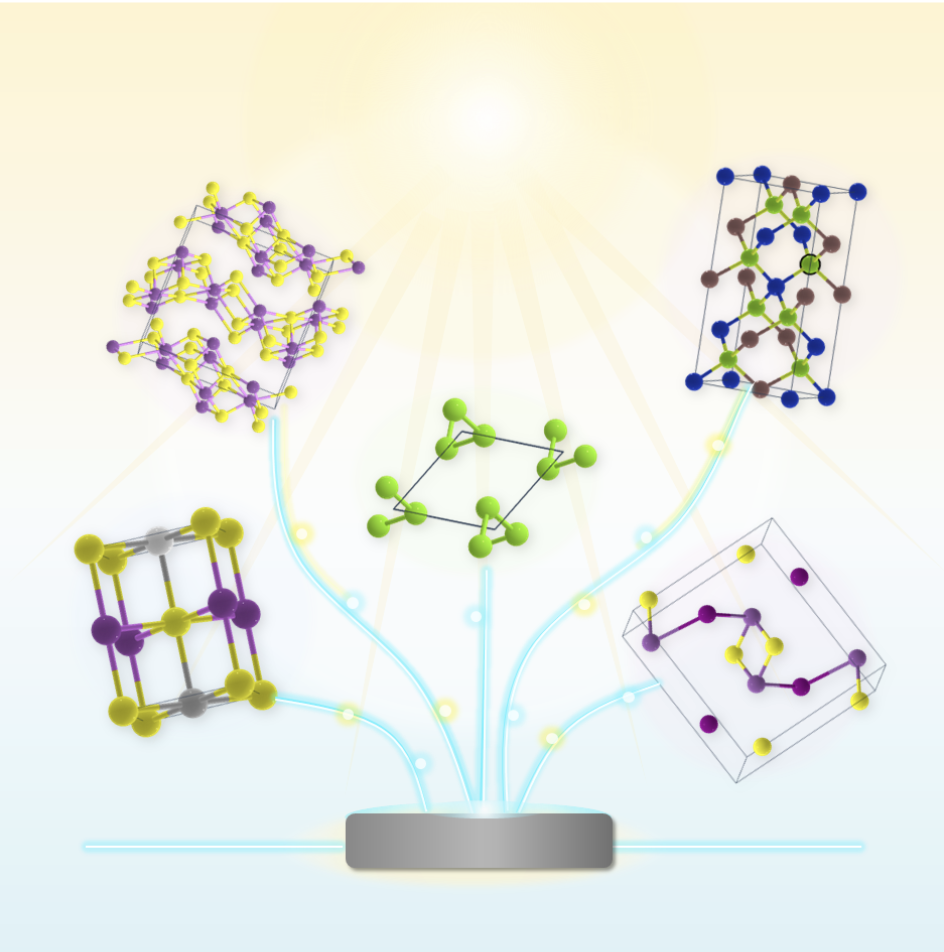
Every established photovoltaic technology carries trade-offs in cost, stability, resource availability, and scalability, so the search for alternatives remains open. Inorganic chalcogenides could answer the need with earth-abundant chemistries, intrinsic stability, and band gaps tunable across the single-junction and tandem range. Previous research on kesterite Cu2ZnSn(S,Se)4 (CZTSSe) based photovoltaic devices stalled at 12.6% power conversion efficiency for a decade, but renewed interest enabled the technology to climb past 15% certified efficiency in just three years. This shows that sustained work on defect and phase-evolution control can reopen a technology that many had set aside.
This PRX Energy Collection on Inorganic Chalcogenide Thin-Film Photovoltaics invites work on emerging and established chalcogenide-based solar absorbers, including kesterites, Sb2(S,Se)3, wide-band-gap CIGS, selenium, chalcohalides, chalcogenide perovskites such as BaZrS3, and AgBiS2, and work on chalcogenide/perovskite tandems with particular attention to the chalcogenide bottom cell.
The Collection is being guest-edited by Byungha Shin from Korea Advanced Institute of Science and Technology, Edgardo Saucedo from Universitat Politècnica de Catalunya, Xiaojing Hao from University of New South Wales, and Qingbo Meng from Institute of Physics, Chinese Academy of Sciences. Every article in this Collection is subject to a rigorous peer review process, upholding the high standards applied to all papers in the journal. The PRX Energy editorial team manages peer review and makes all editorial decisions.