Recent Articles

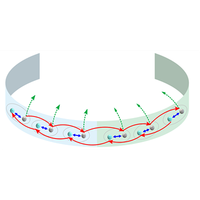
Non-Hermitian Mott Skin Effect

Tsuneya Yoshida, Song-Bo Zhang, Titus Neupert, and Norio Kawakami

Phys. Rev. Lett. 133, 076502 (2024) - Published 14 August, 2024

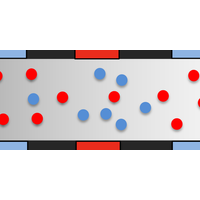
Discontinuous Transition in Electrolyte Flow through Charge-Patterned Nanochannels

Tine Curk, Sergi G. Leyva, and Ignacio Pagonabarraga

Phys. Rev. Lett. 133, 078201 (2024) - Published 14 August, 2024

Electrically patterning the walls of a nanochannel could provide a route to creating “valves” that abruptly alter the speed at which a charged fluid flows through a nanofluidic device.

Persistent Ballistic Entanglement Spreading with Optimal Control in Quantum Spin Chains

Ying Lu, Pei Shi, Xiao-Han Wang, Jie Hu, and Shi-Ju Ran

Phys. Rev. Lett. 133, 070402 (2024) - Published 13 August, 2024

Work Sum Rule for Open Quantum Systems

Parth Kumar, Caleb M. Webb, and Charles A. Stafford

Phys. Rev. Lett. 133, 070404 (2024) - Published 13 August, 2024

Observation of Non-Hermitian Edge Burst in Quantum Dynamics

Lei Xiao, Wen-Tan Xue, Fei Song, Yu-Min Hu, Wei Yi, Zhong Wang, and Peng Xue

Phys. Rev. Lett. 133, 070801 (2024) - Published 13 August, 2024

In non-Hermitian systems, boundary effects are more pronounced than in Hermitian systems.

Search by the SENSEI Experiment for Millicharged Particles Produced in the NuMI Beam

Liron Barak et al. (SENSEI Collaboration)

Phys. Rev. Lett. 133, 071801 (2024) - Published 13 August, 2024

Estimate for the Bulk Viscosity of Strongly Coupled Quark Matter Using Perturbative QCD and Holography

Jesús Cruz Rojas, Tyler Gorda, Carlos Hoyos, Niko Jokela, Matti Järvinen, Aleksi Kurkela, Risto Paatelainen, Saga Säppi, and Aleksi Vuorinen

Phys. Rev. Lett. 133, 071901 (2024) - Published 13 August, 2024

First Exploration of Monopole-Driven Shell Evolution above the N=126 Shell Closure: New Millisecond Isomers in Tl213 and Tl215

T. T. Yeung et al.

Phys. Rev. Lett. 133, 072501 (2024) - Published 13 August, 2024

Direct Observation of Competing M1 and M3 Transitions in B10

A. Kuşoğlu et al.

Phys. Rev. Lett. 133, 072502 (2024) - Published 13 August, 2024

Strong-Field Ionization Phenomena Revealed by Quantum Trajectories

Taylor Moon, Klaus Bartschat, and Nicolas Douguet

Phys. Rev. Lett. 133, 073201 (2024) - Published 13 August, 2024

Fundamental Limits of Feedback Cooling Ultracold Atomic Gases

Zain Mehdi, Simon A. Haine, Joseph J. Hope, and Stuart S. Szigeti

Phys. Rev. Lett. 133, 073401 (2024) - Published 13 August, 2024

Self-Suppressed Quantum-Limited Timing Jitter and Fundamental Noise Limit of Soliton Microcombs

Xing Jin, Zhe Lv, Lu Yao, Qihuang Gong, and Qi-Fan Yang

Phys. Rev. Lett. 133, 073801 (2024) - Published 13 August, 2024

Data-Driven Learning of the Generalized Langevin Equation with State-Dependent Memory

Pei Ge, Zhongqiang Zhang, and Huan Lei

Phys. Rev. Lett. 133, 077301 (2024) - Published 13 August, 2024

Measuring Entanglement in Physical Networks

Cory Glover and Albert-László Barabási

Phys. Rev. Lett. 133, 077401 (2024) - Published 13 August, 2024

A new mathematical measure of knottiness could help improve the transport efficiencies of subway and road systems, as well as other physical networks.

Power-Law Entanglement and Hilbert Space Fragmentation in Nonreciprocal Quantum Circuits

K. Klocke, J. E. Moore, and M. Buchhold

Phys. Rev. Lett. 133, 070401 (2024) - Published 12 August, 2024

Conditional Dynamics in Heterodyne Detection of Superradiant Lasing with Incoherently Pumped Atoms

Huihui Yu, Yuan Zhang, Qilong Wu, Chong-Xin Shan, and Klaus Mølmer

Phys. Rev. Lett. 133, 073601 (2024) - Published 12 August, 2024

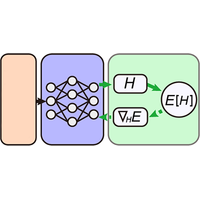
Neural-network Density Functional Theory Based on Variational Energy Minimization

Yang Li, Zechen Tang, Zezhou Chen, Minghui Sun, Boheng Zhao, He Li, Honggeng Tao, Zilong Yuan, Wenhui Duan, and Yong Xu

Phys. Rev. Lett. 133, 076401 (2024) - Published 12 August, 2024

Instead of training the neural networks with predictions derived from DFT, unsupervised learning by treating the energy functional of variational DFT as the loss function of the neural network yields predictions of material properties.

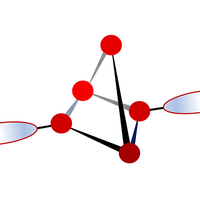
Many-Body Quantum Interference Route to the Two-Channel Kondo Effect: Inverse Design for Molecular Junctions and Quantum Dot Devices

Sudeshna Sen and Andrew K. Mitchell

Phys. Rev. Lett. 133, 076501 (2024) - Published 12 August, 2024

Many-body quantum interference can be used in molecular transistors and quantum dot nanostructures to engineer fractionalized Kondo anyons.

Runaway Gravitational Production of Dark Photons

Christian Capanelli, Leah Jenks, Edward W. Kolb, and Evan McDonough

Phys. Rev. Lett. 133, 061602 (2024) - Published 9 August, 2024

Gravitational production of the hypothetical dark photons due to its nonminimal coupling to gravity can suffer from an instability which leads to runaway particle production.

Simulating Holographic Conformal Field Theories on Hyperbolic Lattices

Santanu Dey, Anffany Chen, Pablo Basteiro, Alexander Fritzsche, Martin Greiter, Matthias Kaminski, Patrick M. Lenggenhager, René Meyer, Riccardo Sorbello, Alexander Stegmaier, Ronny Thomale, Johanna Erdmenger, and Igor Boettcher

Phys. Rev. Lett. 133, 061603 (2024) - Published 9 August, 2024

A proof-of-principle demonstration suggests that holographic correspondences may be simulated in electrical circuits.

Sign In to Your Journals Account

Filter

Recent Issues

Vol. 137, Iss. 18
30 October 2026
Vol. 137, Iss. 17
23 October 2026
Vol. 137, Iss. 16
16 October 2026
Vol. 137, Iss. 15
9 October 2026
Category
Article Type
Section

Filter

Article Lookup

Enter a citation