Browse Issues:

HIGHLIGHTED ARTICLES

Experimental realization of a polariton beam amplifier

Dominik Niemietz, Johannes Schmutzler, Przemyslaw Lewandowski, Karol Winkler, Marc Aßmann, Stefan Schumacher, Sebastian Brodbeck, Martin Kamp, Christian Schneider, Sven Höfling, and Manfred Bayer

Phys. Rev. B 93, 235301 (2016) - Published 1 June, 2016

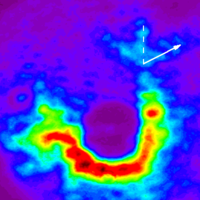
For polariton condensates, nonresonant excitation creates carriers that act both as a repulsive potential and a gain medium for the condensate. The repulsive potential allows for direct imprinting of functional optical elements and simple circuits based on flowing polaritons just by shaping the excitation beam. However, extended geometries will also require amplification of the polariton beam. Another nonresonant pump beam may act as an amplifier, but will necessarily also result in an undesired deflection of the traveling polariton beam. The authors show that a deflectionless amplifier can be realized by embedding the amplification beam in a photonic trap that cancels the repulsive potential created by the amplification beam. This work emphasizes the potential of polariton condensates as a platform for reconfigurable optical circuits.

Ising tricriticality in the extended Hubbard model with bond dimerization

Satoshi Ejima, Fabian H. L. Essler, Florian Lange, and Holger Fehske

Phys. Rev. B 93, 235118 (2016) - Published 10 June, 2016

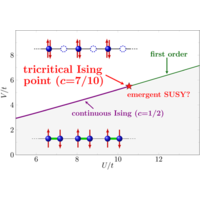
The tricritical Ising universality class emerges at the end point of a line of continuous Ising phase transitions, above which the transition is first order. In 1+1 dimensions, it is described by the second minimal model of conformal field theory (CFT) with central charge c=7/10. Recently, there has been a revival of interest in the tricritical Ising model due to its emergent space-time supersymmetry. Combining numerical (infinite density-matrix renormalization group) and field theoretical (bosonization and CFT) techniques, there authors demonstrate here that Ising tricriticality occurs in a paradigmatic extended one dimensional Hubbard model with explicit bond dimerization. The low-energy sector can be described by a triple sine-Gordon model, which, in the transition region, reduces to the tricritical Ising CFT. The theoretically predicted decay of various two-point correlation functions is found to be in excellent agreement with the density-matrix renormalization group data.

Mott physics and spin fluctuations: A functional viewpoint

Thomas Ayral and Olivier Parcollet

Phys. Rev. B 93, 235124 (2016) - Published 14 June, 2016

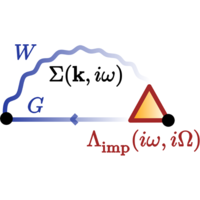
Two important scenarios have been put forth to explain high-temperature superconductivity. One scenario emphasizes, following Philip W. Anderson, that for many high-Tc superconductors their undoped parent compounds are Mott insulators, with local physics playing a major role. Another scenario stresses instead the importance of spin fluctuations near a quantum critical point. In this work, the authors reconcile both viewpoints by constructing a functional of the Green’s function of the electron (G), of the fluctuations (W) and of the vertex that couples the two (Λ). In the approach presented by the authors, Mott physics as well as the charge and spin fluctuations are taken into account in the description of correlations. This is done at a computational cost comparable to that of the dynamical mean field theory, making the method suitable for multiorbital extensions.

Origin of dissipative Fermi arc transport in Weyl semimetals

E. V. Gorbar, V. A. Miransky, I. A. Shovkovy, and P. O. Sukhachov

Phys. Rev. B 93, 235127 (2016) - Published 15 June, 2016

The existence of the surface Fermi arc states is a signature property of the Weyl semimetals. In view of their one-dimensional chiral nature, one might naively expect that the corresponding surface transport is nondissipative. In a drastic contrast to such an expectation, the authors show here that the dynamics of the chiral surface states is dissipative in semimetals. In the presence of impurities, the origin of the dissipation is the scattering of surface Fermi arc states into the bulk of the semimetal. The gapless spectrum of the bulk states in semimetals is the key feature that allows such processes to happen. By taking into account all scattering processes, the authors perform a model calculation of the electric conductivity of the surface Fermi arc states.

Spectral functions of the uniform electron gas via coupled-cluster theory and comparison to the GW and related approximations

James McClain, Johannes Lischner, Thomas Watson, Devin A. Matthews, Enrico Ronca, Steven G. Louie, Timothy C. Berkelbach, and Garnet Kin-Lic Chan

Phys. Rev. B 93, 235139 (2016) - Published 20 June, 2016

Coupled-cluster theory is a “gold standard” of molecular quantum chemistry, but has only recently been extended to condensed-phase systems. In this work, excited-state coupled-cluster techniques are brought to bear on the spectral function of the uniform electron gas. The diagrammatic content of coupled-cluster theory goes beyond that of the GW approximation, which has become a canonical approach in first-principles condensed-matter physics. Benchmark calculations demonstrate that the coupled-cluster results are more accurate than those of GW-based approaches, insensitive to the mean-field reference, and systematically improvable towards the exact result. Calculations on large systems approaching the thermodynamic limit reveal an accurate quasiparticle bandwidth as well as plasmonic satellite structure in the core-hole spectral function.

History dependence of the magnetic properties of single-crystal Fe1−xCoxSi

A. Bauer, M. Garst, and C. Pfleiderer

Phys. Rev. B 93, 235144 (2016) - Published 21 June, 2016

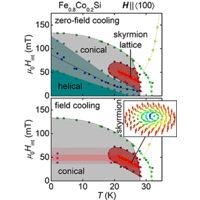
Cubic chiral magnets crystallizing in space group P213 give rise to a spin structure of nontrivial topology, the so-called skyrmion lattice. The strongly doped semiconductor Fe1-xCoxSi is a fascinating member of this material class of compounds as it exhibits helimagnetism over a wide compositional range. The authors study the magnetic properties of this itinerant magnet for different values of x, combine their results with previous reports, and infer the magnetic phase diagrams. The latter are rather isotropic but depend on the field and temperature history. In particular, when cooled in an applied magnetic field, the skyrmion lattice may persist down to lowest temperatures. This history dependence, in combination with the variation of temperature, field, and length scale of the magnetic order by means of compositional tuning, makes Fe1-xCoxSi an excellent material for future experiments studying skyrmions.

Nature of composite fermions and the role of particle-hole symmetry: A microscopic account

Ajit C. Balram and J. K. Jain

Phys. Rev. B 93, 235152 (2016) - Published 27 June, 2016

Motivated by the particle-hole symmetry at the half-filled lowest Landau level, many articles have taken the point of view, following D. T. Son, that composite fermions are Dirac particles and their Fermi sea is akin to that occurring at the surface of a three dimensional topological insulator. This presents a paradox, because the microscopic theory of composite fermions, which treats composite fermions as non-relativistic particles, has been confirmed in great detail. The authors discuss what features of the Dirac-composite fermion view can be reconciled with the microscopic theory. They also show how particle-hole symmetry can emerge in the Chern-Simons formulation of composite fermions.

In situ hard x-ray photoemission spectroscopy of barrier-height control at metal/PMN-PT interfaces

E. Kröger, A. Petraru, A. Quer, R. Soni, M. Kalläne, N. A. Pertsev, H. Kohlstedt, and K. Rossnagel

Phys. Rev. B 93, 235415 (2016) - Published 10 June, 2016

Ferroelectrics exhibit switchable spontaneous polarization, a functionality that can be harnessed in nonvolatile memory devices. The main characteristics of these devices are governed by the electronic band alignment at the interfaces, particularly at the metallic contacts. Here, the authors study such an interface using state-of-the-art high-energy x-ray photoelectron spectroscopy, with in situ polarization reversal achieved by applying poling voltage. They confirm a result central to the physics of ferroelectric devices: an electrode-dependent potential drop at the interface that is linear in the spontaneous polarization. They also reveal a novel effect: electric-field-dependent increase of the energy offset due to the field-induced strain in the ferroelectric material.

Conductance of a proximitized nanowire in the Coulomb blockade regime

B. van Heck, R. M. Lutchyn, and L. I. Glazman

Phys. Rev. B 93, 235431 (2016) - Published 20 June, 2016

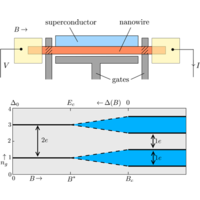
The search for Majorana bound states, motivated by the prospect of discovering non-Abelian exchange statistics and developing topological quantum computing, is an ongoing challenge in condensed matter physics. Crafting a wire hosting Majorana states is not a trivial task, requiring great care in the choice of materials and in the device design. Experimentalists rely on the electron transport measurements to characterize the devices. It is therefore important to have a detailed theory for interpreting the experimental data and reliably detecting the nontrivial (topological) superconductivity needed for the appearance of Majorana states. Here, the authors have developed such a theory for short small-capacitance wires. In such wires, the apperance of Majorana states coexists with the effects of single-electron charging. The theory here provides quantitative results for the electric conduction of wires in these conditions and provides guidance for those in the field seeking understanding of important recent experiments, as well as those designing the future ones.

ARTICLES

Electronic structure and strongly correlated systems

Interleaved numerical renormalization group as an efficient multiband impurity solver

K. M. Stadler, A. K. Mitchell, J. von Delft, and A. Weichselbaum

Phys. Rev. B 93, 235101 (2016) - Published 1 June, 2016

Manipulating the metal-to-insulator transition of NdNiO3 films by orbital polarization

J. J. Peng, C. Song, M. Wang, F. Li, B. Cui, G. Y. Wang, P. Yu, and F. Pan

Phys. Rev. B 93, 235102 (2016) - Published 1 June, 2016

Quantum cluster algorithm for frustrated Ising models in a transverse field

Sounak Biswas, Geet Rakala, and Kedar Damle

Phys. Rev. B 93, 235103 (2016) - Published 1 June, 2016

Nonequilibrium self-energy functional approach to the dynamical Mott transition

Felix Hofmann, Martin Eckstein, and Michael Potthoff

Phys. Rev. B 93, 235104 (2016) - Published 2 June, 2016

Stability of a spin-triplet nematic state near to a quantum critical point

G. Hannappel, C. J. Pedder, F. Krüger, and A. G. Green

Phys. Rev. B 93, 235105 (2016) - Published 2 June, 2016

Nonempirical range-separated hybrid functionals for solids and molecules

Jonathan H. Skone, Marco Govoni, and Giulia Galli

Phys. Rev. B 93, 235106 (2016) - Published 3 June, 2016

Nonequilibrium electron dynamics in a solid with a changing nodal excitation gap

Christopher L. Smallwood, Tristan L. Miller, Wentao Zhang, Robert A. Kaindl, and Alessandra Lanzara

Phys. Rev. B 93, 235107 (2016) - Published 6 June, 2016

Quasiparticle interactions in frustrated Heisenberg chains

Laurens Vanderstraeten, Jutho Haegeman, Frank Verstraete, and Didier Poilblanc

Phys. Rev. B 93, 235108 (2016) - Published 6 June, 2016

Influence of quantum confinement and strain on orbital polarization of four-layer LaNiO3 superlattices: A DFT+DMFT study

Hyowon Park, Andrew J. Millis, and Chris A. Marianetti

Phys. Rev. B 93, 235109 (2016) - Published 7 June, 2016

Interlayer excitons with tunable dispersion relation

Brian Skinner

Phys. Rev. B 93, 235110 (2016) - Published 7 June, 2016

Cotunneling into a Kondo lattice with odd hybridization

Pier Paolo Baruselli and Matthias Vojta

Phys. Rev. B 93, 235111 (2016) - Published 7 June, 2016

Strong correlation effects on topological quantum phase transitions in three dimensions

A. Amaricci, J. C. Budich, M. Capone, B. Trauzettel, and G. Sangiovanni

Phys. Rev. B 93, 235112 (2016) - Published 7 June, 2016

Correlation energy for the homogeneous electron gas: Exact Bethe-Salpeter solution and an approximate evaluation

Emanuele Maggio and Georg Kresse

Phys. Rev. B 93, 235113 (2016) - Published 7 June, 2016

Symmetry-broken local-density approximation for one-dimensional systems

Fergus J. M. Rogers, Caleb J. Ball, and Pierre-François Loos

Phys. Rev. B 93, 235114 (2016) - Published 8 June, 2016

Conditions for observing emergent SU(4) symmetry in a double quantum dot

Yunori Nishikawa, Oliver J. Curtin, Alex C. Hewson, Daniel J. G. Crow, and Johannes Bauer

Phys. Rev. B 93, 235115 (2016) - Published 8 June, 2016

Tuning the work function in transition metal oxides and their heterostructures

Z. Zhong and P. Hansmann

Phys. Rev. B 93, 235116 (2016) - Published 8 June, 2016

Hydrostatic pressure response of an oxide-based two-dimensional electron system

J. Zabaleta, V. S. Borisov, R. Wanke, H. O. Jeschke, S. C. Parks, B. Baum, A. Teker, T. Harada, K. Syassen, T. Kopp, N. Pavlenko, R. Valentí, and J. Mannhart

Phys. Rev. B 93, 235117 (2016) - Published 8 June, 2016

Ising tricriticality in the extended Hubbard model with bond dimerization

Satoshi Ejima, Fabian H. L. Essler, Florian Lange, and Holger Fehske

Phys. Rev. B 93, 235118 (2016) - Published 10 June, 2016

The tricritical Ising universality class emerges at the end point of a line of continuous Ising phase transitions, above which the transition is first order. In 1+1 dimensions, it is described by the second minimal model of conformal field theory (CFT) with central charge c=7/10. Recently, there has been a revival of interest in the tricritical Ising model due to its emergent space-time supersymmetry. Combining numerical (infinite density-matrix renormalization group) and field theoretical (bosonization and CFT) techniques, there authors demonstrate here that Ising tricriticality occurs in a paradigmatic extended one dimensional Hubbard model with explicit bond dimerization. The low-energy sector can be described by a triple sine-Gordon model, which, in the transition region, reduces to the tricritical Ising CFT. The theoretically predicted decay of various two-point correlation functions is found to be in excellent agreement with the density-matrix renormalization group data.

Evolution operators in conformal field theories and conformal mappings: Entanglement Hamiltonian, the sine-square deformation, and others

Xueda Wen, Shinsei Ryu, and Andreas W. W. Ludwig

Phys. Rev. B 93, 235119 (2016) - Published 13 June, 2016

Phonons in nonlocal van der Waals density functional theory

Riccardo Sabatini, Emine Küçükbenli, Cong Huy Pham, and Stefano de Gironcoli

Phys. Rev. B 93, 235120 (2016) - Published 13 June, 2016

Experimental determination of the Fermi surface of Sr3Ir4Sn13

Xiaoye Chen, Swee K. Goh, David A. Tompsett, Wing Chi Yu, Lina Klintberg, Sven Friedemann, Hong'En Tan, Jinhu Yang, Bin Chen, M. Imai, Kazuyoshi Yoshimura, Monika B. Gamza, F. Malte Grosche, and Michael L. Sutherland

Phys. Rev. B 93, 235121 (2016) - Published 13 June, 2016

Formulation of the relativistic quantum Hall effect and parity anomaly

Kouki Yonaga, Kazuki Hasebe, and Naokazu Shibata

Phys. Rev. B 93, 235122 (2016) - Published 13 June, 2016

Ground-state ordering of the J1−J2 model on the simple cubic and body-centered cubic lattices

D. J. J. Farnell, O. Götze, and J. Richter

Phys. Rev. B 93, 235123 (2016) - Published 14 June, 2016

Mott physics and spin fluctuations: A functional viewpoint

Thomas Ayral and Olivier Parcollet

Phys. Rev. B 93, 235124 (2016) - Published 14 June, 2016

Two important scenarios have been put forth to explain high-temperature superconductivity. One scenario emphasizes, following Philip W. Anderson, that for many high-Tc superconductors their undoped parent compounds are Mott insulators, with local physics playing a major role. Another scenario stresses instead the importance of spin fluctuations near a quantum critical point. In this work, the authors reconcile both viewpoints by constructing a functional of the Green’s function of the electron (G), of the fluctuations (W) and of the vertex that couples the two (Λ). In the approach presented by the authors, Mott physics as well as the charge and spin fluctuations are taken into account in the description of correlations. This is done at a computational cost comparable to that of the dynamical mean field theory, making the method suitable for multiorbital extensions.

Embedding dynamical mean-field theory for superconductivity in layered materials and heterostructures

Francesco Petocchi and Massimo Capone

Phys. Rev. B 93, 235125 (2016) - Published 15 June, 2016

Detailed investigation of the phase transition in KxP4W8O32 and experimental arguments for a charge density wave due to hidden nesting

Kamil Kolincio, Olivier Pérez, Sylvie Hébert, Pierre Fertey, and Alain Pautrat

Phys. Rev. B 93, 235126 (2016) - Published 15 June, 2016

Origin of dissipative Fermi arc transport in Weyl semimetals

E. V. Gorbar, V. A. Miransky, I. A. Shovkovy, and P. O. Sukhachov

Phys. Rev. B 93, 235127 (2016) - Published 15 June, 2016

The existence of the surface Fermi arc states is a signature property of the Weyl semimetals. In view of their one-dimensional chiral nature, one might naively expect that the corresponding surface transport is nondissipative. In a drastic contrast to such an expectation, the authors show here that the dynamics of the chiral surface states is dissipative in semimetals. In the presence of impurities, the origin of the dissipation is the scattering of surface Fermi arc states into the bulk of the semimetal. The gapless spectrum of the bulk states in semimetals is the key feature that allows such processes to happen. By taking into account all scattering processes, the authors perform a model calculation of the electric conductivity of the surface Fermi arc states.

Electron pair emission from surfaces: Intensity relations

F. O. Schumann, Y. Aliaev, I. Kostanovskiy, G. Di Filippo, Z. Wei, and J. Kirschner

Phys. Rev. B 93, 235128 (2016) - Published 15 June, 2016

Local electronic state in the half-metallic ferromagnet CrO2 investigated by site-selective Cr53 NMR measurements

Hikaru Takeda, Yasuhiro Shimizu, Yoshiaki Kobayashi, Masayuki Itoh, Takaaki Jin-no, Masahiko Isobe, Yutaka Ueda, Sho Yoshida, Yuji Muraoka, and Takayoshi Yokoya

Phys. Rev. B 93, 235129 (2016) - Published 15 June, 2016

Theory of triplon dynamics in the quantum magnet BiCu2PO6

Kyusung Hwang and Yong Baek Kim

Phys. Rev. B 93, 235130 (2016) - Published 17 June, 2016

Magnetochiral nonreciprocity of volume spin wave propagation in chiral-lattice ferromagnets

S. Seki, Y. Okamura, K. Kondou, K. Shibata, M. Kubota, R. Takagi, F. Kagawa, M. Kawasaki, G. Tatara, Y. Otani, and Y. Tokura

Phys. Rev. B 93, 235131 (2016) - Published 16 June, 2016

Electronic and optical properties of hexathiapentacene in the gas and crystal phases

R. Cardia, G. Malloci, G.-M. Rignanese, X. Blase, E. Molteni, and G. Cappellini

Phys. Rev. B 93, 235132 (2016) - Published 16 June, 2016

Quantum geometry and stability of the fractional quantum Hall effect in the Hofstadter model

David Bauer, T. S. Jackson, and Rahul Roy

Phys. Rev. B 93, 235133 (2016) - Published 17 June, 2016

Landau-like states in neutral particles

Saikat Banerjee, Hans Ågren, and A. V. Balatsky

Phys. Rev. B 93, 235134 (2016) - Published 20 June, 2016

Electronic properties of asymmetrically doped twisted graphene bilayers

Guy Trambly de Laissardière, Omid Faizy Namarvar, Didier Mayou, and Laurence Magaud

Phys. Rev. B 93, 235135 (2016) - Published 20 June, 2016

Finite-width effects for the localized edge modes in zigzag graphene nanoribbons

Arash Akbari-Sharbaf and Michael G. Cottam

Phys. Rev. B 93, 235136 (2016) - Published 20 June, 2016

Generation of chiral spin state by quantum simulation

Tetsufumi Tanamoto

Phys. Rev. B 93, 235137 (2016) - Published 20 June, 2016

High photon energy spectroscopy of NiO: Experiment and theory

S. K. Panda, Banabir Pal, Suman Mandal, Mihaela Gorgoi, Shyamashis Das, Indranil Sarkar, Wolfgang Drube, Weiwei Sun, I. Di Marco, Andreas Lindblad, P. Thunström, A. Delin, Olof Karis, Y. O. Kvashnin, M. van Schilfgaarde, O. Eriksson, and D. D. Sarma

Phys. Rev. B 93, 235138 (2016) - Published 20 June, 2016

Spectral functions of the uniform electron gas via coupled-cluster theory and comparison to the GW and related approximations

James McClain, Johannes Lischner, Thomas Watson, Devin A. Matthews, Enrico Ronca, Steven G. Louie, Timothy C. Berkelbach, and Garnet Kin-Lic Chan

Phys. Rev. B 93, 235139 (2016) - Published 20 June, 2016

Coupled-cluster theory is a “gold standard” of molecular quantum chemistry, but has only recently been extended to condensed-phase systems. In this work, excited-state coupled-cluster techniques are brought to bear on the spectral function of the uniform electron gas. The diagrammatic content of coupled-cluster theory goes beyond that of the GW approximation, which has become a canonical approach in first-principles condensed-matter physics. Benchmark calculations demonstrate that the coupled-cluster results are more accurate than those of GW-based approaches, insensitive to the mean-field reference, and systematically improvable towards the exact result. Calculations on large systems approaching the thermodynamic limit reveal an accurate quasiparticle bandwidth as well as plasmonic satellite structure in the core-hole spectral function.

Weak crystallization theory of metallic alloys

Ivar Martin, Sarang Gopalakrishnan, and Eugene A. Demler

Phys. Rev. B 93, 235140 (2016) - Published 20 June, 2016

Dynamical properties of bidirectional charge-density waves in ErTe3

A. A. Sinchenko, P. Lejay, O. Leynaud, and P. Monceau

Phys. Rev. B 93, 235141 (2016) - Published 21 June, 2016

Charge compensation in extremely large magnetoresistance materials LaSb and LaBi revealed by first-principles calculations

Peng-Jie Guo, Huan-Cheng Yang, Bing-Jing Zhang, Kai Liu, and Zhong-Yi Lu

Phys. Rev. B 93, 235142 (2016) - Published 21 June, 2016

Magnetic correlations in a periodic Anderson model with nonuniform conduction electron coordination

N. Hartman, W.-T. Chiu, and R. T. Scalettar

Phys. Rev. B 93, 235143 (2016) - Published 21 June, 2016

History dependence of the magnetic properties of single-crystal Fe1−xCoxSi

A. Bauer, M. Garst, and C. Pfleiderer

Phys. Rev. B 93, 235144 (2016) - Published 21 June, 2016

Cubic chiral magnets crystallizing in space group P213 give rise to a spin structure of nontrivial topology, the so-called skyrmion lattice. The strongly doped semiconductor Fe1-xCoxSi is a fascinating member of this material class of compounds as it exhibits helimagnetism over a wide compositional range. The authors study the magnetic properties of this itinerant magnet for different values of x, combine their results with previous reports, and infer the magnetic phase diagrams. The latter are rather isotropic but depend on the field and temperature history. In particular, when cooled in an applied magnetic field, the skyrmion lattice may persist down to lowest temperatures. This history dependence, in combination with the variation of temperature, field, and length scale of the magnetic order by means of compositional tuning, makes Fe1-xCoxSi an excellent material for future experiments studying skyrmions.

Novel energy scale in the interacting two-dimensional electron system evidenced from transport and thermodynamic measurements

L. A. Morgun, A. Yu. Kuntsevich, and V. M. Pudalov

Phys. Rev. B 93, 235145 (2016) - Published 22 June, 2016

Majorana spectroscopy of three-dimensional Kitaev spin liquids

A. Smith, J. Knolle, D. L. Kovrizhin, J. T. Chalker, and R. Moessner

Phys. Rev. B 93, 235146 (2016) - Published 22 June, 2016

Momentum-space structure of surface states in a topological semimetal with a nexus point of Dirac lines

T. Hyart and T. T. Heikkilä

Phys. Rev. B 93, 235147 (2016) - Published 22 June, 2016

Spin and quadrupolar orders in the spin-1 bilinear-biquadratic model for iron-based superconductors

Cheng Luo, Trinanjan Datta, and Dao-Xin Yao

Phys. Rev. B 93, 235148 (2016) - Published 23 June, 2016

Energy projection and modified Laughlin states

M. Fremling, J. Fulsebakke, N. Moran, and J. K. Slingerland

Phys. Rev. B 93, 235149 (2016) - Published 24 June, 2016

Quantum phase diagram of a frustrated antiferromagnet on the bilayer honeycomb lattice

Hao Zhang, Carlos A. Lamas, Marcelo Arlego, and Wolfram Brenig

Phys. Rev. B 93, 235150 (2016) - Published 27 June, 2016

Distinctive response of many-body localized systems to a strong electric field

Maciej Kozarzewski, Peter Prelovšek, and Marcin Mierzejewski

Phys. Rev. B 93, 235151 (2016) - Published 27 June, 2016

Nature of composite fermions and the role of particle-hole symmetry: A microscopic account

Ajit C. Balram and J. K. Jain

Phys. Rev. B 93, 235152 (2016) - Published 27 June, 2016

Motivated by the particle-hole symmetry at the half-filled lowest Landau level, many articles have taken the point of view, following D. T. Son, that composite fermions are Dirac particles and their Fermi sea is akin to that occurring at the surface of a three dimensional topological insulator. This presents a paradox, because the microscopic theory of composite fermions, which treats composite fermions as non-relativistic particles, has been confirmed in great detail. The authors discuss what features of the Dirac-composite fermion view can be reconciled with the microscopic theory. They also show how particle-hole symmetry can emerge in the Chern-Simons formulation of composite fermions.

Electronic structure theory of weakly interacting bilayers

Shiang Fang and Efthimios Kaxiras

Phys. Rev. B 93, 235153 (2016) - Published 27 June, 2016

Current-induced and interaction-driven Dirac point drag of massless quasirelativistic fermions

Inti Sodemann

Phys. Rev. B 93, 235154 (2016) - Published 27 June, 2016

Three-dimensional photonic Dirac points stabilized by point group symmetry

HaiXiao Wang, Lin Xu, HuanYang Chen, and Jian-Hua Jiang

Phys. Rev. B 93, 235155 (2016) - Published 27 June, 2016

Slow convergence to effective medium in finite discrete metamaterials

M. Lapine, R. C. McPhedran, and C. G. Poulton

Phys. Rev. B 93, 235156 (2016) - Published 27 June, 2016

Simultaneous metal-insulator and antiferromagnetic transitions in orthorhombic perovskite iridate Sr0.94Ir0.78O2.68 single crystals

H. Zheng, J. Terzic, Feng Ye, X. G. Wan, D. Wang, Jinchen Wang, Xiaoping Wang, P. Schlottmann, S. J. Yuan, and G. Cao

Phys. Rev. B 93, 235157 (2016) - Published 27 June, 2016

Coexistence of light and heavy surface states in a topological multiband Kondo insulator

Robert Peters, Tsuneya Yoshida, Hirofumi Sakakibara, and Norio Kawakami

Phys. Rev. B 93, 235159 (2016) - Published 29 June, 2016

Universal fidelity near quantum and topological phase transitions in finite one-dimensional systems

E. J. König, A. Levchenko, and N. Sedlmayr

Phys. Rev. B 93, 235160 (2016) - Published 29 June, 2016

Time reversal invariant gapped boundaries of the double semion state

Fiona Burnell, Xie Chen, Alexei Kitaev, Max Metlitski, and Ashvin Vishwanath

Phys. Rev. B 93, 235161 (2016) - Published 30 June, 2016

mBEEF-vdW: Robust fitting of error estimation density functionals

Keld T. Lundgaard, Jess Wellendorff, Johannes Voss, Karsten W. Jacobsen, and Thomas Bligaard

Phys. Rev. B 93, 235162 (2016) - Published 30 June, 2016

Semiconductors I: bulk

Magnetic and transport properties of degenerate ferromagnetic semiconductor EuO

Masao Takahashi

Phys. Rev. B 93, 235201 (2016) - Published 13 June, 2016

Fine structure of the Mn acceptor in GaAs

I. V. Krainov, J. Debus, N. S. Averkiev, G. S. Dimitriev, V. F. Sapega, and E. Lähderanta

Phys. Rev. B 93, 235202 (2016) - Published 13 June, 2016

Impact of doping on the density of states and the mobility in organic semiconductors

Guangzheng Zuo, Hassan Abdalla, and Martijn Kemerink

Phys. Rev. B 93, 235203 (2016) - Published 27 June, 2016

Realistic multiband k·p approach from ab initio and spin-orbit coupling effects of InAs and InP in wurtzite phase

Paulo E. Faria Junior, Tiago Campos, Carlos M. O. Bastos, Martin Gmitra, Jaroslav Fabian, and Guilherme M. Sipahi

Phys. Rev. B 93, 235204 (2016) - Published 30 June, 2016

Semiconductors II: surfaces, interfaces, microstructures, and related topics

Experimental realization of a polariton beam amplifier

Dominik Niemietz, Johannes Schmutzler, Przemyslaw Lewandowski, Karol Winkler, Marc Aßmann, Stefan Schumacher, Sebastian Brodbeck, Martin Kamp, Christian Schneider, Sven Höfling, and Manfred Bayer

Phys. Rev. B 93, 235301 (2016) - Published 1 June, 2016

For polariton condensates, nonresonant excitation creates carriers that act both as a repulsive potential and a gain medium for the condensate. The repulsive potential allows for direct imprinting of functional optical elements and simple circuits based on flowing polaritons just by shaping the excitation beam. However, extended geometries will also require amplification of the polariton beam. Another nonresonant pump beam may act as an amplifier, but will necessarily also result in an undesired deflection of the traveling polariton beam. The authors show that a deflectionless amplifier can be realized by embedding the amplification beam in a photonic trap that cancels the repulsive potential created by the amplification beam. This work emphasizes the potential of polariton condensates as a platform for reconfigurable optical circuits.

Superradiance in spherical layered nanostructures

S. V. Goupalov

Phys. Rev. B 93, 235302 (2016) - Published 9 June, 2016

Photoluminescence upconversion at GaAs/InGaP2 interfaces driven by a sequential two-photon absorption mechanism

N. P. Hylton, T. F. Hinrichsen, A. R. Vaquero-Stainer, M. Yoshida, A. Pusch, M. Hopkinson, O. Hess, C. C. Phillips, and N. J. Ekins-Daukes

Phys. Rev. B 93, 235303 (2016) - Published 9 June, 2016

Improved ab initio calculation of surface second-harmonic generation from Si(111)(1×1):H

Sean M. Anderson, Nicolas Tancogne-Dejean, Bernardo S. Mendoza, and Valérie Véniard

Phys. Rev. B 93, 235304 (2016) - Published 13 June, 2016

Oxygen vacancies: The origin of n-type conductivity in ZnO

Lishu Liu, Zengxia Mei, Aihua Tang, Alexander Azarov, Andrej Kuznetsov, Qi-Kun Xue, and Xiaolong Du

Phys. Rev. B 93, 235305 (2016) - Published 15 June, 2016

Electron mobility of a two-dimensional electron gas at the interface of SrTiO3 and LaAlO3

A. Faridi, Reza Asgari, and A. Langari

Phys. Rev. B 93, 235306 (2016) - Published 16 June, 2016

Spherical silicon photonic microcavities: From amorphous to polycrystalline

R. Fenollosa, M. Garín, and F. Meseguer

Phys. Rev. B 93, 235307 (2016) - Published 16 June, 2016

Switchable magnetic moment in cobalt-doped graphene bilayer on Cu(111): An ab initio study

Everson S. Souza, Wanderlã L. Scopel, and R. H. Miwa

Phys. Rev. B 93, 235308 (2016) - Published 20 June, 2016

All-optical dynamical Casimir effect in a three-dimensional terahertz photonic band gap

David Hagenmüller

Phys. Rev. B 93, 235309 (2016) - Published 20 June, 2016

Vertically coupled dipolar exciton molecules

Kobi Cohen, Maxim Khodas, Boris Laikhtman, Paulo V. Santos, and Ronen Rapaport

Phys. Rev. B 93, 235310 (2016) - Published 23 June, 2016

Surface roughness scattering in multisubband accumulation layers

Han Fu, K. V. Reich, and B. I. Shklovskii

Phys. Rev. B 93, 235312 (2016) - Published 23 June, 2016

Excited-state charging energies in quantum dots investigated by terahertz photocurrent spectroscopy

Y. Zhang, K. Shibata, N. Nagai, C. Ndebeka-Bandou, G. Bastard, and K. Hirakawa

Phys. Rev. B 93, 235313 (2016) - Published 24 June, 2016

Impact of inhomogeneous broadening on optical polarization of high-inclination semipolar and nonpolar InxGa1−xN/GaN quantum wells

Christian Mounir, Ulrich T. Schwarz, Ingrid L. Koslow, Michael Kneissl, Tim Wernicke, Tilman Schimpke, and Martin Strassburg

Phys. Rev. B 93, 235314 (2016) - Published 27 June, 2016

Electrically tunable spin polarization of chiral edge modes in a quantum anomalous Hall insulator

Rui-Xing Zhang, Hsiu-Chuan Hsu, and Chao-Xing Liu

Phys. Rev. B 93, 235315 (2016) - Published 27 June, 2016

Semiclassical Landau quantization of spin-orbit coupled systems

Tommy Li, Baruch Horovitz, and Oleg P. Sushkov

Phys. Rev. B 93, 235316 (2016) - Published 28 June, 2016

Tunable spin-charge conversion through topological phase transitions in zigzag nanoribbons

Hang Li and Aurélien Manchon

Phys. Rev. B 93, 235317 (2016) - Published 29 June, 2016

Surface physics, nanoscale physics, low-dimensional systems

Readout of relaxation rates by nonadiabatic pumping spectroscopy

Roman-Pascal Riwar, Benoît Roche, Xavier Jehl, and Janine Splettstoesser

Phys. Rev. B 93, 235401 (2016) - Published 1 June, 2016

Plasticity of single-atom Pb junctions

M. Müller, C. Salgado, N. Néel, J. J. Palacios, and J. Kröger

Phys. Rev. B 93, 235402 (2016) - Published 1 June, 2016

Multiple negative differential conductance regions and inelastic phonon assisted tunneling in graphene/h−BN/graphene structures

B. Amorim, R. M. Ribeiro, and N. M. R. Peres

Phys. Rev. B 93, 235403 (2016) - Published 2 June, 2016

Electron motion induced by magnetic pulse in a bilayer quantum wire

T. Chwiej

Phys. Rev. B 93, 235405 (2016) - Published 3 June, 2016

Structure and ordering of oxygen on unreconstructed Ir(100)

P. Ferstl, T. Schmitt, M. A. Schneider, L. Hammer, A. Michl, and S. Müller

Phys. Rev. B 93, 235406 (2016) - Published 3 June, 2016

Excitation of ultrasharp trapped-mode resonances in mirror-symmetric metamaterials

Shengyan Yang, Zhe Liu, Xiaoxiang Xia, Yiwen E, Chengchun Tang, Yujin Wang, Junjie Li, Li Wang, and Changzhi Gu

Phys. Rev. B 93, 235407 (2016) - Published 6 June, 2016

Graphene kirigami as a platform for stretchable and tunable quantum dot arrays

D. A. Bahamon, Zenan Qi, Harold S. Park, Vitor M. Pereira, and David K. Campbell

Phys. Rev. B 93, 235408 (2016) - Published 6 June, 2016

Anisotropy of in-plane hole g factor in CdTe/ZnTe quantum dots

A. Bogucki, T. Smoleński, M. Goryca, T. Kazimierczuk, J. Kobak, W. Pacuski, P. Wojnar, and P. Kossacki

Phys. Rev. B 93, 235410 (2016) - Published 8 June, 2016

Magnetic properties of a two-dimensional electron gas strongly coupled to light

K. Dini, O. V. Kibis, and I. A. Shelykh

Phys. Rev. B 93, 235411 (2016) - Published 8 June, 2016

Exploring the cation dynamics in lead-bromide hybrid perovskites

Carlo Motta, Fedwa El-Mellouhi, and Stefano Sanvito

Phys. Rev. B 93, 235412 (2016) - Published 8 June, 2016

Optimal geometry of lateral GaAs and Si/SiGe quantum dots for electrical control of spin qubits

Ognjen Malkoc, Peter Stano, and Daniel Loss

Phys. Rev. B 93, 235413 (2016) - Published 9 June, 2016

Dislocations in stacking and commensurate-incommensurate phase transition in bilayer graphene and hexagonal boron nitride

Irina V. Lebedeva, Alexander V. Lebedev, Andrey M. Popov, and Andrey A. Knizhnik

Phys. Rev. B 93, 235414 (2016) - Published 10 June, 2016

In situ hard x-ray photoemission spectroscopy of barrier-height control at metal/PMN-PT interfaces

E. Kröger, A. Petraru, A. Quer, R. Soni, M. Kalläne, N. A. Pertsev, H. Kohlstedt, and K. Rossnagel

Phys. Rev. B 93, 235415 (2016) - Published 10 June, 2016

Ferroelectrics exhibit switchable spontaneous polarization, a functionality that can be harnessed in nonvolatile memory devices. The main characteristics of these devices are governed by the electronic band alignment at the interfaces, particularly at the metallic contacts. Here, the authors study such an interface using state-of-the-art high-energy x-ray photoelectron spectroscopy, with in situ polarization reversal achieved by applying poling voltage. They confirm a result central to the physics of ferroelectric devices: an electrode-dependent potential drop at the interface that is linear in the spontaneous polarization. They also reveal a novel effect: electric-field-dependent increase of the energy offset due to the field-induced strain in the ferroelectric material.

One-dimensional carbon nanostructures for terahertz electron-beam radiation

Khwanchai Tantiwanichapan, Anna K. Swan, and Roberto Paiella

Phys. Rev. B 93, 235416 (2016) - Published 10 June, 2016

Dielectric response and novel electromagnetic modes in three-dimensional Dirac semimetal films

O. V. Kotov and Yu. E. Lozovik

Phys. Rev. B 93, 235417 (2016) - Published 13 June, 2016

Atomic force spectroscopy and density-functional study of graphene corrugation on Ru(0001)

Elena Voloshina and Yuriy Dedkov

Phys. Rev. B 93, 235418 (2016) - Published 13 June, 2016

Anharmonic effects in the optical and acoustic bending modes of graphene

R. Ramírez, E. Chacón, and C. P. Herrero

Phys. Rev. B 93, 235419 (2016) - Published 13 June, 2016

Laue diffraction in one-dimensional photonic crystals: The way for phase-matched second-harmonic generation

V. B. Novikov, A. I. Maydykovskiy, B. I. Mantsyzov, and T. V. Murzina

Phys. Rev. B 93, 235420 (2016) - Published 13 June, 2016

Spontaneous appearance of a low-dimensional magnetic electron system on semiconductor nanostructures

Keisuke Sawada, Jun-Ichi Iwata, and Atsushi Oshiyama

Phys. Rev. B 93, 235421 (2016) - Published 13 June, 2016

Laser-driven parametric instability and generation of entangled photon-plasmon states in graphene

Mikhail Tokman, Yongrui Wang, Ivan Oladyshkin, A. Ryan Kutayiah, and Alexey Belyanin

Phys. Rev. B 93, 235422 (2016) - Published 14 June, 2016

Length divergence of the lattice thermal conductivity in suspended graphene nanoribbons

Arnab K. Majee and Zlatan Aksamija

Phys. Rev. B 93, 235423 (2016) - Published 14 June, 2016

Perfect electromagnetic absorption using graphene and epsilon-near-zero metamaterials

Michaël Lobet, Bruno Majerus, Luc Henrard, and Philippe Lambin

Phys. Rev. B 93, 235424 (2016) - Published 14 June, 2016

Multilogarithmic velocity renormalization in graphene

Anand Sharma and Peter Kopietz

Phys. Rev. B 93, 235425 (2016) - Published 15 June, 2016

Nature of single-particle states in disordered graphene

Sabyasachi Nag, Arti Garg, and T. V. Ramakrishnan

Phys. Rev. B 93, 235426 (2016) - Published 15 June, 2016

Parity-time-symmetric teleportation

Y. Ra'di, D. L. Sounas, A. Alù, and S. A. Tretyakov

Phys. Rev. B 93, 235427 (2016) - Published 15 June, 2016

Photon-assisted tunneling and charge dephasing in a carbon nanotube double quantum dot

A. Mavalankar, T. Pei, E. M. Gauger, J. H. Warner, G. A. D. Briggs, and E. A. Laird

Phys. Rev. B 93, 235428 (2016) - Published 16 June, 2016

Au enrichment and vertical relaxation of the Cu3Au(111) surface studied by normal-incidence x-ray standing waves

O. Bauer, C. H. Schmitz, J. Ikonomov, M. Willenbockel, S. Soubatch, F. S. Tautz, and M. Sokolowski

Phys. Rev. B 93, 235429 (2016) - Published 16 June, 2016

First-principles study of the terahertz third-order nonlinear response of metallic armchair graphene nanoribbons

Yichao Wang and David R. Andersen

Phys. Rev. B 93, 235430 (2016) - Published 17 June, 2016

Conductance of a proximitized nanowire in the Coulomb blockade regime

B. van Heck, R. M. Lutchyn, and L. I. Glazman

Phys. Rev. B 93, 235431 (2016) - Published 20 June, 2016

The search for Majorana bound states, motivated by the prospect of discovering non-Abelian exchange statistics and developing topological quantum computing, is an ongoing challenge in condensed matter physics. Crafting a wire hosting Majorana states is not a trivial task, requiring great care in the choice of materials and in the device design. Experimentalists rely on the electron transport measurements to characterize the devices. It is therefore important to have a detailed theory for interpreting the experimental data and reliably detecting the nontrivial (topological) superconductivity needed for the appearance of Majorana states. Here, the authors have developed such a theory for short small-capacitance wires. In such wires, the apperance of Majorana states coexists with the effects of single-electron charging. The theory here provides quantitative results for the electric conduction of wires in these conditions and provides guidance for those in the field seeking understanding of important recent experiments, as well as those designing the future ones.

Optical signatures of electric-field-driven magnetic phase transitions in graphene quantum dots

Tista Basak and Alok Shukla

Phys. Rev. B 93, 235432 (2016) - Published 20 June, 2016

Spin diffusion in p-type bilayer WSe2

F. Yang and M. W. Wu

Phys. Rev. B 93, 235433 (2016) - Published 20 June, 2016

Orbital effect of magnetic field on the Majorana phase diagram

Bas Nijholt and Anton R. Akhmerov

Phys. Rev. B 93, 235434 (2016) - Published 20 June, 2016

Screening and many-body effects in two-dimensional crystals: Monolayer MoS2

Diana Y. Qiu, Felipe H. da Jornada, and Steven G. Louie

Phys. Rev. B 93, 235435 (2016) - Published 20 June, 2016

Phase diagram of two interacting helical states

Raul A. Santos, D. B. Gutman, and Sam T. Carr

Phys. Rev. B 93, 235436 (2016) - Published 21 June, 2016

Infrared dynamics of cold atoms on hot graphene membranes

Sanghita Sengupta, Valeri N. Kotov, and Dennis P. Clougherty

Phys. Rev. B 93, 235437 (2016) - Published 21 June, 2016

Atomistic simulation of frictional anisotropy on quasicrystal approximant surfaces

Zhijiang Ye, Ashlie Martini, Patricia Thiel, Heather H. Lovelady, Keith McLaughlin, and David A. Rabson

Phys. Rev. B 93, 235438 (2016) - Published 23 June, 2016

Tunable Fano resonances and enhanced optical bistability in composites of coated cylinders due to nonlocality

Yang Huang and Lei Gao

Phys. Rev. B 93, 235439 (2016) - Published 23 June, 2016

Local and nonlocal thermopower in three-terminal nanostructures

G. Michałek, M. Urbaniak, B. R. Bułka, T. Domański, and K. I. Wysokiński

Phys. Rev. B 93, 235440 (2016) - Published 23 June, 2016

Line defects in graphene: How doping affects the electronic and mechanical properties

Daniel Berger and Christian Ratsch

Phys. Rev. B 93, 235441 (2016) - Published 24 June, 2016

Biexciton cascade emission reveals absolute absorption cross section of single semiconductor nanocrystals

Toshiyuki Ihara

Phys. Rev. B 93, 235442 (2016) - Published 24 June, 2016

Bilayer graphene under pressure: Electron-hole symmetry breaking, valley Hall effect, and Landau levels

F. Munoz, H. P. Ojeda Collado, Gonzalo Usaj, Jorge O. Sofo, and C. A. Balseiro

Phys. Rev. B 93, 235443 (2016) - Published 27 June, 2016

Gold-induced nanowires on the Ge(100) surface yield a 2D and not a 1D electronic structure

N. de Jong, R. Heimbuch, S. Eliëns, S. Smit, E. Frantzeskakis, J.-S. Caux, H. J. W. Zandvliet, and M. S. Golden

Phys. Rev. B 93, 235444 (2016) - Published 27 June, 2016

Real-space characterization of reactivity towards water at the Bi2Te3(111) surface

Kai-Wen Zhang, Ding Ding, Chao-Long Yang, Yuan Gan, Shichao Li, Wen-Kai Huang, Ye-Heng Song, Zhen-Yu Jia, Xiang-Bing Li, Zihua Zhu, Jinsheng Wen, Mingshu Chen, and Shao-Chun Li

Phys. Rev. B 93, 235445 (2016) - Published 27 June, 2016

Dispersion and line shape of plasmon satellites in one, two, and three dimensions

Derek Vigil-Fowler, Steven G. Louie, and Johannes Lischner

Phys. Rev. B 93, 235446 (2016) - Published 27 June, 2016

Universal collisionless transport of graphene

Julia M. Link, Peter P. Orth, Daniel E. Sheehy, and Jörg Schmalian

Phys. Rev. B 93, 235447 (2016) - Published 28 June, 2016

Atomistic view of impurities interacting with a quasi-one-dimensional charge density wave

Deok Mahn Oh and Han Woong Yeom

Phys. Rev. B 93, 235448 (2016) - Published 29 June, 2016

Nonsymmetrized noise in a quantum dot: Interpretation in terms of energy transfer and coherent superposition of scattering paths

R. Zamoum, M. Lavagna, and A. Crépieux

Phys. Rev. B 93, 235449 (2016) - Published 29 June, 2016

Electron-photon interaction in a quantum point contact coupled to a microwave resonator

Udson C. Mendes and Christophe Mora

Phys. Rev. B 93, 235450 (2016) - Published 29 June, 2016

Two-dimensional topological insulators in group-11 chalcogenide compounds: M2Te(M=Cu,Ag)

Yandong Ma, Liangzhi Kou, Ying Dai, and Thomas Heine

Phys. Rev. B 93, 235451 (2016) - Published 29 June, 2016

Interactions and thermoelectric effects in a parallel-coupled double quantum dot

Miguel A. Sierra, M. Saiz-Bretín, F. Domínguez-Adame, and David Sánchez

Phys. Rev. B 93, 235452 (2016) - Published 30 June, 2016

ERRATA

Erratum: High-temperature behavior of supported graphene: Electron-phonon coupling and substrate-induced doping [Phys. Rev. B 86, 161402(R) (2012)]

Søren Ulstrup, Marco Bianchi, Richard Hatch, Dandan Guan, Alessandro Baraldi, Dario Alfè, Liv Hornekær, and Philip Hofmann

Phys. Rev. B 93, 239901 (2016) - Published 6 June, 2016

Erratum: Low-energy effective theory in the bulk for transport in a topological phase [Phys. Rev. B 91, 125303 (2015)]

Barry Bradlyn and N. Read

Phys. Rev. B 93, 239902 (2016) - Published 13 June, 2016

Publisher's Note: Manifestation of a non-Abelian Berry phase in a p-type semiconductor system [Phys. Rev. B 93, 205424 (2016)]

T. Li, L. A. Yeoh, A. Srinivasan, O. Klochan, D. A. Ritchie, M. Y. Simmons, O. P. Sushkov, and A. R. Hamilton

Phys. Rev. B 93, 239903 (2016) - Published 13 June, 2016

Publisher's Note: Optically enabled magnetic resonance study of As75 and Sb121 in Si28 [Phys. Rev. B 92, 195203 (2015)]

Jeff Z. Salvail, Phillip Dluhy, Kevin J. Morse, Michael Szech, Kamyar Saeedi, Julian Huber, Helge Riemann, Nikolai V. Abrosimov, Peter Becker, Hans-Joachim Pohl, and Michael L. W. Thewalt

Phys. Rev. B 93, 239905 (2016) - Published 20 June, 2016

Sign In to Your Journals Account

Filter

Filter

Article Lookup

Enter a citation