Browse Issues:

HIGHLIGHTED ARTICLES

Influence of nonequilibrium phonons on the spin dynamics of a single Cr atom

V. Tiwari, K. Makita, M. Arino, M. Morita, S. Kuroda, H. Boukari, and L. Besombes

Phys. Rev. B 101, 035305 (2020) - Published 30 January, 2020

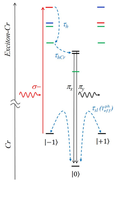
Doping semiconductor quantum dots with transition elements can create an optical probe and can control spins of individual magnetic atoms. Such atoms that feature both spin and orbital degrees of freedom present a large spin-to-strain coupling and could be used in hybrid spin-mechanical devices. In particular, this is the case for chromium. Here, the authors show that the spin dynamics of an individual Cr atom embedded in a quantum dot is controlled by the interaction with nonequilibrium phonons. Excitation conditions are found where the Cr spin states can be optically initialized, conserved in the dark for a few microseconds, and read out by resonant fluorescence.

Universal finite-size scaling around tricriticality between topologically ordered, symmetry-protected topological, and trivial phases

Ke Wang and T. A. Sedrakyan

Phys. Rev. B 101, 035410 (2020) - Published 10 January, 2020

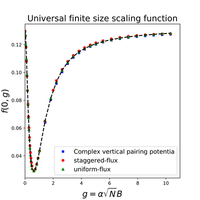
Quantum one-dimensional criticality with conformal invariance is known to be characterized by conformal field theory with the inherent central charge (c), and universal finite-size amplitudes. Here, the authors demonstrate that around a quantum criticality with c=½ and two Majorana boundary modes, the symmetry-breaking effect modifies the finite-size amplitudes from a universal constant to be a universal function of an emergent scale. This finding provides a new perspective to study the interplay of topology and quantum criticality.

Complete state tomography of a quantum dot spin qubit

Dan Cogan, Giora Peniakov, Zu-En Su, and David Gershoni

Phys. Rev. B 101, 035424 (2020) - Published 28 January, 2020

Semiconductor quantum dots are the preferred choice for interfacing anchored matter spin qubits and flying photonic qubits. They are particularly attractive for generating highly entangled hybrid spin-multiphoton entangled cluster and graph states. These highly entangled multiqubit states are required for measurement-based quantum communication and computing. Here, the authors develop a novel all-optical method for conducting full tomography of the confined electronic spin qubits. This method is essential for characterization and benchmarking these hybrid entangled spin-multiphoton cluster and graph states.

Inelastic light scattering by intrasubband spin-density excitations in GaAs-AlGaAs quantum wells with balanced Bychkov-Rashba and Dresselhaus spin-orbit interaction: Quantitative determination of the spin-orbit field

S. Gelfert, C. Frankerl, C. Reichl, D. Schuh, G. Salis, W. Wegscheider, D. Bougeard, T. Korn, and C. Schüller

Phys. Rev. B 101, 035427 (2020) - Published 29 January, 2020

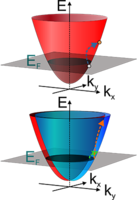
The theoretically infinite spin lifetime makes the persistent spin helix (PSH) a very interesting candidate for spintronic research. Resonant Raman scattering on spin-density excitations permits insights into subtle many-body effects. Utilizing electronic Raman scattering, the authors present here a precise mapping of the huge spin-splitting anisotropy for two different configurations of the PSH. By modulating the effective spin-orbit fields with an external magnetic field, they reveal electron g factors for the two different configurations, probably influenced by collective effects in the intrasubband spin-density excitations.

Tuning single-electron charging and interactions between compressible Landau level islands in graphene

Daniel Walkup, Fereshte Ghahari, Christopher Gutiérrez, Kenji Watanabe, Takashi Taniguchi, Nikolai B. Zhitenev, and Joseph A. Stroscio

Phys. Rev. B 101, 035428 (2020) - Published 29 January, 2020

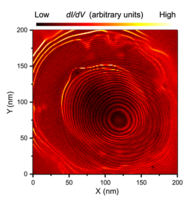
Interacting and tunable quantum dots (QDs) provide a powerful testbed in condensed matter physics and quantum information science. Here, the authors use a low-temperature scanning tunneling microscope to both create and directly image a new type of coupled QD system in graphene. In a strong magnetic field, the carriers condense into Landau levels (LLs), and the successive LLs form concentric spatially isolated Coulomb islands (compressible rings) within the confining electric potential well that behave as controllably coupled QDs.

Conductance and adhesion in an atomically precise Au-Au point contact

Lukas Gerhard and Wulf Wulfhekel

Phys. Rev. B 101, 035429 (2020) - Published 30 January, 2020

Electrical and mechanical properties of atom-sized metal contacts are of central importance for a number of fields in nanoscience. Here, the authors use an STM tip to contact an Au(111) surface. As both electrodes remain stable throughout 19,000 measurements, the atomic configuration of the point contact can be precisely controlled by positioning the tip with respect to the substrate. This allows to relate the atomic configuration of the electrodes to the conductance and the stiffness of the junction.

ARTICLES

Electronic structure and strongly correlated systems

Lattice models that realize Zn-1 symmetry-protected topological states for even n

Lokman Tsui and Xiao-Gang Wen

Phys. Rev. B 101, 035101 (2020) - Published 2 January, 2020

Direct observation of hidden spin polarization in 2H−MoTe2

J. Tu, X. B. Chen, X. Z. Ruan, Y. F. Zhao, H. F. Xu, Z. D. Chen, X. Q. Zhang, X. W. Zhang, J. Wu, L. He, Y. Zhang, R. Zhang, and Y. B. Xu

Phys. Rev. B 101, 035102 (2020) - Published 3 January, 2020

Phonon renormalization in the Kitaev quantum spin liquid

Alexandros Metavitsiadis and Wolfram Brenig

Phys. Rev. B 101, 035103 (2020) - Published 6 January, 2020

Longitudinal spin Seebeck effect in pyrochlore iridates with bulk and interfacial Dzyaloshinskii-Moriya interaction

Bowen Ma, Benedetta Flebus, and Gregory A. Fiete

Phys. Rev. B 101, 035104 (2020) - Published 6 January, 2020

Zeeman-splitting-induced topological nodal structure and anomalous Hall conductivity in ZrTe5

Yichul Choi, John W. Villanova, and Kyungwha Park

Phys. Rev. B 101, 035105 (2020) - Published 6 January, 2020

Dynamical slave-boson mean-field study of the Mott transition in the Hubbard model in the large-z limit

Sen Zhou, Long Liang, and Ziqiang Wang

Phys. Rev. B 101, 035106 (2020) - Published 6 January, 2020

Characterization of Sr2RuO4 Josephson junctions made of epitaxial films

Masaki Uchida, Ikkei Sakuraba, Minoru Kawamura, Motoharu Ide, Kei S. Takahashi, Yoshinori Tokura, and Masashi Kawasaki

Phys. Rev. B 101, 035107 (2020) - Published 6 January, 2020

Simulation of a topological phase transition in a Kitaev chain with long-range coupling using a superconducting circuit

Ziyu Tao, Tongxing Yan, Weiyang Liu, Jingjing Niu, Yuxuan Zhou, Libo Zhang, Hao Jia, Weiqiang Chen, Song Liu, Yuanzhen Chen, and Dapeng Yu

Phys. Rev. B 101, 035109 (2020) - Published 8 January, 2020

Doping-induced topological phase transition in Bi: The role of quantum electronic stress

Kyung-Hwan Jin, Han Woong Yeom, and Feng Liu

Phys. Rev. B 101, 035111 (2020) - Published 8 January, 2020

Revealing the hidden hyperfine interactions in ε-iron

Dimitrios Bessas, Ilya Sergueev, Konstantin Glazyrin, Cornelius Strohm, Ilya Kupenko, Daniel G. Merkel, Gary J. Long, Fernande Grandjean, Aleksandr I. Chumakov, and Rudolf Rüffer

Phys. Rev. B 101, 035112 (2020) - Published 8 January, 2020

Long-range behavior of a nonlocal correlation-energy density functional based on the random-phase approximation

Yuan Gao, Wenguang Zhu, and Xinguo Ren

Phys. Rev. B 101, 035113 (2020) - Published 9 January, 2020

Quantum Lifshitz criticality in a frustrated two-dimensional XY model

Yaroslav A. Kharkov, Jaan Oitmaa, and Oleg P. Sushkov

Phys. Rev. B 101, 035114 (2020) - Published 9 January, 2020

Photoemission spectrum of Ca2RuO4: Spin polaron physics in an S=1 antiferromagnet with anisotropies

Adam Kłosiński, Dmitri V. Efremov, Jeroen van den Brink, and Krzysztof Wohlfeld

Phys. Rev. B 101, 035115 (2020) - Published 13 January, 2020

Isoelectronic tuning of heavy fermion systems: Proposal to synthesize Ce3Sb4Pd3

Jan M. Tomczak

Phys. Rev. B 101, 035116 (2020) - Published 13 January, 2020

Quantum Boltzmann equation for bilayer graphene

Dung X. Nguyen, Glenn Wagner, and Steven H. Simon

Phys. Rev. B 101, 035117 (2020) - Published 13 January, 2020

Generic “unnecessary” quantum critical points with minimal degrees of freedom

Chao-Ming Jian and Cenke Xu

Phys. Rev. B 101, 035118 (2020) - Published 13 January, 2020

Tuning the Kondo effect via gating-controlled orbital selection in the LaAlO3/SrTiO3 interfacial d-electron system

Yuedong Yan, Linhai Guo, Lin Li, Laiming Wei, Weiqiang Chen, Changgan Zeng, and Jianguo Hou

Phys. Rev. B 101, 035119 (2020) - Published 13 January, 2020

Evolution of pair correlation symmetries and supercurrent reversal in tilted Weyl semimetals

Mohammad Alidoust and Klaus Halterman

Phys. Rev. B 101, 035120 (2020) - Published 13 January, 2020

Generalized hydrodynamic approach to charge and energy currents in the one-dimensional Hubbard model

Yuji Nozawa and Hirokazu Tsunetsugu

Phys. Rev. B 101, 035121 (2020) - Published 13 January, 2020

Spin liquids and pseudogap metals in the SU(4) Hubbard model in a moiré superlattice

Ya-Hui Zhang and Dan Mao

Phys. Rev. B 101, 035122 (2020) - Published 13 January, 2020

Pressure-induced electronic and isostructural phase transitions in PdPS: Raman, x-ray, and first-principles study

Satyendra Nath Gupta, Anjali Singh, Sujoy Sarkar, D. V. S. Muthu, Srinivasan Sampath, Umesh Waghmare, and A. K. Sood

Phys. Rev. B 101, 035123 (2020) - Published 14 January, 2020

Kondo effect in monolayer transition metal dichalcogenide Ising superconductors

Yu Zhang, Lin Li, Jin-Hua Sun, Dong-Hui Xu, Rong Lü, Hong-Gang Luo, and Wei-Qiang Chen

Phys. Rev. B 101, 035124 (2020) - Published 15 January, 2020

Crystal size effects on giant thermopower in CrSb2

Qianheng Du (杜乾衡), David Guzman, Sangkook Choi, and C. Petrovic

Phys. Rev. B 101, 035125 (2020) - Published 16 January, 2020

Lattice dynamics in FeSe via inelastic x-ray scattering and first-principles calculations

Naoki Murai, Tatsuo Fukuda, Masamichi Nakajima, Mitsuaki Kawamura, Daisuke Ishikawa, Setsuko Tajima, and Alfred Q. R. Baron

Phys. Rev. B 101, 035126 (2020) - Published 16 January, 2020

Locally polarized wave propagation through crystalline metamaterials

Simon Yves, Thomas Berthelot, Geoffroy Lerosey, and Fabrice Lemoult

Phys. Rev. B 101, 035127 (2020) - Published 16 January, 2020

Photoemission signatures of nonequilibrium carrier dynamics from first principles

Fabio Caruso, Dino Novko, and Claudia Draxl

Phys. Rev. B 101, 035128 (2020) - Published 16 January, 2020

Quantum-statistical theory for laser-tuned transport and optical conductivities of dressed electrons in α−T3 materials

Andrii Iurov, Liubov Zhemchuzhna, Dipendra Dahal, Godfrey Gumbs, and Danhong Huang

Phys. Rev. B 101, 035129 (2020) - Published 17 January, 2020

Quantum chaos associated with an emergent ergosurface in the transition layer between type-I and type-II Weyl semimetals

Yu-Ge Chen, Xi Luo, Fei-Ye Li, Bin Chen, and Yue Yu

Phys. Rev. B 101, 035130 (2020) - Published 17 January, 2020

Anomalous localization at the boundary of an interacting topological insulator

Itamar Kimchi, Yang-Zhi Chou, Rahul M. Nandkishore, and Leo Radzihovsky

Phys. Rev. B 101, 035131 (2020) - Published 17 January, 2020

Quantum-to-classical correspondence in two-dimensional Heisenberg models

Tao Wang, Xiansheng Cai, Kun Chen, Nikolay V. Prokof'ev, and Boris V. Svistunov

Phys. Rev. B 101, 035132 (2020) - Published 17 January, 2020

Evidence from transport measurements for YRh6Ge4 being a triply degenerate nodal semimetal

Yanglin Zhu, Xin Gui, Yu Wang, David Graf, Weiwei Xie, Jin Hu, and Zhiqiang Mao

Phys. Rev. B 101, 035133 (2020) - Published 17 January, 2020

Charge-density-wave melting in the one-dimensional Holstein model

Jan Stolpp, Jacek Herbrych, Florian Dorfner, Elbio Dagotto, and Fabian Heidrich-Meisner

Phys. Rev. B 101, 035134 (2020) - Published 17 January, 2020

Potential superconducting interfaces in polar ABO3/Ba(Sr)BiO3 heterostructures

Arash Khazraie, Ilya Elfimov, Kateryna Foyevtsova, and George A. Sawatzky

Phys. Rev. B 101, 035135 (2020) - Published 21 January, 2020

Quantitative electronic stopping power from localized basis set

Ivan Maliyov, Jean-Paul Crocombette, and Fabien Bruneval

Phys. Rev. B 101, 035136 (2020) - Published 21 January, 2020

Photoinduced topological phase transition and optical conductivity of black phosphorene

Yousung Kang, Suk-Young Park, and Kyungsun Moon

Phys. Rev. B 101, 035137 (2020) - Published 22 January, 2020

Continuous phase transition between bosonic integer quantum Hall liquid and a trivial insulator: Evidence for deconfined quantum criticality

Tian-Sheng Zeng, D. N. Sheng, and W. Zhu

Phys. Rev. B 101, 035138 (2020) - Published 23 January, 2020

Complex-time shredded propagator method for large-scale GW calculations

Minjung Kim, Glenn J. Martyna, and Sohrab Ismail-Beigi

Phys. Rev. B 101, 035139 (2020) - Published 23 January, 2020

Abelian and non-Abelian chiral spin liquids in a compact tensor network representation

Hyun-Yong Lee, Ryui Kaneko, Tsuyoshi Okubo, and Naoki Kawashima

Phys. Rev. B 101, 035140 (2020) - Published 23 January, 2020

Coherent control of the noninstantaneous nonlinear power-law response in resonant nanostructures

Eyal Bahar, Uri Arieli, Michael Mrejen, and Haim Suchowski

Phys. Rev. B 101, 035141 (2020) - Published 24 January, 2020

Topological and conventional phases of a three-dimensional electronic glass

Prateek Mukati, Adhip Agarwala, and Subhro Bhattacharjee

Phys. Rev. B 101, 035142 (2020) - Published 27 January, 2020

Efficient hybridization fitting for dynamical mean-field theory via semi-definite relaxation

Carlos Mejuto-Zaera, Leonardo Zepeda-Núñez, Michael Lindsey, Norm Tubman, Birgitta Whaley, and Lin Lin

Phys. Rev. B 101, 035143 (2020) - Published 27 January, 2020

Sparse sampling approach to efficient ab initio calculations at finite temperature

Jia Li, Markus Wallerberger, Naoya Chikano, Chia-Nan Yeh, Emanuel Gull, and Hiroshi Shinaoka

Phys. Rev. B 101, 035144 (2020) - Published 27 January, 2020

Anisotropic magnetoresistance and de Haas-van Alphen effect in hafnium ditelluride

Yi-Yan Wang, Peng-Jie Guo, Sheng Xu, Kai Liu, and Tian-Long Xia

Phys. Rev. B 101, 035145 (2020) - Published 27 January, 2020

Proximity coupling of superconducting nanograins with fractal distributions

Takashi Uchino, Nanami Teramachi, Ryosuke Matsuzaki, Emi Tsushima, Shusuke Fujii, Yusuke Seto, Kazuyuki Takahashi, Takao Mori, Yutaka Adachi, Yukihito Nagashima, Yoshifumi Sakaguchi, Kazuki Ohishi, Akihiro Koda, Takahiro Sakurai, and Hitoshi Ohta

Phys. Rev. B 101, 035146 (2020) - Published 27 January, 2020

Mixed-order transition and tricritical point associated with checkerboard supersolidity in the two-dimensional t2−V1 model

Amrita Ghosh, Satyaki Kar, and Sudhakar Yarlagadda

Phys. Rev. B 101, 035147 (2020) - Published 28 January, 2020

Time dynamics with matrix product states: Many-body localization transition of large systems revisited

Titas Chanda, Piotr Sierant, and Jakub Zakrzewski

Phys. Rev. B 101, 035148 (2020) - Published 29 January, 2020

Quantum critical behavior and thermodynamics of the repulsive one-dimensional Hubbard model in a magnetic field

Ovidiu I. Pâţu, Andreas Klümper, and Angela Foerster

Phys. Rev. B 101, 035149 (2020) - Published 29 January, 2020

Charge ordering and low-temperature lattice distortion in the β′-(BEDT-TTF)2CF3CF2SO3 dimer Mott insulator

I. Olejniczak, R. Wesołowski, H. O. Jeschke, R. Valentí, B. Barszcz, and J. A. Schlueter

Phys. Rev. B 101, 035150 (2020) - Published 29 January, 2020

Relevance of Cu–3d multiplet structure in models of high-Tc cuprates

Mi Jiang, Mirko Moeller, Mona Berciu, and George A. Sawatzky

Phys. Rev. B 101, 035151 (2020) - Published 31 January, 2020

Probing image potential states on the surface of the topological semimetal antimony

Jian-Feng Ge, Haimei Zhang, Yang He, Zhihuai Zhu, Yau Chuen Yam, Pengcheng Chen, and Jennifer E. Hoffman

Phys. Rev. B 101, 035152 (2020) - Published 31 January, 2020

Semiconductors I: bulk

Many-body renormalization of the electron effective mass of InSe

Wenbin Li and Feliciano Giustino

Phys. Rev. B 101, 035201 (2020) - Published 13 January, 2020

Quadrupolar interactions between acceptor pairs in p-doped semiconductors

Adam C. Durst, Genesis Yang-Mejia, and R. N. Bhatt

Phys. Rev. B 101, 035202 (2020) - Published 22 January, 2020

Ultrafast nonequilibrium evolution of excitonic modes in semiconductors

Yuta Murakami, Michael Schüler, Shintaro Takayoshi, and Philipp Werner

Phys. Rev. B 101, 035203 (2020) - Published 28 January, 2020

Electric dipole spin resonance of two-dimensional semiconductor spin qubits

Matthew Brooks and Guido Burkard

Phys. Rev. B 101, 035204 (2020) - Published 30 January, 2020

Semiconductors II: surfaces, interfaces, microstructures, and related topics

Short range proximity effect induced by exchange interaction in tunnel-coupled CdTe and (Cd,Mn)Te quantum wells

E. Kirstein, N. V. Kozyrev, M. M. Afanasiev, V. N. Mantsevich, I. S. Krivenko, V. K. Kalevich, M. Salewski, S. Chusnutdinow, T. Wojtowicz, G. Karczewski, Yu. G. Kusrayev, E. A. Zhukov, D. R. Yakovlev, and M. Bayer

Phys. Rev. B 101, 035301 (2020) - Published 9 January, 2020

Strain stiffening, high load-invariant hardness, and electronic anomalies of boron phosphide under pressure

Rui Gui, Zhe Xue, Xuefeng Zhou, Chao Gu, Xiangting Ren, Hu Cheng, Dejiang Ma, Jiaqian Qin, Yongcheng Liang, Xiaozhi Yan, Jianzhong Zhang, Xinyu Zhang, Xiaohui Yu, Liping Wang, Yusheng Zhao, and Shanmin Wang

Phys. Rev. B 101, 035302 (2020) - Published 15 January, 2020

Adiabatic electron charge transfer between two quantum dots in presence of 1/f noise

Jan A. Krzywda and Łukasz Cywiński

Phys. Rev. B 101, 035303 (2020) - Published 15 January, 2020

Lateral Josephson effect on the surface of the magnetic Weyl semimetal Co3Sn2S2

O. O. Shvetsov, V. D. Esin, Yu. S. Barash, A. V. Timonina, N. N. Kolesnikov, and E. V. Deviatov

Phys. Rev. B 101, 035304 (2020) - Published 21 January, 2020

Influence of nonequilibrium phonons on the spin dynamics of a single Cr atom

V. Tiwari, K. Makita, M. Arino, M. Morita, S. Kuroda, H. Boukari, and L. Besombes

Phys. Rev. B 101, 035305 (2020) - Published 30 January, 2020

Doping semiconductor quantum dots with transition elements can create an optical probe and can control spins of individual magnetic atoms. Such atoms that feature both spin and orbital degrees of freedom present a large spin-to-strain coupling and could be used in hybrid spin-mechanical devices. In particular, this is the case for chromium. Here, the authors show that the spin dynamics of an individual Cr atom embedded in a quantum dot is controlled by the interaction with nonequilibrium phonons. Excitation conditions are found where the Cr spin states can be optically initialized, conserved in the dark for a few microseconds, and read out by resonant fluorescence.

D'yakonov-Perel' spin relaxation in a bilayer with local structural inversion asymmetry

Kenji Hayashida and Hiroshi Akera

Phys. Rev. B 101, 035306 (2020) - Published 31 January, 2020

Surface physics, nanoscale physics, low-dimensional systems

Effect of valley, spin, and band nesting on the electronic properties of gated quantum dots in a single layer of transition metal dichalcogenides

Maciej Bieniek, Ludmiła Szulakowska, and Paweł Hawrylak

Phys. Rev. B 101, 035401 (2020) - Published 2 January, 2020

Quantitative predictions of photoelectron spectra in amorphous molecular solids from multiscale quasiparticle embedding

Gianluca Tirimbò, Xander de Vries, Christ H. L. Weijtens, Peter A. Bobbert, Tobias Neumann, Reinder Coehoorn, and Björn Baumeier

Phys. Rev. B 101, 035402 (2020) - Published 7 January, 2020

Dipolar and quadrupolar excitons coupled to a nanoparticle-on-mirror cavity

A. Cuartero-González and A. I. Fernández-Domínguez

Phys. Rev. B 101, 035403 (2020) - Published 7 January, 2020

Proximity-induced ferromagnetism and chemical reactivity in few-layer VSe2 heterostructures

G. Vinai, C. Bigi, A. Rajan, M. D. Watson, T.-L. Lee, F. Mazzola, S. Modesti, S. Barua, M. Ciomaga Hatnean, G. Balakrishnan, P. D. C. King, P. Torelli, G. Rossi, and G. Panaccione

Phys. Rev. B 101, 035404 (2020) - Published 8 January, 2020

Thermodynamic properties of graphene bilayers

Carlos P. Herrero and Rafael Ramírez

Phys. Rev. B 101, 035405 (2020) - Published 8 January, 2020

Excitons in phosphorene: A semi-analytical perturbative approach

J. C. G. Henriques and N. M. R. Peres

Phys. Rev. B 101, 035406 (2020) - Published 8 January, 2020

Real-space investigation of the charge density wave in VTe2 monolayer with broken rotational and mirror symmetries

Guangyao Miao, Siwei Xue, Bo Li, Zijian Lin, Bing Liu, Xuetao Zhu, Weihua Wang, and Jiandong Guo

Phys. Rev. B 101, 035407 (2020) - Published 8 January, 2020

Fundamental limits to radiative heat transfer: Theory

Sean Molesky, Prashanth S. Venkataram, Weiliang Jin, and Alejandro W. Rodriguez

Phys. Rev. B 101, 035408 (2020) - Published 9 January, 2020

Rare-region onset of superconductivity in niobium nanoislands

Malcolm Durkin, Rita Garrido-Menacho, Sarang Gopalakrishnan, Narendra K. Jaggi, Ji-Hwan Kwon, Jian-Min Zuo, and Nadya Mason

Phys. Rev. B 101, 035409 (2020) - Published 10 January, 2020

Universal finite-size scaling around tricriticality between topologically ordered, symmetry-protected topological, and trivial phases

Ke Wang and T. A. Sedrakyan

Phys. Rev. B 101, 035410 (2020) - Published 10 January, 2020

Quantum one-dimensional criticality with conformal invariance is known to be characterized by conformal field theory with the inherent central charge (c), and universal finite-size amplitudes. Here, the authors demonstrate that around a quantum criticality with c=½ and two Majorana boundary modes, the symmetry-breaking effect modifies the finite-size amplitudes from a universal constant to be a universal function of an emergent scale. This finding provides a new perspective to study the interplay of topology and quantum criticality.

Berry phase in superconducting multiterminal quantum dots

Benoît Douçot, Romain Danneau, Kang Yang, Jean-Guy Caputo, and Régis Mélin

Phys. Rev. B 101, 035411 (2020) - Published 13 January, 2020

Electron g-factor engineering for nonreciprocal spin photonics

Parijat Sengupta, Chinmay Khandekar, Todd Van Mechelen, Rajib Rahman, and Zubin Jacob

Phys. Rev. B 101, 035412 (2020) - Published 15 January, 2020

Tunneling and fluctuating electron-hole Cooper pairs in double bilayer graphene

Dmitry K. Efimkin, G. William Burg, Emanuel Tutuc, and Allan H. MacDonald

Phys. Rev. B 101, 035413 (2020) - Published 15 January, 2020

Symmetry breaking of the persistent spin helix in quantum transport

Pirmin J. Weigele, D. C. Marinescu, Florian Dettwiler, Jiyong Fu, Shawn Mack, J. Carlos Egues, David D. Awschalom, and Dominik M. Zumbühl

Phys. Rev. B 101, 035414 (2020) - Published 16 January, 2020

Corundum insulating phases in highly Ti-doped V2O3 nanocrystals

Yoichi Ishiwata, Toru Maruyama, Sho Otsuru, Takuto Tsukahara, Hirofumi Ishii, Yen-Fa Liao, Ku-Ding Tsuei, Masaki Imamura, Kazutoshi Takahashi, Yuji Inagaki, Tatsuya Kawae, Tetsuya Kida, Satoshi Suehiro, Masashi Nantoh, and Koji Ishibashi

Phys. Rev. B 101, 035415 (2020) - Published 16 January, 2020

Plasmon lifetime enhancement in a bright-dark mode coupled system

Bilge Can Yildiz, Alpan Bek, and Mehmet Emre Tasgin

Phys. Rev. B 101, 035416 (2020) - Published 16 January, 2020

Performance of the T-matrix based master equation for Coulomb drag in double quantum dots

Wan-Xiu He, Zhan Cao, Gao-Yang Li, Lin Li, Hai-Feng Lü, ZhenHua Li, and Hong-Gang Luo

Phys. Rev. B 101, 035417 (2020) - Published 21 January, 2020

Plateaus of quantized conductance with high steps in topological nodal-line semimetals

Ning-Xuan Yang, Zhe Hou, and Qing-Feng Sun

Phys. Rev. B 101, 035418 (2020) - Published 21 January, 2020

Intrinsic resistance peaks in AB-stacked multilayer graphene with odd number of layers

Tomoaki Nakasuga, Taiki Hirahara, Kota Horii, Ryoya Ebisuoka, Shingo Tajima, Kenji Watanabe, Takashi Taniguchi, and Ryuta Yagi

Phys. Rev. B 101, 035419 (2020) - Published 21 January, 2020

Diffusion-inspired time-varying phosphorescent decay in a nanostructured environment

Denis Kislov, Denis Novitsky, Alexey Kadochkin, Dmitrii Redka, Alexander S. Shalin, and Pavel Ginzburg

Phys. Rev. B 101, 035420 (2020) - Published 22 January, 2020

Hot electron effects and electric field scaling near the metal-insulator transition in multilayer MoS2

Byoung Hee Moon, Gang Hee Han, and Young Hee Lee

Phys. Rev. B 101, 035421 (2020) - Published 24 January, 2020

Electronic properties and spintronic applications of carbon phosphide nanoribbons

Liemao Cao, Yee Sin Ang, Qingyun Wu, and L. K. Ang

Phys. Rev. B 101, 035422 (2020) - Published 27 January, 2020

Electrically controllable magneto-optic effects in a two-dimensional hexagonal organometallic lattice

Haixia Da, Qi Song, Hongwei Dai, Peng Dong, Qiaoliang Bao, Huapeng Ye, Yipeng An, Jing Chen, Yandong Guo, Xiangfu Wang, and Xiaohong Yan

Phys. Rev. B 101, 035423 (2020) - Published 27 January, 2020

Complete state tomography of a quantum dot spin qubit

Dan Cogan, Giora Peniakov, Zu-En Su, and David Gershoni

Phys. Rev. B 101, 035424 (2020) - Published 28 January, 2020

Semiconductor quantum dots are the preferred choice for interfacing anchored matter spin qubits and flying photonic qubits. They are particularly attractive for generating highly entangled hybrid spin-multiphoton entangled cluster and graph states. These highly entangled multiqubit states are required for measurement-based quantum communication and computing. Here, the authors develop a novel all-optical method for conducting full tomography of the confined electronic spin qubits. This method is essential for characterization and benchmarking these hybrid entangled spin-multiphoton cluster and graph states.

Resistively detected NMR in a triple-gate quantum point contact: Magnetic field dependence

Annisa Noorhidayati, Mohammad Hamzah Fauzi, Muhammad Fauzi Sahdan, Shunta Maeda, Ken Sato, Katsumi Nagase, and Yoshiro Hirayama

Phys. Rev. B 101, 035425 (2020) - Published 28 January, 2020

Depth-resolved core level spectroscopy of noncentrosymmetric solid BiPd

Arindam Pramanik, Ram Prakash Pandeya, Khadiza Ali, Bhanu Joshi, Indranil Sarkar, Paolo Moras, Polina M. Sheverdyaeva, Asish K. Kundu, Carlo Carbone, A. Thamizhavel, S. Ramakrishnan, and Kalobaran Maiti

Phys. Rev. B 101, 035426 (2020) - Published 29 January, 2020

Inelastic light scattering by intrasubband spin-density excitations in GaAs-AlGaAs quantum wells with balanced Bychkov-Rashba and Dresselhaus spin-orbit interaction: Quantitative determination of the spin-orbit field

S. Gelfert, C. Frankerl, C. Reichl, D. Schuh, G. Salis, W. Wegscheider, D. Bougeard, T. Korn, and C. Schüller

Phys. Rev. B 101, 035427 (2020) - Published 29 January, 2020

The theoretically infinite spin lifetime makes the persistent spin helix (PSH) a very interesting candidate for spintronic research. Resonant Raman scattering on spin-density excitations permits insights into subtle many-body effects. Utilizing electronic Raman scattering, the authors present here a precise mapping of the huge spin-splitting anisotropy for two different configurations of the PSH. By modulating the effective spin-orbit fields with an external magnetic field, they reveal electron g factors for the two different configurations, probably influenced by collective effects in the intrasubband spin-density excitations.

Tuning single-electron charging and interactions between compressible Landau level islands in graphene

Daniel Walkup, Fereshte Ghahari, Christopher Gutiérrez, Kenji Watanabe, Takashi Taniguchi, Nikolai B. Zhitenev, and Joseph A. Stroscio

Phys. Rev. B 101, 035428 (2020) - Published 29 January, 2020

Interacting and tunable quantum dots (QDs) provide a powerful testbed in condensed matter physics and quantum information science. Here, the authors use a low-temperature scanning tunneling microscope to both create and directly image a new type of coupled QD system in graphene. In a strong magnetic field, the carriers condense into Landau levels (LLs), and the successive LLs form concentric spatially isolated Coulomb islands (compressible rings) within the confining electric potential well that behave as controllably coupled QDs.

Conductance and adhesion in an atomically precise Au-Au point contact

Lukas Gerhard and Wulf Wulfhekel

Phys. Rev. B 101, 035429 (2020) - Published 30 January, 2020

Electrical and mechanical properties of atom-sized metal contacts are of central importance for a number of fields in nanoscience. Here, the authors use an STM tip to contact an Au(111) surface. As both electrodes remain stable throughout 19,000 measurements, the atomic configuration of the point contact can be precisely controlled by positioning the tip with respect to the substrate. This allows to relate the atomic configuration of the electrodes to the conductance and the stiffness of the junction.

Electronic structure of semiconductor nanostructures: A modified localization landscape theory

D. Chaudhuri, J. C. Kelleher, M. R. O'Brien, E P. O'Reilly, and S. Schulz

Phys. Rev. B 101, 035430 (2020) - Published 30 January, 2020

Electron energy loss spectroscopy of thin slabs with supercell calculations

Christine Giorgetti, Ilia Iagupov, and Valérie Véniard

Phys. Rev. B 101, 035431 (2020) - Published 31 January, 2020

Sign In to Your Journals Account

Filter

Filter

Article Lookup

Enter a citation