



Doping-induced disorder and conductivity anisotropy in the spin density wave state of iron pnictides
Dheeraj Kumar Singh and Yunkyu Bang
Phys. Rev. B 101, 155101 (2020) - Published 1 April, 2020
Defining the topological influencers and predictive principles to engineer the band structure of halide perovskites
Ravi Kashikar, Mayank Gupta, and B. R. K. Nanda
Phys. Rev. B 101, 155102 (2020) - Published 3 April, 2020
Nuclear spin relaxation rate near the disorder-driven quantum critical point in Weyl fermion systems
Tomoki Hirosawa, Hideaki Maebashi, and Masao Ogata
Phys. Rev. B 101, 155103 (2020) - Published 6 April, 2020
Truncated unity parquet solver
Christian J. Eckhardt, Carsten Honerkamp, Karsten Held, and Anna Kauch
Phys. Rev. B 101, 155104 (2020) - Published 6 April, 2020
Tensor network approach to two-dimensional bosonization
Sujeet K. Shukla, Tyler D. Ellison, and Lukasz Fidkowski
Phys. Rev. B 101, 155105 (2020) - Published 7 April, 2020
Speeding up ab initio diffusion Monte Carlo simulations by a smart lattice regularization
Kousuke Nakano, Ryo Maezono, and Sandro Sorella
Phys. Rev. B 101, 155106 (2020) - Published 7 April, 2020
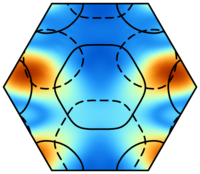
Ab initio phonon self-energies and fluctuation diagnostics of phonon anomalies: Lattice instabilities from Dirac pseudospin physics in transition metal dichalcogenides
Jan Berges, Erik G. C. P. van Loon, Arne Schobert, Malte Rösner, and Tim O. Wehling
Phys. Rev. B 101, 155107 (2020) - Published 7 April, 2020
The origin of lattice instabilities in layered materials has been controversial for several decades. In this work, the authors disentangle the underlying interplay of electrons and lattice vibrations (phonons) for the prototypical case of a TaS monolayer. They introduce the technique of to the field of electron-phonon physics and identify unambiguously the electronic degrees of freedom that are responsible for the phonon-mode softening. Here, the physics of massive Dirac fermions is shown to drive the lattice instability.
Unique Dirac and triple point fermiology in simple transition metals and their binary alloys
Chiranjit Mondal, Chanchal K. Barman, Shuvam Sarkar, Sudipta Roy Barman, Aftab Alam, and Biswarup Pathak
Phys. Rev. B 101, 155108 (2020) - Published 7 April, 2020
Comprehensive surface magnetotransport study of
Y. S. Eo, S. Wolgast, A. Rakoski, D. Mihaliov, B. Y. Kang, M. S. Song, B. K. Cho, M. Ciomaga Hatnean, G. Balakrishnan, Z. Fisk, S. R. Saha, X. Wang, J. Paglione, and Ç. Kurdak
Phys. Rev. B 101, 155109 (2020) - Published 8 April, 2020
First-principles calculation of spin and orbital contributions to magnetically ordered moments in
Christopher Lane, Yubo Zhang, James W. Furness, Robert S. Markiewicz, Bernardo Barbiellini, Jianwei Sun, and Arun Bansil
Phys. Rev. B 101, 155110 (2020) - Published 9 April, 2020
Weak localization in microflakes
Zhaoguo Li, Jicheng Zhang, Minjie Zhou, Yong Zeng, Daojian Qi, and Jia Li
Phys. Rev. B 101, 155111 (2020) - Published 10 April, 2020
Magnetic phase transitions in quantum spin-orbital liquids
Shi Feng, Niravkumar D. Patel, Panjin Kim, Jung Hoon Han, and Nandini Trivedi
Phys. Rev. B 101, 155112 (2020) - Published 10 April, 2020
Global anomaly matching in the higher-dimensional model
Takuya Furusawa and Masaru Hongo
Phys. Rev. B 101, 155113 (2020) - Published 13 April, 2020
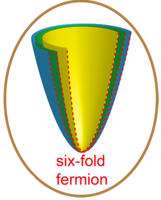
Direct observation of sixfold exotic fermions in the pyrite-structured topological semimetal
Z. P. Sun, C. Q. Hua, X. L. Liu, Z. T. Liu, M. Ye, S. Qiao, Z. H. Liu, J. S. Liu, Y. F. Guo, Y. H. Lu, and D. W. Shen
Phys. Rev. B 101, 155114 (2020) - Published 13 April, 2020
Rather than Poincarè symmetry, it is the invariance under crystal symmetry of space groups that constrains fermions in solids, and thus there might exist some exotic fermions beyond elementary particles in high-energy physics. Here, the authors verify the existence of the long-sought-after sixfold fermions in pyrite PdSb by means of high-resolution ARPES and first-principles calculations. They show that this sixfold degeneracy is a heretofore unknown single fermion node carrying zero Chern number, quite unlike the previously reported sixfold double spin-1 chiral fermions.
Partial bosonization for the two-dimensional Hubbard model
Tobias Denz, Mario Mitter, Jan M. Pawlowski, Christof Wetterich, and Masatoshi Yamada
Phys. Rev. B 101, 155115 (2020) - Published 14 April, 2020
Electronic transport through correlated electron systems with nonhomogeneous charge orderings
Rudolf Smorka, Martin Žonda, and Michael Thoss
Phys. Rev. B 101, 155116 (2020) - Published 15 April, 2020
Bulk Fermi surface of the layered superconductor with three-dimensional strong topological state
Wei Xia, Xianbiao Shi, Yong Zhang, Hao Su, Qin Wang, Linchao Ding, Leiming Chen, Xia Wang, Zhiqiang Zou, Na Yu, Li Pi, Yufeng Hao, Bin Li, Zengwei Zhu, Weiwei Zhao, Xufeng Kou, and Yanfeng Guo
Phys. Rev. B 101, 155117 (2020) - Published 15 April, 2020
Multipolar magnetism in -orbital systems: Crystal field levels, octupolar order, and orbital loop currents
Sreekar Voleti, D. D. Maharaj, B. D. Gaulin, Graeme Luke, and A. Paramekanti
Phys. Rev. B 101, 155118 (2020) - Published 15 April, 2020
Spin dynamics in antiferromagnetic oxypnictides and fluoropnictides: LaMnAsO, LaMnSbO, and BaMnAsF
Farhan Islam, Elijah Gordon, Pinaki Das, Yong Liu, Liqin Ke, Douglas L. Abernathy, Robert J. McQueeney, and David Vaknin
Phys. Rev. B 101, 155119 (2020) - Published 15 April, 2020
Bound states in two-dimensional Fermi systems with quadratic band touching
Flávio L. N. Santos, Mônica A. Caracanhas, M. C. O. Aguiar, and Rodrigo G. Pereira
Phys. Rev. B 101, 155120 (2020) - Published 16 April, 2020
Criticality of Dirac fermions in the presence of emergent gauge fields
Elliot Christou, Fernado de Juan, and Frank Krüger
Phys. Rev. B 101, 155121 (2020) - Published 16 April, 2020
Quantum entanglement in the chain: From charge-spin separation to recombination
Wayne Zheng and Zheng-Yu Weng
Phys. Rev. B 101, 155122 (2020) - Published 17 April, 2020
Critical supercurrent and state for probing a persistent spin helix
Mohammad Alidoust
Phys. Rev. B 101, 155123 (2020) - Published 20 April, 2020
Exactly solvable model for a beyond-cohomology symmetry-protected topological phase
Lukasz Fidkowski, Jeongwan Haah, and Matthew B. Hastings
Phys. Rev. B 101, 155124 (2020) - Published 20 April, 2020
High-field ultrasonic study of quadrupole ordering and crystal symmetry breaking in
R. Kurihara, A. Miyake, M. Tokunaga, Y. Hirose, and R. Settai
Phys. Rev. B 101, 155125 (2020) - Published 21 April, 2020
Magnetic fluctuations and superconducting pairing in -iron
A. S. Belozerov, A. A. Katanin, V. Yu. Irkhin, and V. I. Anisimov
Phys. Rev. B 101, 155126 (2020) - Published 21 April, 2020
Optical excitations in compressible and incompressible two-dimensional electron liquids
Tobias Graß, Ovidiu Cotlet, Atac İmamoğlu, and Mohammad Hafezi
Phys. Rev. B 101, 155127 (2020) - Published 22 April, 2020
Resonant-state expansion for planar photonic crystal structures
Sam Neale and Egor A. Muljarov
Phys. Rev. B 101, 155128 (2020) - Published 22 April, 2020
Doping a bad metal: Origin of suppression of the metal-insulator transition in nonstoichiometric
P. Ganesh, Frank Lechermann, Ilkka Kylänpää, Jaron T. Krogel, Paul R. C. Kent, and Olle Heinonen
Phys. Rev. B 101, 155129 (2020) - Published 23 April, 2020
Axion coupling in the hybrid Wannier representation
Nicodemos Varnava, Ivo Souza, and David Vanderbilt
Phys. Rev. B 101, 155130 (2020) - Published 24 April, 2020
Quench dynamics of Hopf insulators
Haiping Hu, Chao Yang, and Erhai Zhao
Phys. Rev. B 101, 155131 (2020) - Published 24 April, 2020
Exciton-driven giant nonlinear overtone signals from buckled hexagonal monolayer GaAs
Himani Mishra and Sitangshu Bhattacharya
Phys. Rev. B 101, 155132 (2020) - Published 28 April, 2020
Second-order bulk-boundary correspondence in rotationally symmetric topological superconductors from stacked Dirac Hamiltonians
Elis Roberts, Jan Behrends, and Benjamin Béri
Phys. Rev. B 101, 155133 (2020) - Published 27 April, 2020
Efficient simulation of open quantum systems coupled to a fermionic bath
Alexander Nüßeler, Ish Dhand, Susana F. Huelga, and Martin B. Plenio
Phys. Rev. B 101, 155134 (2020) - Published 27 April, 2020
The problem of open quantum systems coupled to fermionic environments arises in a variety of fields, ranging from quantum dots to quantum transport at zero and finite temperature. This work presents and analyzes a tensor network based time integration scheme for this problem, which enables simulations of such systems with controllable and certified error. Furthermore, it is shown that performing simulations in the Heisenberg picture can lead to significant efficiency gains.
Landscape of coexisting excitonic states in the insulating single-layer cuprates and nickelates
Christopher Lane and Jian-Xin Zhu
Phys. Rev. B 101, 155135 (2020) - Published 27 April, 2020
Fermion-induced quantum critical point in the Landau-Devonshire model
Shuai Yin and Zhi-Yao Zuo
Phys. Rev. B 101, 155136 (2020) - Published 27 April, 2020
Polymorphous nature of cubic halide perovskites
Xin-Gang Zhao, Gustavo M. Dalpian, Zhi Wang, and Alex Zunger
Phys. Rev. B 101, 155137 (2020) - Published 27 April, 2020
Evidence for ferromagnetic order in the CoSb layer of
Muyuan Zou, Jianan Chu, Hui Zhang, Tianzhong Yuan, Peng Cheng, Wentao Jin, Da Jiang, Xuguang Xu, Wenjie Yu, Zhenghua An, Xinyuan Wei, Gang Mu, and Wei Li
Phys. Rev. B 101, 155138 (2020) - Published 27 April, 2020
First-principles study of electron-phonon coupling and magnetoresistance of LaBi under pressure
Jian-Feng Zhang, Peng-Jie Guo, Miao Gao, Kai Liu, and Zhong-Yi Lu
Phys. Rev. B 101, 155139 (2020) - Published 27 April, 2020
Charge density wave like behavior with magnetic ordering in orthorhombic
C. N. Kuo, C. J. Hsu, C. W. Tseng, W. T. Chen, S. Y. Lin, W. Z. Liu, Y. K. Kuo, and C. S. Lue
Phys. Rev. B 101, 155140 (2020) - Published 28 April, 2020
Gapped spin liquid in the breathing kagome Heisenberg antiferromagnet
Mohsin Iqbal, Didier Poilblanc, and Norbert Schuch
Phys. Rev. B 101, 155141 (2020) - Published 28 April, 2020
Hybridization between the ligand band and orbitals in the p-type ferromagnetic semiconductor (Ga,Fe)Sb
Takahito Takeda, Masahiro Suzuki, Le Duc Anh, Nguyen Thanh Tu, Thorsten Schmitt, Satoshi Yoshida, Masato Sakano, Kyoko Ishizaka, Yukiharu Takeda, Shin-ichi Fujimori, Munetoshi Seki, Hitoshi Tabata, Atsushi Fujimori, Vladimir N. Strocov, Masaaki Tanaka, and Masaki Kobayashi
Phys. Rev. B 101, 155142 (2020) - Published 28 April, 2020
Weyl semimetals with symmetry
Yuting Qian, Jiacheng Gao, Zhida Song, Simin Nie, Zhijun Wang, Hongming Weng, and Zhong Fang
Phys. Rev. B 101, 155143 (2020) - Published 28 April, 2020
Toward the equilibrium ground state of the charge density waves in rare-earth tritellurides
A. V. Frolov, A. P. Orlov, A. Hadj-Azzem, P. Lejay, A. A. Sinchenko, and P. Monceau
Phys. Rev. B 101, 155144 (2020) - Published 28 April, 2020
Separable and entangled states in the high-spin central spin model
Ning Wu, Xi-Wen Guan, and Jon Links
Phys. Rev. B 101, 155145 (2020) - Published 28 April, 2020
Dependence of transport coefficients of intermetallics on temperature and cobalt concentration
V. Zlatić and U. Stockert
Phys. Rev. B 101, 155146 (2020) - Published 29 April, 2020
Rich phase diagram of quantum phases in the anisotropic subohmic spin-boson model
Yan-Zhi Wang, Shu He, Liwei Duan, and Qing-Hu Chen
Phys. Rev. B 101, 155147 (2020) - Published 29 April, 2020
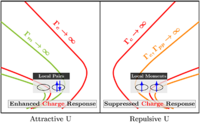
Interplay between local response and vertex divergences in many-fermion systems with on-site attraction
D. Springer, P. Chalupa, S. Ciuchi, G. Sangiovanni, and A. Toschi
Phys. Rev. B 101, 155148 (2020) - Published 29 April, 2020
Surprising singularities occur, almost ubiquitously, when inverting the Bethe-Salpeter equations of fundamental many-fermion models. For systems with repulsive interactions, they were interpreted as nonperturbative manifestations of a progressive suppression of fluctuations. By studying here the case of attractive interactions, the authors provide a counterexample to this interpretation: they find that singularities also affect a dominant sector of the attractive model, the charge channel. The fact that singularities are not confined to suppressed sectors poses additional challenges to the many-fermion theory, whose clarification calls for dedicated studies in the near future.
Ferromagnetism and superconductivity in twisted double bilayer graphene
Fengcheng Wu and Sankar Das Sarma
Phys. Rev. B 101, 155149 (2020) - Published 30 April, 2020
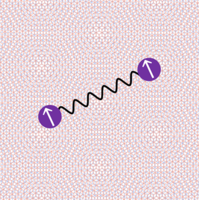
Twisted double bilayer graphene is a highly tunable moiré system to study strongly interacting physics. Here, the authors present a theory of competing ferromagnetic and superconducting orders in this system. They show that the single-particle moiré bands can be drastically modified by a perpendicular electric displacement field. As a result, the ferromagnetic insulating gap driven by Coulomb interaction has a dome shape dependence on the layer potential difference, as observed in several experiments. The stability of the ferromagnetic insulator against collective excitations, including spin and valley magnons, is theoretically verified. Furthermore, the authors investigate the possibility of phonon-mediated intervalley equal-spin pairing, using the property that the acoustic phonon mediated attraction respects an enlarged SU(2)×SU(2) symmetry.
Anomalous relaxation and multiple timescales in the quantum XY model with boundary dissipation
Shun-Yao Zhang, Ming Gong, Guang-Can Guo, and Zheng-Wei Zhou
Phys. Rev. B 101, 155150 (2020) - Published 30 April, 2020
Charge carrier transport with low-temperature anomalies in engineered oxide superlattices of
Hui Xu, Alexander J. Grutter, Zhangzhang Cui, Zhicheng Wang, Xiaofang Zhai, and Yalin Lu
Phys. Rev. B 101, 155151 (2020) - Published 30 April, 2020
Adiabatic ground state preparation in an expanding lattice
Christopher T. Olund, Maxwell Block, Snir Gazit, John McGreevy, and Norman Y. Yao
Phys. Rev. B 101, 155152 (2020) - Published 30 April, 2020