Browse Issues:

HIGHLIGHTED ARTICLES

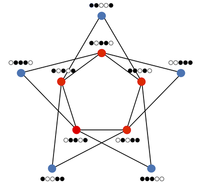
Many-body localization landscape

Shankar Balasubramanian, Yunxiang Liao, and Victor Galitski

Phys. Rev. B 101, 014201 (2020) - Published 6 January, 2020

Recently, a structure called the localization landscape was shown to accurately predict the location of eigenfunctions in the single-particle Anderson model. Here, the authors generalize the localization landscape to a large class of interacting many-body systems. They use the many-body localization landscape (MBLL) to prove decay estimates of eigenstates, and show robustness of the MBLL to weak interactions and hopping by deriving a convergent locator expansion. This establishes the MBLL as a method for efficiently estimating low-energy eigenstates and understanding possible phases in MBL models.

Variational Schrieffer-Wolff transformations for quantum many-body dynamics

Jonathan Wurtz, Pieter W. Claeys, and Anatoli Polkovnikov

Phys. Rev. B 101, 014302 (2020) - Published 10 January, 2020

The description of nonequilibrium dynamics in interacting quantum systems is a long-standing challenge within condensed matter physics. In this theoretical work, the authors introduce a method to block-diagonalize low-energy sectors of strongly interacting Hamiltonians by variationally computing generators of rotations, equivalent to a nonperturbative dressing of quasiparticle excitations. This procedure allows for the calculation of effective dynamics including quenches and response functions, as is demonstrated in a Fermi-Hubbard model and an integrability-broken XY model, both of which demonstrate excellent convergence.

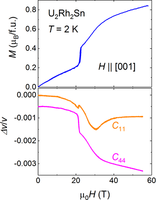
Acoustic signatures of the phase transitions in the antiferromagnet U2Rh2Sn

D. I. Gorbunov, A. V. Andreev, I. Ishii, K. Prokeš, T. Suzuki, S. Zherlitsyn, and J. Wosnitza

Phys. Rev. B 101, 014408 (2020) - Published 8 January, 2020

The 5f electrons of uranium-based intermetallic compounds are known to be between localized and itinerant. It is very hard to determine the degree of their localization. Here, by using sophisticated ultrasound experiments and a crystal electric field analysis for U2Rh2Sn, the authors conclude that the 5f electrons tend to be localized in the paramagnetic regime.

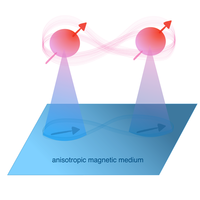
Tuning entanglement by squeezing magnons in anisotropic magnets

Ji Zou, Se Kwon Kim, and Yaroslav Tserkovnyak

Phys. Rev. B 101, 014416 (2020) - Published 13 January, 2020

There has been much recent interest in coherently preparing and manipulating entanglement in various systems, stimulated by its importance in quantum information science. Here, the authors discuss entanglement between individual spins within anisotropic magnets in thermodynamic equilibrium, suggesting magnetic materials as a natural resource for processing quantum information. Furthermore, they show that entanglement can jump discontinuously by varying an applied magnetic field, which can potentially serve as a switch for quantum information processing tasks.

Field and temperature dependence of the skyrmion lattice phase in chiral magnet membranes

David M. Burn, Shasha Wang, Weiwei Wang, Gerrit van der Laan, Shilei Zhang, Haifeng Du, and Thorsten Hesjedal

Phys. Rev. B 101, 014446 (2020) - Published 29 January, 2020

Using high-resolution small-angle resonant elastic x-ray scattering, the authors study here the field and temperature dependence of the skyrmion lattice in FeGe membranes. In stark contrast to Cu2OSeO3, the lattice constant and skyrmion size undergo a continuous evolution within the skyrmion phase pocket, whereby the lattice constant changes by up to 15%. Micromagnetic modeling shows that the competing energy terms contributing to the formation of the skyrmion lattice fully explain the observed breathing behavior.

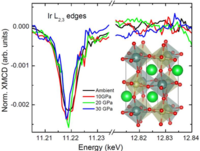
Magnetism of Ir5+-based double perovskites: Unraveling its nature and the influence of structure

M. A. Laguna-Marco, E. Arias-Egido, C. Piquer, V. Cuartero, L. Hernández-López, P. Kayser, J. A. Alonso, J. A. T. Barker, G. Fabbris, C. A. Escanhoela, Jr., and T. Irifune

Phys. Rev. B 101, 014449 (2020) - Published 30 January, 2020

Iridates having pentavalent Ir5+ ions have emerged in the last years as an exciting playground to tune the atomic magnetic ground state from nonmagnetic J=0 to magnetic J≠0 by either distortions of the IrO6 octahedra or increased orbital overlap. Here, the authors analyze the origin of the magnetic response observed in Sr2YIrO6 and reveal that in this case neither volume contraction nor structural distortions are sufficient to cause any change in the magnetic state of the Ir5+ ions.

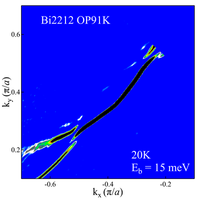
Selective hybridization between the main band and the superstructure band in the Bi2Sr2CaCu2O8+δ superconductor

Qiang Gao, Hongtao Yan, Jing Liu, Ping Ai, Yongqing Cai, Cong Li, Xiangyu Luo, Cheng Hu, Chunyao Song, Jianwei Huang, Hongtao Rong, Yuan Huang, Qingyan Wang, Guodong Liu, Genda Gu, Fengfeng Zhang, Feng Yang, Shenjin Zhang, Qinjun Peng, Zuyan Xu, Lin Zhao, Tao Xiang, and X. J. Zhou

Phys. Rev. B 101, 014513 (2020) - Published 29 January, 2020

Unexpected hybridization between the main band and the superstructure band in the Bi2Sr2CaCu2O8+δ (Bi2212) superconductor is revealed by high-resolution laser-based angle-resolved photoemission measurements. It can be understood by considering the selective hybridization of bands from the bilayer splitting in Bi2212. These observations indicate that the origin of the superstructure bands is intrinsic to the CuO2 planes. Understanding the physical properties and superconductivity in Bi2212 needs consideration of the complete Fermi surface topology, involving the main bands, the superstructure bands, and their interactions.

ARTICLES

Structure, structural phase transitions, mechanical properties, defects

Dirac degeneracy and elastic topological valley modes induced by local resonant states

Quan Zhang, Yi Chen, Kai Zhang, and Gengkai Hu

Phys. Rev. B 101, 014101 (2020) - Published 7 January, 2020

Ultrafast reversal of the ferroelectric polarization by a midinfrared pulse

Veniamin A. Abalmasov

Phys. Rev. B 101, 014102 (2020) - Published 9 January, 2020

Quadrupole arrangements and the ground state of solid hydrogen

Sebastiaan van de Bund and Graeme J. Ackland

Phys. Rev. B 101, 014103 (2020) - Published 10 January, 2020

Plastic flow between nanometer-spaced planar defects in nanostructured diamond and boron nitride

S. H. Zhang, D. Legut, T. C. Germann, S. Veprek, H. J. Zhang, and R. F. Zhang

Phys. Rev. B 101, 014104 (2020) - Published 14 January, 2020

Giant tunneling electroresistance in two-dimensional ferroelectric tunnel junctions with out-of-plane ferroelectric polarization

Lili Kang, Peng Jiang, Hua Hao, Yanhong Zhou, Xiaohong Zheng, Lei Zhang, and Zhi Zeng

Phys. Rev. B 101, 014105 (2020) - Published 14 January, 2020

Determination of the melting curve of gold up to 110 GPa

Gunnar Weck, Vanina Recoules, Jean-Antoine Queyroux, Frédéric Datchi, Johann Bouchet, Sandra Ninet, Gaston Garbarino, Mohamed Mezouar, and Paul Loubeyre

Phys. Rev. B 101, 014106 (2020) - Published 17 January, 2020

Annealing temperature dependence of optical and structural properties of Cu films

Jiamin Liu, Meng Wang, Hao Jiang, Jianbin Lin, Honggang Gu, Xiuguo Chen, Tielin Shi, and Shiyuan Liu

Phys. Rev. B 101, 014107 (2020) - Published 17 January, 2020

Role of V-V dimerization in the insulator-metal transition and optical transmittance of pure and doped VO2 thin films

S. S. Majid, S. R. Sahu, A. Ahad, K. Dey, K. Gautam, F. Rahman, P. Behera, U. Deshpande, V. G. Sathe, and D. K. Shukla

Phys. Rev. B 101, 014108 (2020) - Published 17 January, 2020

Origin of Rashba-Dresselhaus effect in the ferroelectric nitride perovskite LaWN3

Subhadeep Bandyopadhyay, Atanu Paul, and I. Dasgupta

Phys. Rev. B 101, 014109 (2020) - Published 22 January, 2020

Diversity of hole-trap centers due to small polarons and bipolarons in Ca-doped BiFeO3: Origin of electrochromism

Jounghee Lee, Ho-Hyun Nahm, and Yong-Hyun Kim

Phys. Rev. B 101, 014110 (2020) - Published 24 January, 2020

Geometric confinement governs toughness and strength in defective diamond nanowires

Zhaocheng Zhang and Zubaer M. Hossain

Phys. Rev. B 101, 014111 (2020) - Published 27 January, 2020

Prediction of superconductivity in pressure-induced new silicon boride phases

Xiaowei Liang, Aitor Bergara, Yu Xie, Linyan Wang, Rongxin Sun, Yufei Gao, Xiang-Feng Zhou, Bo Xu, Julong He, Dongli Yu, Guoying Gao, and Yongjun Tian

Phys. Rev. B 101, 014112 (2020) - Published 27 January, 2020

Atomistic structural mechanism for the glass transition: Entropic contribution

Dong Han, Dan Wei, Jie Yang, Hui-Ling Li, Min-Qiang Jiang, Yun-Jiang Wang, Lan-Hong Dai, and Alessio Zaccone

Phys. Rev. B 101, 014113 (2020) - Published 28 January, 2020

High-temperature magnetism and crystallography of a YCrO3 single crystal

Yinghao Zhu, Si Wu, Bao Tu, Shangjian Jin, Ashfia Huq, Jörg Persson, Haoshi Gao, Defang Ouyang, Zhubing He, Dao-Xin Yao, Zikang Tang, and Hai-Feng Li

Phys. Rev. B 101, 014114 (2020) - Published 30 January, 2020

Inhomogeneous, disordered, and partially ordered systems

Many-body localization landscape

Shankar Balasubramanian, Yunxiang Liao, and Victor Galitski

Phys. Rev. B 101, 014201 (2020) - Published 6 January, 2020

Recently, a structure called the localization landscape was shown to accurately predict the location of eigenfunctions in the single-particle Anderson model. Here, the authors generalize the localization landscape to a large class of interacting many-body systems. They use the many-body localization landscape (MBLL) to prove decay estimates of eigenstates, and show robustness of the MBLL to weak interactions and hopping by deriving a convergent locator expansion. This establishes the MBLL as a method for efficiently estimating low-energy eigenstates and understanding possible phases in MBL models.

Non-Hermitian disorder in two-dimensional optical lattices

A. F. Tzortzakakis, K. G. Makris, and E. N. Economou

Phys. Rev. B 101, 014202 (2020) - Published 6 January, 2020

Toy model for anomalous transport and Griffiths effects near the many-body localization transition

M. Schiró and M. Tarzia

Phys. Rev. B 101, 014203 (2020) - Published 17 January, 2020

Anderson transition in three-dimensional systems with non-Hermitian disorder

Yi Huang (黄奕) and B. I. Shklovskii

Phys. Rev. B 101, 014204 (2020) - Published 21 January, 2020

Mixed spectra and partially extended states in a two-dimensional quasiperiodic model

Attila Szabó and Ulrich Schneider

Phys. Rev. B 101, 014205 (2020) - Published 21 January, 2020

Electron transport and electron density inside quasi-one-dimensional disordered conductors

Pier A. Mello and Miztli Yépez

Phys. Rev. B 101, 014206 (2020) - Published 22 January, 2020

Slow structural relaxation process facilitates solidification in liquid gallium

F. Demmel

Phys. Rev. B 101, 014207 (2020) - Published 23 January, 2020

Entanglement and spectra in topological many-body localized phases

K. S. C. Decker, D. M. Kennes, J. Eisert, and C. Karrasch

Phys. Rev. B 101, 014208 (2020) - Published 24 January, 2020

Probing interacting two-level systems with rare-earth ions

Dapeng Ding, David van Driel, Lino M. C. Pereira, Jared F. Bauters, Martijn J. R. Heck, Gesa Welker, Michiel J. A. de Dood, André Vantomme, John E. Bowers, Wolfgang Löffler, and Dirk Bouwmeester

Phys. Rev. B 101, 014209 (2020) - Published 29 January, 2020

Ab initio typical medium theory of substitutional disorder

A. Östlin, Y. Zhang, H. Terletska, F. Beiuşeanu, V. Popescu, K. Byczuk, L. Vitos, M. Jarrell, D. Vollhardt, and L. Chioncel

Phys. Rev. B 101, 014210 (2020) - Published 29 January, 2020

Dynamics, dynamical systems, lattice effects

Variational Schrieffer-Wolff transformations for quantum many-body dynamics

Jonathan Wurtz, Pieter W. Claeys, and Anatoli Polkovnikov

Phys. Rev. B 101, 014302 (2020) - Published 10 January, 2020

The description of nonequilibrium dynamics in interacting quantum systems is a long-standing challenge within condensed matter physics. In this theoretical work, the authors introduce a method to block-diagonalize low-energy sectors of strongly interacting Hamiltonians by variationally computing generators of rotations, equivalent to a nonperturbative dressing of quasiparticle excitations. This procedure allows for the calculation of effective dynamics including quenches and response functions, as is demonstrated in a Fermi-Hubbard model and an integrability-broken XY model, both of which demonstrate excellent convergence.

Manifestation of a topological gapless phase in a two-dimensional chiral symmetric system through Loschmidt echo

K. L. Zhang and Z. Song

Phys. Rev. B 101, 014303 (2020) - Published 13 January, 2020

Hot carrier dynamics and phonon anharmonicity of ZrTe5 revealed with femtosecond transient optical spectroscopy

Ning Li, Weizheng Liang, and Sheng-Nian Luo

Phys. Rev. B 101, 014304 (2020) - Published 21 January, 2020

Non-Hermitian Floquet topological superconductors with multiple Majorana edge modes

Longwen Zhou

Phys. Rev. B 101, 014306 (2020) - Published 22 January, 2020

Scattering theory and cancellation of gravity-flexural waves of floating plates

M. Farhat, P.-Y. Chen, H. Bagci, K. N. Salama, A. Alù, and S. Guenneau

Phys. Rev. B 101, 014307 (2020) - Published 28 January, 2020

Anomalous phonon-mode dependence in polarized Raman spectroscopy of the topological Weyl semimetal TaP

Kunyan Zhang, Xiaoqi Pang, Tong Wang, Fei Han, Shun-Li Shang, Nguyen T. Hung, Ahmad R. T. Nugraha, Zi-Kui Liu, Mingda Li, Riichiro Saito, and Shengxi Huang

Phys. Rev. B 101, 014308 (2020) - Published 30 January, 2020

Magnetism

Spin accumulation dynamics in spin valves in the terahertz regime

A. Vedyaev, N. Ryzhanova, N. Strelkov, A. Lobachev, and B. Dieny

Phys. Rev. B 101, 014401 (2020) - Published 2 January, 2020

Itinerant ferromagnetism and intrinsic anomalous Hall effect in amorphous iron-germanium

D. S. Bouma, Z. Chen, B. Zhang, F. Bruni, M. E. Flatté, A. Ceballos, R. Streubel, L.-W. Wang, R. Q. Wu, and F. Hellman

Phys. Rev. B 101, 014402 (2020) - Published 2 January, 2020

Edge localization of spin waves in antidot multilayers with perpendicular magnetic anisotropy

S. Pan, S. Mondal, M. Zelent, R. Szwierz, S. Pal, O. Hellwig, M. Krawczyk, and A. Barman

Phys. Rev. B 101, 014403 (2020) - Published 3 January, 2020

Highly efficient spin-orbit torque in Pt/Co/Ir multilayers with antiferromagnetic interlayer exchange coupling

Yuto Ishikuro, Masashi Kawaguchi, Tomohiro Taniguchi, and Masamitsu Hayashi

Phys. Rev. B 101, 014404 (2020) - Published 3 January, 2020

Magnetostriction in transversely isotropic hexagonal crystals

Giancarlo Consolo, Salvatore Federico, and Giovanna Valenti

Phys. Rev. B 101, 014405 (2020) - Published 6 January, 2020

Reversible control of Dzyaloshinskii-Moriya interaction at the graphene/Co interface via hydrogen absorption

Baishun Yang, Qirui Cui, Jinghua Liang, Mairbek Chshiev, and Hongxin Yang

Phys. Rev. B 101, 014406 (2020) - Published 7 January, 2020

Disorder and magnetic excitations in CaCrxFe2−xO4(x=0,0.5)

M. Songvilay, S. Petit, M. Koza, S. Rols, E. Suard, V. Skumryev, C. Martin, and F. Damay

Phys. Rev. B 101, 014407 (2020) - Published 8 January, 2020

Acoustic signatures of the phase transitions in the antiferromagnet U2Rh2Sn

D. I. Gorbunov, A. V. Andreev, I. Ishii, K. Prokeš, T. Suzuki, S. Zherlitsyn, and J. Wosnitza

Phys. Rev. B 101, 014408 (2020) - Published 8 January, 2020

The 5f electrons of uranium-based intermetallic compounds are known to be between localized and itinerant. It is very hard to determine the degree of their localization. Here, by using sophisticated ultrasound experiments and a crystal electric field analysis for U2Rh2Sn, the authors conclude that the 5f electrons tend to be localized in the paramagnetic regime.

Magnetic structure of selected Gd intermetallic alloys from first principles

L. Petit, Z. Szotek, D. Paudyal, A. Biswas, Y. Mudryk, V. K. Pecharsky, and J. B. Staunton

Phys. Rev. B 101, 014409 (2020) - Published 8 January, 2020

Switching of magnetism via modifying phase shift of quantum-well states by tailoring the interface electronic structure

Shunsuke Sakuragi, Hiroyuki Kageshima, and Tetsuya Sato

Phys. Rev. B 101, 014410 (2020) - Published 9 January, 2020

Quantum computation of magnon spectra

Akhil Francis, J. K. Freericks, and A. F. Kemper

Phys. Rev. B 101, 014411 (2020) - Published 9 January, 2020

Titanium 3d ferromagnetism with perpendicular anisotropy in defective anatase

Markus Stiller, Alpha T. N'Diaye, Hendrik Ohldag, José Barzola-Quiquia, Pablo D. Esquinazi, Thomas Amelal, Carsten Bundesmann, Daniel Spemann, Martin Trautmann, Angelika Chassé, Hichem Ben Hamed, Waheed A. Adeagbo, and Wolfram Hergert

Phys. Rev. B 101, 014412 (2020) - Published 9 January, 2020

Perpendicular magnetic anisotropy in conducting NiCo2O4 films from spin-lattice coupling

Corbyn Mellinger, Jace Waybright, Xiaozhe Zhang, Caleb Schmidt, and Xiaoshan Xu

Phys. Rev. B 101, 014413 (2020) - Published 10 January, 2020

Splitting of antiferromagnetic resonance modes in the quasi-two-dimensional collinear antiferromagnet Cu(en)(H2O)2SO4

V. N. Glazkov, Yu. V. Krasnikova, I. K. Rodygina, J. Chovan, R. Tarasenko, and A. Orendáčová

Phys. Rev. B 101, 014414 (2020) - Published 10 January, 2020

Characterization of magnetic symmetry and electric polarization of YCr0.5Fe0.5O3

J. Y. Yang, X. D. Shen, V. Pomjakushin, L. Keller, E. Pomjakushina, Y. W. Long, and M. Kenzelmann

Phys. Rev. B 101, 014415 (2020) - Published 13 January, 2020

Tuning entanglement by squeezing magnons in anisotropic magnets

Ji Zou, Se Kwon Kim, and Yaroslav Tserkovnyak

Phys. Rev. B 101, 014416 (2020) - Published 13 January, 2020

There has been much recent interest in coherently preparing and manipulating entanglement in various systems, stimulated by its importance in quantum information science. Here, the authors discuss entanglement between individual spins within anisotropic magnets in thermodynamic equilibrium, suggesting magnetic materials as a natural resource for processing quantum information. Furthermore, they show that entanglement can jump discontinuously by varying an applied magnetic field, which can potentially serve as a switch for quantum information processing tasks.

Magnon spectrum of the Weyl semimetal half-Heusler compound GdPtBi

A. S. Sukhanov, Y. A. Onykiienko, R. Bewley, C. Shekhar, C. Felser, and D. S. Inosov

Phys. Rev. B 101, 014417 (2020) - Published 14 January, 2020

Breathing mode of a skyrmion on a lattice

Dmitry A. Garanin, Reem Jaafar, and Eugene M. Chudnovsky

Phys. Rev. B 101, 014418 (2020) - Published 14 January, 2020

Enhancement of magnon-magnon entanglement inside a cavity

H. Y. Yuan, Shasha Zheng, Zbigniew Ficek, Q. Y. He, and Man-Hong Yung

Phys. Rev. B 101, 014419 (2020) - Published 14 January, 2020

Quantification of local Ising magnetism in rare-earth pyrogermanates Er2Ge2O7 and Yb2Ge2O7

Daniel M. Pajerowski, K. M. Taddei, L. D. Sanjeewa, A. T. Savici, M. B. Stone, and J. W. Kolis

Phys. Rev. B 101, 014420 (2020) - Published 15 January, 2020

Density matrix renormalization group study of nematicity in two dimensions: Application to a spin-1 bilinear-biquadratic model on the square lattice

Wen-Jun Hu, Shou-Shu Gong, Hsin-Hua Lai, Qimiao Si, and Elbio Dagotto

Phys. Rev. B 101, 014421 (2020) - Published 15 January, 2020

Exchange-biased nanocomposite ferromagnetic insulator

Ji Zhang, Jingtian Zhou, Zhen-Lin Luo, Y. B. Chen, Jian Zhou, Weiwei Lin, Ming-Hui Lu, Shan-Tao Zhang, Chen Gao, Di Wu, and Yan-Feng Chen

Phys. Rev. B 101, 014422 (2020) - Published 15 January, 2020

Pursuing the high-temperature quantum anomalous Hall effect in MnBi2Te4/Sb2Te3 heterostructures

Shifei Qi, Ruiling Gao, Maozhi Chang, Yulei Han, and Zhenhua Qiao

Phys. Rev. B 101, 014423 (2020) - Published 15 January, 2020

Detection of antiskyrmions by topological Hall effect in Heusler compounds

Vivek Kumar, Nitesh Kumar, Manfred Reehuis, Jacob Gayles, A. S. Sukhanov, Andreas Hoser, Françoise Damay, Chandra Shekhar, Peter Adler, and Claudia Felser

Phys. Rev. B 101, 014424 (2020) - Published 15 January, 2020

Influence of atomic roughness at the uncompensated Fe/CoO(111) interface on the exchange-bias effect

Rui Wu, Mingzhu Xue, Tuhin Maity, Yuxuan Peng, Samir Kumar Giri, Guang Tian, Judith L. MacManus-Driscoll, and Jinbo Yang

Phys. Rev. B 101, 014425 (2020) - Published 15 January, 2020

Computational screening of Fe-Ta hard magnetic phases

S. Arapan, P. Nieves, H. C. Herper, and D. Legut

Phys. Rev. B 101, 014426 (2020) - Published 21 January, 2020

Interplay of local moment and itinerant magnetism in cobalt-based Heusler ferromagnets: Co2TiSi, Co2MnSi and Co2FeSi

Guanhua Qin, Wei Ren, and David J. Singh

Phys. Rev. B 101, 014427 (2020) - Published 21 January, 2020

Engineering the dynamics of topological spin textures by anisotropic spin-orbit torques

J.-P. Hanke, F. Freimuth, B. Dupé, J. Sinova, M. Kläui, and Y. Mokrousov

Phys. Rev. B 101, 014428 (2020) - Published 21 January, 2020

Structural, magnetic, and spin dynamical properties of the polar antiferromagnets Ni3−xCoxTeO6(x=1,2)

Stella Skiadopoulou, Maria Retuerto, Fedir Borodavka, Christelle Kadlec, Filip Kadlec, Martin Míšek, Jan Prokleška, Zheng Deng, Xiaoyan Tan, Corey Frank, Jose A. Alonso, Maria Tereza Fernandez-Diaz, Mark Croft, Fabio Orlandi, Pascal Manuel, Emma McCabe, Dominik Legut, Martha Greenblatt, and Stanislav Kamba

Phys. Rev. B 101, 014429 (2020) - Published 21 January, 2020

Fluctuation diagnostics of the finite-temperature quasi-antiferromagnetic regime of the two-dimensional Hubbard model

Behnam Arzhang, A. E. Antipov, and J. P. F. LeBlanc

Phys. Rev. B 101, 014430 (2020) - Published 21 January, 2020

Modulating superexchange strength to achieve robust ferromagnetic couplings in two-dimensional semiconductors

Jiewen Xiao, Dominik Legut, Weidong Luo, Haoxiang Guo, Xiaopeng Liu, Ruifeng Zhang, and Qianfan Zhang

Phys. Rev. B 101, 014431 (2020) - Published 21 January, 2020

Low-temperature spin dynamics in the TmFeO3 orthoferrite with a non-Kramers ion

S. A. Skorobogatov, S. E. Nikitin, K. A. Shaykhutdinov, A. D. Balaev, K. Yu. Terentjev, G. Ehlers, G. Sala, E. V. Pomjakushina, K. Conder, and A. Podlesnyak

Phys. Rev. B 101, 014432 (2020) - Published 22 January, 2020

Dynamics of domain-wall motion driven by spin-orbit torque in antiferromagnets

Luis Sánchez-Tejerina, Vito Puliafito, Pedram Khalili Amiri, Mario Carpentieri, and Giovanni Finocchio

Phys. Rev. B 101, 014433 (2020) - Published 22 January, 2020

Monte Carlo studies of the spin-chirality decoupling in the three-dimensional Heisenberg spin glass

Takumi Ogawa, Kazuki Uematsu, and Hikaru Kawamura

Phys. Rev. B 101, 014434 (2020) - Published 22 January, 2020

Interface reflectivity of a superdiffusive spin current in ultrafast demagnetization and terahertz emission

Wen-Tian Lu, Yawen Zhao, Marco Battiato, Yizheng Wu, and Zhe Yuan

Phys. Rev. B 101, 014435 (2020) - Published 22 January, 2020

Zero-field propagation of spin waves in waveguides prepared by focused ion beam direct writing

Lukáš Flajšman, Kai Wagner, Marek Vaňatka, Jonáš Gloss, Viola Křižáková, Michael Schmid, Helmut Schultheiss, and Michal Urbánek

Phys. Rev. B 101, 014436 (2020) - Published 24 January, 2020

Magnetic properties of a spin-12 honeycomb lattice antiferromagnet

Y. Kono, T. Okabe, N. Uemoto, Y. Iwasaki, Y. Hosokoshi, S. Kittaka, T. Sakakibara, and H. Yamaguchi

Phys. Rev. B 101, 014437 (2020) - Published 24 January, 2020

Analytical description of the topological interaction between magnetic domain walls in nanowires

A. Pivano and V. O. Dolocan

Phys. Rev. B 101, 014438 (2020) - Published 27 January, 2020

Identification and time-resolved study of ferrimagnetic spin-wave modes in a microwave cavity in the strong-coupling regime

Angelo Leo, Anna Grazia Monteduro, Silvia Rizzato, Luigi Martina, and Giuseppe Maruccio

Phys. Rev. B 101, 014439 (2020) - Published 27 January, 2020

Magnetic anisotropy and low-field magnetic phase diagram of the quasi-two-dimensional ferromagnet Cr2Ge2Te6

S. Selter, G. Bastien, A. U. B. Wolter, S. Aswartham, and B. Büchner

Phys. Rev. B 101, 014440 (2020) - Published 27 January, 2020

Spin and orbital excitations through the metal-to-insulator transition in Cd2Os2O7 probed with high-resolution resonant inelastic x-ray scattering

J. G. Vale, S. Calder, N. A. Bogdanov, C. Donnerer, M. Moretti Sala, N. R. Davies, D. Mandrus, J. van den Brink, A. D. Christianson, and D. F. McMorrow

Phys. Rev. B 101, 014441 (2020) - Published 27 January, 2020

Oriented propagation of magnetization due to chiral edge modes in Kitaev-type models

Tomonari Mizoguchi, Tohru Koma, and Yasuhito Yoshida

Phys. Rev. B 101, 014442 (2020) - Published 27 January, 2020

Temperature dependence of exchange stiffness in an off-stoichiometric Ni2MnIn Heusler alloy

K. Niitsu, X. Xu, R. Y. Umetsu, R. Kainuma, and K. Harada

Phys. Rev. B 101, 014443 (2020) - Published 29 January, 2020

Self-consistent local mean-field theory for phase transitions and magnetic properties of FeRh

Brianne R. McGrath, Robert E. Camley, and Karen L. Livesey

Phys. Rev. B 101, 014444 (2020) - Published 29 January, 2020

Field and temperature dependence of the skyrmion lattice phase in chiral magnet membranes

David M. Burn, Shasha Wang, Weiwei Wang, Gerrit van der Laan, Shilei Zhang, Haifeng Du, and Thorsten Hesjedal

Phys. Rev. B 101, 014446 (2020) - Published 29 January, 2020

Using high-resolution small-angle resonant elastic x-ray scattering, the authors study here the field and temperature dependence of the skyrmion lattice in FeGe membranes. In stark contrast to Cu2OSeO3, the lattice constant and skyrmion size undergo a continuous evolution within the skyrmion phase pocket, whereby the lattice constant changes by up to 15%. Micromagnetic modeling shows that the competing energy terms contributing to the formation of the skyrmion lattice fully explain the observed breathing behavior.

Electric field modulation of exchange bias at the Co/CoOx interface

T. Hirai, T. Koyama, and D. Chiba

Phys. Rev. B 101, 014447 (2020) - Published 29 January, 2020

Field-sweep-rate and time dependence of transverse resistivity anomalies in ultrathin SrRuO3 films

Daisuke Kan, Takahiro Moriyama, and Yuichi Shimakawa

Phys. Rev. B 101, 014448 (2020) - Published 30 January, 2020

Magnetism of Ir5+-based double perovskites: Unraveling its nature and the influence of structure

M. A. Laguna-Marco, E. Arias-Egido, C. Piquer, V. Cuartero, L. Hernández-López, P. Kayser, J. A. Alonso, J. A. T. Barker, G. Fabbris, C. A. Escanhoela, Jr., and T. Irifune

Phys. Rev. B 101, 014449 (2020) - Published 30 January, 2020

Iridates having pentavalent Ir5+ ions have emerged in the last years as an exciting playground to tune the atomic magnetic ground state from nonmagnetic J=0 to magnetic J≠0 by either distortions of the IrO6 octahedra or increased orbital overlap. Here, the authors analyze the origin of the magnetic response observed in Sr2YIrO6 and reveal that in this case neither volume contraction nor structural distortions are sufficient to cause any change in the magnetic state of the Ir5+ ions.

Exchange explosions of topological edge defects in a square micromagnet

Sam D. Slöetjes, Erik Folven, and Jostein K. Grepstad

Phys. Rev. B 101, 014450 (2020) - Published 31 January, 2020

Rashba spin splitting and perpendicular magnetic anisotropy of Gd-adsorbed zigzag graphene nanoribbon modulated by edge states under external electric fields

Zhenzhen Qin, Guangzhao Qin, Bin Shao, and Xu Zuo

Phys. Rev. B 101, 014451 (2020) - Published 31 January, 2020

Critical local moment fluctuations and enhanced pairing correlations in a cluster Anderson model

Ang Cai, J. H. Pixley, Kevin Ingersent, and Qimiao Si

Phys. Rev. B 101, 014452 (2020) - Published 31 January, 2020

Hilbert space fragmentation and Ashkin-Teller criticality in fluctuation coupled Ising models

Pranay Patil and Anders W. Sandvik

Phys. Rev. B 101, 014453 (2020) - Published 31 January, 2020

Superfluidity and superconductivity

Pairing and non-Fermi liquid behavior in partially flat-band systems: Beyond nesting physics

Sharareh Sayyad, Edwin W. Huang, Motoharu Kitatani, Mohammad-Sadegh Vaezi, Zohar Nussinov, Abolhassan Vaezi, and Hideo Aoki

Phys. Rev. B 101, 014501 (2020) - Published 6 January, 2020

Low-field vortex melting in a single crystal of Ba0.6K0.4Fe2As2

Ankit Kumar, Sayantan Ghosh, Tsuyoshi Tamegai, and S. S. Banerjee

Phys. Rev. B 101, 014502 (2020) - Published 7 January, 2020

Majorana phase gate based on the geometric phase

Andrzej Więckowski, Marcin Mierzejewski, and Michał Kupczyński

Phys. Rev. B 101, 014504 (2020) - Published 7 January, 2020

Microscopic characterization of the superconducting gap function in Sn1−xInxTe

T. Nomoto, M. Kawamura, T. Koretsune, R. Arita, T. Machida, T. Hanaguri, M. Kriener, Y. Taguchi, and Y. Tokura

Phys. Rev. B 101, 014505 (2020) - Published 8 January, 2020

Use of a spoof plasmon to optimize the coupling of infrared radiation to Josephson-junction fluxon oscillations

A. Tagliacozzo, S. De Nicola, D. Montemurro, G. Campagnano, C. Petrarca, C. Forestiere, G. Rubinacci, F. Tafuri, and G. P. Pepe

Phys. Rev. B 101, 014506 (2020) - Published 8 January, 2020

Extinction and recovery of mass flow through solid He4 samples

Jaeho Shin and Moses H. W. Chan

Phys. Rev. B 101, 014507 (2020) - Published 9 January, 2020

Strong- to weak-coupling superconductivity in high-Tc bismuthates: Revisiting the phase diagram via μSR

T. Shang, D. J. Gawryluk, M. Naamneh, Z. Salman, Z. Guguchia, M. Medarde, M. Shi, N. C. Plumb, and T. Shiroka

Phys. Rev. B 101, 014508 (2020) - Published 9 January, 2020

Investigation of specific heat in ultrathin two-dimensional superconducting Pb

T. D. Nguyen, A. Frydman, and O. Bourgeois

Phys. Rev. B 101, 014509 (2020) - Published 13 January, 2020

Ising superconductors: Interplay of magnetic field, triplet channels, and disorder

David Möckli and Maxim Khodas

Phys. Rev. B 101, 014510 (2020) - Published 21 January, 2020

Instabilities of the normal state in current-biased narrow superconducting strips

Yury N. Ovchinnikov, Andrey A. Varlamov, Gregory J. Kimmel, and Andreas Glatz

Phys. Rev. B 101, 014511 (2020) - Published 24 January, 2020

Absence of supercurrent sign reversal in a topological junction with a quantum dot

J. Schulenborg and K. Flensberg

Phys. Rev. B 101, 014512 (2020) - Published 28 January, 2020

Selective hybridization between the main band and the superstructure band in the Bi2Sr2CaCu2O8+δ superconductor

Qiang Gao, Hongtao Yan, Jing Liu, Ping Ai, Yongqing Cai, Cong Li, Xiangyu Luo, Cheng Hu, Chunyao Song, Jianwei Huang, Hongtao Rong, Yuan Huang, Qingyan Wang, Guodong Liu, Genda Gu, Fengfeng Zhang, Feng Yang, Shenjin Zhang, Qinjun Peng, Zuyan Xu, Lin Zhao, Tao Xiang, and X. J. Zhou

Phys. Rev. B 101, 014513 (2020) - Published 29 January, 2020

Unexpected hybridization between the main band and the superstructure band in the Bi2Sr2CaCu2O8+δ (Bi2212) superconductor is revealed by high-resolution laser-based angle-resolved photoemission measurements. It can be understood by considering the selective hybridization of bands from the bilayer splitting in Bi2212. These observations indicate that the origin of the superstructure bands is intrinsic to the CuO2 planes. Understanding the physical properties and superconductivity in Bi2212 needs consideration of the complete Fermi surface topology, involving the main bands, the superstructure bands, and their interactions.

Pressure-induced suppression of charge density wave and emergence of superconductivity in 1T−VSe2

S. Sahoo, U. Dutta, L. Harnagea, A. K. Sood, and S. Karmakar

Phys. Rev. B 101, 014514 (2020) - Published 30 January, 2020

Enhanced spin-triplet pairing in magnetic junctions with s-wave superconductors

Thomas Vezin, Chenghao Shen, Jong E. Han, and Igor Žutić

Phys. Rev. B 101, 014515 (2020) - Published 31 January, 2020

Reversible fluxon logic: Topological particles allow ballistic gates along one-dimensional paths

W. Wustmann and K. D. Osborn

Phys. Rev. B 101, 014516 (2020) - Published 31 January, 2020

Sign In to Your Journals Account

Filter

Filter

Article Lookup

Enter a citation