Browse Issues:

HIGHLIGHTED ARTICLES

Surface states and Rashba-type spin polarization in antiferromagnetic MnBi2Te4(0001)

R. C. Vidal et al.

Phys. Rev. B 100, 121104(R) (2019) - Published 11 September, 2019

The layered van der Waals antiferromagnet MnBi2Te4 has been predicted previously to realize the first intrinsic magnetic topological insulator. Here, the authors report spin- and angle-resolved photoemission experiments for the MnBi2Te4(0001) surface, revealing a surface state in the bulk band gap and providing evidence for the interplay between magnetic exchange interaction and spin-orbit coupling in the surface electronic structure. MnBi2Te4 thus constitutes a promising candidate to exploit the interplay of topological states and magnetic order in spintronic device concepts.

Imaging propagative exciton polaritons in atomically thin WSe2 waveguides

F. Hu, Y. Luan, J. Speltz, D. Zhong, C. H. Liu, J. Yan, D. G. Mandrus, X. Xu, and Z. Fei

Phys. Rev. B 100, 121301(R) (2019) - Published 4 September, 2019

This work reports a nano-optical imaging study of the transverse-electric exciton polaritons in atomically thin WSe2 nanoflakes by using a scattering-type scanning near-field optical microscope excited by an s-polarized laser. These exciton polaritons demonstrate the signature back-bending polariton dispersion, a long propagation length, and a tailored polariton wavelength by controlling the thickness of WSe2. The discovery of long-propagating exciton polaritons in WSe2 atomic layers paves the way for the future development of actively tunable polaritonic devices in the near-infrared region.

Origin of the butterfly magnetoresistance in a Dirac nodal-line system

Y.-C. Chiu, K.-W. Chen, R. Schönemann, V. L. Quito, S. Sur, Q. Zhou, D. Graf, E. Kampert, T. Förster, K. Yang, G. T. McCandless, Julia Y. Chan, R. E. Baumbach, M. D. Johannes, and L. Balicas

Phys. Rev. B 100, 125112 (2019) - Published 4 September, 2019

ZrSiSe, similar to ZrSiS and ZrSiTe, displays a set of Dirac nodal lines at nonsymmorphic (and symmorphic) positions that are (are not) protected from gap opening due to spin-orbit coupling. The fourfold angular dependence of its magnetoresistivity was recently claimed to result from a topological phase transition as a function of field orientation. Instead, the calculations here reveal that this compound does not display a (strong) topological character, while the measurements here indicate that this anomalous magnetoresistivity results from the angular dependence of its quasiparticle quantum lifetime(s).

Emergent symmetry and conserved current at a one-dimensional incarnation of deconfined quantum critical point

Rui-Zhen Huang, Da-Chuan Lu, Yi-Zhuang You, Zi Yang Meng, and Tao Xiang

Phys. Rev. B 100, 125137 (2019) - Published 17 September, 2019

Although great efforts have been expended on the deconfined quantum critical point (DQCP) for 2D systems, ambiguities are still not completely clarified. Here, the authors focus on a recently proposed 1D incarnation of DQCP in a spin-½ chain. Using the variational matrix product state, a continuous transition between a valence-bond solid phase and a ferromagnetic phase is discovered. Two emergent O(2) symmetries together with the associated conserved current operators are revealed and in perfect agreement with the controlled field theory predictions.

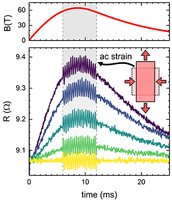
Growth of nematic susceptibility in the field-induced normal state of an iron-based superconductor revealed by elastoresistivity measurements in a 65 T pulsed magnet

J. A. W. Straquadine, J. C. Palmstrom, P. Walmsley, A. T. Hristov, F. Weickert, F. F. Balakirev, M. Jaime, R. McDonald, and I. R. Fisher

Phys. Rev. B 100, 125147 (2019) - Published 23 September, 2019

In iron-based superconductors, questions surrounding a putative nematic quantum critical point motivate study of the nematic susceptibility at low temperatures. By suppressing superconductivity with pulsed magnetic fields, this work extends the range of elastoresistivity measurements in nearly optimally doped Ba(CoxFe1−x)2As2 an order of magnitude lower in temperature. The authors show that the nematic susceptibility in the field-induced normal state grows monotonically as temperature decreases. This is consistent with the existence of a nearby quantum critical point with nematic character.

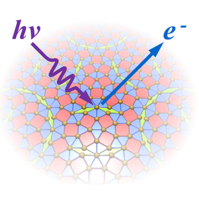
Electronic band structure of a two-dimensional oxide quasicrystal

Cheng-Tien Chiang, Martin Ellguth, Florian O. Schumann, Christian Tusche, Richard Kraska, Stefan Förster, and Wolf Widdra

Phys. Rev. B 100, 125149 (2019) - Published 23 September, 2019

Since the discovery of quasicrystals, the study of their electronic structure has been a challenging topic due to the absence of translational symmetry. Here, the valence bands of a novel two-dimensional ultrathin BaTiO3-derived oxide quasicrystal are determined by momentum-resolved photoelectron spectroscopy. The dispersion of the oxygen 2p bands and the occupation of the Ti 3d states are identified. They bridge the knowledge deriving from free-electron-like wave functions in bulk quasicrystals to that of the more localized electrons in confined dimensions.

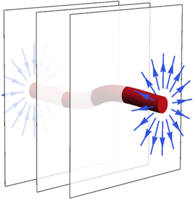
Fractonic matter in symmetry-enriched U(1) gauge theory

Dominic J. Williamson, Zhen Bi, and Meng Cheng

Phys. Rev. B 100, 125150 (2019) - Published 23 September, 2019

This study reveals the relation between symmetry restrictions on the mobility of quasiparticles and symmetry-enriched topological order, where the actions of translation and global symmetries on quasiparticle excitations do not commute. The approach is demonstrably fruitful as one can systematically classify U(1) gauge theories enriched by translation and certain global symmetry and identify new examples of fractonic matter. It is conjectured that all such theories can be constructed by gauging layered symmetry-protected topological phases.

Magnetoelectric control of topological phases in graphene

Hiroyuki Takenaka, Shane Sandhoefner, Alexey A. Kovalev, and Evgeny Y. Tsymbal

Phys. Rev. B 100, 125156 (2019) - Published 25 September, 2019

A new paradigm for voltage controlled topological antiferromagnetic spintronics is envisioned via proximity of a magnetoelectric antiferromagnet to a two-dimensional material. Using graphene/chromia as a model system, the authors predict the emergence of unconventional anomalous Hall effects that are electrically controlled by the Néel vector as well as the appearance and transformation of different topological phases and the emergence of chiral edge states. The results advance the research field of topological phenomena and establish connection between the subfields of antiferromagnetism, magnetoelectricity, topology, spintronics, and valleytronics.

Kondo effect due to a hydrogen impurity in graphene: A multichannel Kondo problem with diverging hybridization

Zheng Shi, Emilian M. Nica, and Ian Affleck

Phys. Rev. B 100, 125158 (2019) - Published 25 September, 2019

Magnetic impurities in conducting media are often Kondo screened by conduction electrons. However, for hydrogen impurities in graphene, which also induce magnetic moments, the picture is complicated by the energy-dependent, unusually enhanced local density of states. Here, the authors study the Kondo effect in this system, which is intimately related to the Kondo problem of three impurity spins on an equilateral triangle in a metallic host. The induced magnetic moment is found to be underscreened for local potential scattering that is not too strong, leaving a residual spin of ½.

Optical excitation of magnons in an easy-plane antiferromagnet: Application to Sr2IrO4

Urban F. P. Seifert and Leon Balents

Phys. Rev. B 100, 125161 (2019) - Published 27 September, 2019

Probing and controlling the dynamics of quantum materials is a growing theme in condensed matter physics. In recent experiments on Mott-insulating antiferromagnets, the excitation of low-energy magnons via an ultrafast subgap laser beam has been demonstrated, implying a direct coupling of the light field to spin excitations. Here, the authors develop a quantum theory for this “Inverse Faraday effect”, with the specific example of the spin-orbit Mott insulator Sr2IrO4 in mind. Their formalism determines the effect’s dependence on the frequency and polarization of the pump laser, revealing a tight relationship to the two-magnon density of states.

Effective dynamics of two-dimensional Bloch electrons in external fields derived from symmetry

E. A. Fajardo and R. Winkler

Phys. Rev. B 100, 125301 (2019) - Published 3 September, 2019

Symmetry is a powerful tool for understanding the dynamics of Bloch electrons in a crystal. Here, the authors develop a general theory to characterize the symmetry of Bloch electrons in a tight-binding description, focusing in particular on the possibility that the symmetry labels called irreducible representations are not always unique, although this does not affect observable physics. The theory is used to construct a generic effective Hamiltonian for electrons in monolayer MoS2, which incorporates spin-orbit coupling, strain, and external electric and magnetic fields.

RAPID COMMUNICATIONS

Electronic structure and strongly correlated systems

Theory of two-fluid metallicity in superconducting FeSe at high pressure

L. Craco and S. Leoni

Phys. Rev. B 100, 121101(R) (2019) - Published 3 September, 2019

Determinant Monte Carlo for irreducible Feynman diagrams in the strongly correlated regime

Fedor Šimkovic, IV and Evgeny Kozik

Phys. Rev. B 100, 121102(R) (2019) - Published 4 September, 2019

Magnetically controllable topological quantum phase transitions in the antiferromagnetic topological insulator MnBi2Te4

Jiaheng Li, Chong Wang, Zetao Zhang, Bing-Lin Gu, Wenhui Duan, and Yong Xu

Phys. Rev. B 100, 121103(R) (2019) - Published 9 September, 2019

Surface states and Rashba-type spin polarization in antiferromagnetic MnBi2Te4(0001)

R. C. Vidal et al.

Phys. Rev. B 100, 121104(R) (2019) - Published 11 September, 2019

The layered van der Waals antiferromagnet MnBi2Te4 has been predicted previously to realize the first intrinsic magnetic topological insulator. Here, the authors report spin- and angle-resolved photoemission experiments for the MnBi2Te4(0001) surface, revealing a surface state in the bulk band gap and providing evidence for the interplay between magnetic exchange interaction and spin-orbit coupling in the surface electronic structure. MnBi2Te4 thus constitutes a promising candidate to exploit the interplay of topological states and magnetic order in spintronic device concepts.

Specific heat maximum as a signature of Mott physics in the two-dimensional Hubbard model

G. Sordi, C. Walsh, P. Sémon, and A.-M. S. Tremblay

Phys. Rev. B 100, 121105(R) (2019) - Published 12 September, 2019

Twist-angle sensitivity of electron correlations in moiré graphene bilayers

Zachary A. H. Goodwin, Fabiano Corsetti, Arash A. Mostofi, and Johannes Lischner

Phys. Rev. B 100, 121106(R) (2019) - Published 13 September, 2019

Topological properties of multilayers and surface steps in the SnTe material class

Wojciech Brzezicki, Marcin M. Wysokiński, and Timo Hyart

Phys. Rev. B 100, 121107(R) (2019) - Published 16 September, 2019

High-field expansion approach to kagome antiferromagnets with Dzyaloshinskii-Moriya interactions

Michael O. Flynn and Rajiv R. P. Singh

Phys. Rev. B 100, 121108(R) (2019) - Published 16 September, 2019

Cavity quantum electrodynamics of strongly correlated electron systems: A no-go theorem for photon condensation

G. M. Andolina, F. M. D. Pellegrino, V. Giovannetti, A. H. MacDonald, and M. Polini

Phys. Rev. B 100, 121109(R) (2019) - Published 18 September, 2019

The antiferromagnetic phase of the Floquet-driven Hubbard model

Nicklas Walldorf, Dante M. Kennes, Jens Paaske, and Andrew J. Millis

Phys. Rev. B 100, 121110(R) (2019) - Published 20 September, 2019

Intrinsic jump character of first-order quantum phase transitions

Qiang Luo, Jize Zhao, and Xiaoqun Wang

Phys. Rev. B 100, 121111(R) (2019) - Published 26 September, 2019

Topological semimetal phases manifested in transition metal dichalcogenides intercalated with 3d metals

Takeshi Inoshita, Motoaki Hirayama, Noriaki Hamada, Hideo Hosono, and Shuichi Murakami

Phys. Rev. B 100, 121112(R) (2019) - Published 26 September, 2019

First-principles study of electron-phonon interactions and transport in anatase TiO2

Youngho Kang, Hartwin Peelaers, and Chris G. Van de Walle

Phys. Rev. B 100, 121113(R) (2019) - Published 30 September, 2019

Ultrafast electric field controlled spin correlations in the Hubbard model

Nagamalleswararao Dasari and Martin Eckstein

Phys. Rev. B 100, 121114(R) (2019) - Published 30 September, 2019

Multiple scattering enabled superdirectivity from a subwavelength ensemble of resonators

S. Metais, G. Lerosey, and F. Lemoult

Phys. Rev. B 100, 121115(R) (2019) - Published 30 September, 2019

Semiconductors I: bulk

Hunting down magnetic monopoles in two-dimensional topological insulators and superconductors

Wenjie Xi (奚文杰) and Wei Ku (顧威)

Phys. Rev. B 100, 121201(R) (2019) - Published 30 September, 2019

Semiconductors II: surfaces, interfaces, microstructures, and related topics

Imaging propagative exciton polaritons in atomically thin WSe2 waveguides

F. Hu, Y. Luan, J. Speltz, D. Zhong, C. H. Liu, J. Yan, D. G. Mandrus, X. Xu, and Z. Fei

Phys. Rev. B 100, 121301(R) (2019) - Published 4 September, 2019

This work reports a nano-optical imaging study of the transverse-electric exciton polaritons in atomically thin WSe2 nanoflakes by using a scattering-type scanning near-field optical microscope excited by an s-polarized laser. These exciton polaritons demonstrate the signature back-bending polariton dispersion, a long propagation length, and a tailored polariton wavelength by controlling the thickness of WSe2. The discovery of long-propagating exciton polaritons in WSe2 atomic layers paves the way for the future development of actively tunable polaritonic devices in the near-infrared region.

Impact of piezoelectric fields on coherent zone-folded phonons in GaAs/AlAs superlattices

Felix Mahler, Klaus Reimann, Michael Woerner, Thomas Elsaesser, Christos Flytzanis, and Klaus Biermann

Phys. Rev. B 100, 121302(R) (2019) - Published 12 September, 2019

Magnetic-field-induced splitting and polarization of monolayer-based valley exciton polaritons

N. Lundt, M. Klaas, E. Sedov, M. Waldherr, H. Knopf, M. Blei, S. Tongay, S. Klembt, T. Taniguchi, K. Watanabe, U. Schulz, A. Kavokin, S. Höfling, F. Eilenberger, and C. Schneider

Phys. Rev. B 100, 121303(R) (2019) - Published 27 September, 2019

Surface physics, nanoscale physics, low-dimensional systems

Microscopic dynamics of electron hopping in a semiconductor quantum well probed by spin-dependent photon echoes

A. N. Kosarev, S. V. Poltavtsev, L. E. Golub, M. M. Glazov, M. Salewski, N. V. Kozyrev, E. A. Zhukov, D. R. Yakovlev, G. Karczewski, S. Chusnutdinow, T. Wojtowicz, I. A. Akimov, and M. Bayer

Phys. Rev. B 100, 121401(R) (2019) - Published 4 September, 2019

Spin and valley waves in Dirac semimetals with population imbalance

A. A. Zyuzin and A. Yu. Zyuzin

Phys. Rev. B 100, 121402(R) (2019) - Published 9 September, 2019

Chiral quasiparticle tunneling between quantum Hall edges in proximity with a superconductor

M. T. Wei, A. W. Draelos, A. Seredinski, C. T. Ke, H. Li, Y. Mehta, K. Watanabe, T. Taniguchi, M. Yamamoto, S. Tarucha, G. Finkelstein, F. Amet, and I. V. Borzenets

Phys. Rev. B 100, 121403(R) (2019) - Published 10 September, 2019

Antilocalization in oxides: Effective spin-32 model

Patrick Seiler, Elias Lettl, Daniel Braak, and Thilo Kopp

Phys. Rev. B 100, 121404(R) (2019) - Published 10 September, 2019

Quantum anomalous valley Hall effect for bosons

V. M. Kovalev and I. G. Savenko

Phys. Rev. B 100, 121405(R) (2019) - Published 26 September, 2019

Charge qubit in van der Waals heterostructures

Bruno Lucatto, Daniel S. Koda, Friedhelm Bechstedt, Marcelo Marques, and Lara K. Teles

Phys. Rev. B 100, 121406(R) (2019) - Published 27 September, 2019

Introducing strong correlation effects into graphene by gadolinium intercalation

S. Link, S. Forti, A. Stöhr, K. Küster, M. Rösner, D. Hirschmeier, C. Chen, J. Avila, M. C. Asensio, A. A. Zakharov, T. O. Wehling, A. I. Lichtenstein, M. I. Katsnelson, and U. Starke

Phys. Rev. B 100, 121407(R) (2019) - Published 30 September, 2019

ARTICLES

Electronic structure and strongly correlated systems

Topological phase, supercritical point, and emergent phenomena in an extended parafermion chain

Shun-Yao Zhang, Hong-Ze Xu, Yue-Xin Huang, Guang-Can Guo, Zheng-Wei Zhou, and Ming Gong

Phys. Rev. B 100, 125101 (2019) - Published 3 September, 2019

Lindblad dissipative dynamics in the presence of phase coexistence

Andrea Nava and Michele Fabrizio

Phys. Rev. B 100, 125102 (2019) - Published 3 September, 2019

Omega-bianisotropic metasurface for converting a propagating wave into a surface wave

Vladislav Popov, Ana Díaz-Rubio, Viktar Asadchy, Svetlana Tcvetkova, Fabrice Boust, Sergei Tretyakov, and Shah Nawaz Burokur

Phys. Rev. B 100, 125103 (2019) - Published 3 September, 2019

Landau level degeneracy in twisted bilayer graphene: Role of symmetry breaking

Ya-Hui Zhang, Hoi Chun Po, and T. Senthil

Phys. Rev. B 100, 125104 (2019) - Published 3 September, 2019

Conductivity noise across temperature-driven transitions of rare-earth nickelate heterostructures

Gopi Nath Daptary, Siddharth Kumar, M. Kareev, J. Chakhalian, Aveek Bid, and S. Middey

Phys. Rev. B 100, 125105 (2019) - Published 3 September, 2019

Kinetic energy density of nearly free electrons. I. Response functionals of the external potential

William C. Witt and Emily A. Carter

Phys. Rev. B 100, 125106 (2019) - Published 3 September, 2019

Kinetic energy density of nearly free electrons. II. Response functionals of the electron density

William C. Witt and Emily A. Carter

Phys. Rev. B 100, 125107 (2019) - Published 3 September, 2019

Towards topological protection based millimeter wave devices

Gian Guido Gentili, Giuseppe Pelosi, Francesco S. Piccioli, and Stefano Selleri

Phys. Rev. B 100, 125108 (2019) - Published 3 September, 2019

Spectral properties of spin-orbital polarons as a fingerprint of orbital order

Krzysztof Bieniasz, Mona Berciu, and Andrzej M. Oleś

Phys. Rev. B 100, 125109 (2019) - Published 3 September, 2019

Slow quenches in Chern insulator ribbons

Lara Ulčakar, Jernej Mravlje, and Tomaž Rejec

Phys. Rev. B 100, 125110 (2019) - Published 3 September, 2019

Statistical analysis of the Chern number in the interacting Haldane-Hubbard model

Thomas Mertz, Karim Zantout, and Roser Valentí

Phys. Rev. B 100, 125111 (2019) - Published 4 September, 2019

Origin of the butterfly magnetoresistance in a Dirac nodal-line system

Y.-C. Chiu, K.-W. Chen, R. Schönemann, V. L. Quito, S. Sur, Q. Zhou, D. Graf, E. Kampert, T. Förster, K. Yang, G. T. McCandless, Julia Y. Chan, R. E. Baumbach, M. D. Johannes, and L. Balicas

Phys. Rev. B 100, 125112 (2019) - Published 4 September, 2019

ZrSiSe, similar to ZrSiS and ZrSiTe, displays a set of Dirac nodal lines at nonsymmorphic (and symmorphic) positions that are (are not) protected from gap opening due to spin-orbit coupling. The fourfold angular dependence of its magnetoresistivity was recently claimed to result from a topological phase transition as a function of field orientation. Instead, the calculations here reveal that this compound does not display a (strong) topological character, while the measurements here indicate that this anomalous magnetoresistivity results from the angular dependence of its quasiparticle quantum lifetime(s).

A-phase, field-induced tricritical point, and universal magnetocaloric scaling in EuPtSi

Ashish Kumar Mishra and V. Ganesan

Phys. Rev. B 100, 125113 (2019) - Published 4 September, 2019

First-principles study of the electronic structure and the Fermi surface in rare-earth filled skutterudites RPt4Ge12

Gheorghe Lucian Pascut, Michael Widom, Kristjan Haule, and Khandker F. Quader

Phys. Rev. B 100, 125114 (2019) - Published 5 September, 2019

Signatures of information scrambling in the dynamics of the entanglement spectrum

T. Rakovszky, S. Gopalakrishnan, S. A. Parameswaran, and F. Pollmann

Phys. Rev. B 100, 125115 (2019) - Published 6 September, 2019

Electronic ground state in bilayer graphene with realistic Coulomb interactions

Jia Ning Leaw, Ho-Kin Tang, Pinaki Sengupta, Fakher F. Assaad, Igor F. Herbut, and Shaffique Adam

Phys. Rev. B 100, 125116 (2019) - Published 6 September, 2019

Effect of spin-orbit interaction on the vortex dynamics in LaAlO3/SrTiO3 interfaces near the superconducting transition

Gopi Nath Daptary, Hemanta Kumar Kundu, Pramod Kumar, Anjana Dogra, Narayan Mohanta, A. Taraphder, and Aveek Bid

Phys. Rev. B 100, 125117 (2019) - Published 9 September, 2019

Landau level broadening, hyperuniformity, and discrete scale invariance

Jean-Noël Fuchs, Rémy Mosseri, and Julien Vidal

Phys. Rev. B 100, 125118 (2019) - Published 9 September, 2019

Probing single-unit-cell resolved electronic structure modulations in oxide superlattices with standing-wave photoemission

W. Yang, R. U. Chandrasena, M. Gu, R. M. S. dos Reis, E. J. Moon, Arian Arab, M.-A. Husanu, S. Nemšák, E. M. Gullikson, J. Ciston, V. N. Strocov, J. M. Rondinelli, S. J. May, and A. X. Gray

Phys. Rev. B 100, 125119 (2019) - Published 9 September, 2019

Magnetic response of Sr2RuO4: Quasi-local spin fluctuations due to Hund's coupling

Hugo U. R. Strand, Manuel Zingl, Nils Wentzell, Olivier Parcollet, and Antoine Georges

Phys. Rev. B 100, 125120 (2019) - Published 10 September, 2019

Thermal tensor network simulations of the Heisenberg model on the Bethe lattice

Dai-Wei Qu, Wei Li, and Tao Xiang

Phys. Rev. B 100, 125121 (2019) - Published 10 September, 2019

Unusual change in the Dirac-cone energy band upon a two-step magnetic transition in CeBi

Hikaru Oinuma, Seigo Souma, Kosuke Nakayama, Koji Horiba, Hiroshi Kumigashira, Makoto Yoshida, Akira Ochiai, Takashi Takahashi, and Takafumi Sato

Phys. Rev. B 100, 125122 (2019) - Published 10 September, 2019

Enhanced localization and protection of topological edge states due to geometric frustration

L. Madail, S. Flannigan, A. M. Marques, A. J. Daley, and R. G. Dias

Phys. Rev. B 100, 125123 (2019) - Published 11 September, 2019

Two-dimensional frustrated J1−J2 model studied with neural network quantum states

Kenny Choo, Titus Neupert, and Giuseppe Carleo

Phys. Rev. B 100, 125124 (2019) - Published 11 September, 2019

Edge states, corner states, and flat bands in a two-dimensional PT-symmetric system

Akira Yoshida, Yuria Otaki, Rimako Otaki, and Takahiro Fukui

Phys. Rev. B 100, 125125 (2019) - Published 12 September, 2019

Magnetic field tuning of quantum spin excitations in a weakly coupled S=12 Heisenberg spin chain as seen from NMR

Long Ma, Z. Wang, L. Hu, Z. Qu, N. Hao, and Li Pi

Phys. Rev. B 100, 125126 (2019) - Published 12 September, 2019

Mass divergence type metal-insulator transition in charge transfer rare-earth nickelates

K. Santhosh Kumar, E. V. Phanindra, and D. S. Rana

Phys. Rev. B 100, 125127 (2019) - Published 12 September, 2019

Matrix product state description and gaplessness of the Haldane-Rezayi state

Valentin Crépel, Nicolas Regnault, and Benoit Estienne

Phys. Rev. B 100, 125128 (2019) - Published 12 September, 2019

Quantum Monte Carlo algorithm for out-of-equilibrium Green's functions at long times

Corentin Bertrand, Olivier Parcollet, Antoine Maillard, and Xavier Waintal

Phys. Rev. B 100, 125129 (2019) - Published 12 September, 2019

Cluster functional renormalization group and absence of a bilinear spin liquid in the J1−J2 Heisenberg model

Dietrich Roscher, Nico Gneist, Michael M. Scherer, Simon Trebst, and Sebastian Diehl

Phys. Rev. B 100, 125130 (2019) - Published 13 September, 2019

Neural Gutzwiller-projected variational wave functions

Francesco Ferrari, Federico Becca, and Juan Carrasquilla

Phys. Rev. B 100, 125131 (2019) - Published 13 September, 2019

Charge- and spin-specific local integrals of motion in a disordered Hubbard model

Brandon Leipner-Johns and Rachel Wortis

Phys. Rev. B 100, 125132 (2019) - Published 13 September, 2019

Orthogonal metal in the Hubbard model with liberated slave spins

Martin Hohenadler and Fakher F. Assaad

Phys. Rev. B 100, 125133 (2019) - Published 16 September, 2019

Gate-tunable Rashba spin-orbit coupling and spin polarization at diluted oxide interfaces

Yulin Gan, Yu Zhang, Dennis Valbjørn Christensen, Nini Pryds, and Yunzhong Chen

Phys. Rev. B 100, 125134 (2019) - Published 16 September, 2019

Exchange-correlation magnetic fields in spin-density-functional theory

Edward A. Pluhar, III and Carsten A. Ullrich

Phys. Rev. B 100, 125135 (2019) - Published 16 September, 2019

Observation of a topological nodal-line semimetal in YbMnSb2 through optical spectroscopy

Ziyang Qiu, Congcong Le, Zhiyu Liao, Bing Xu, Run Yang, Jiangping Hu, Yaomin Dai, and Xianggang Qiu

Phys. Rev. B 100, 125136 (2019) - Published 16 September, 2019

Emergent symmetry and conserved current at a one-dimensional incarnation of deconfined quantum critical point

Rui-Zhen Huang, Da-Chuan Lu, Yi-Zhuang You, Zi Yang Meng, and Tao Xiang

Phys. Rev. B 100, 125137 (2019) - Published 17 September, 2019

Although great efforts have been expended on the deconfined quantum critical point (DQCP) for 2D systems, ambiguities are still not completely clarified. Here, the authors focus on a recently proposed 1D incarnation of DQCP in a spin-½ chain. Using the variational matrix product state, a continuous transition between a valence-bond solid phase and a ferromagnetic phase is discovered. Two emergent O(2) symmetries together with the associated conserved current operators are revealed and in perfect agreement with the controlled field theory predictions.

Interplay between tilt, disorder, and Coulomb interaction in type-I Dirac fermions

Peng-Lu Zhao and An-Min Wang

Phys. Rev. B 100, 125138 (2019) - Published 17 September, 2019

Entanglement growth after inhomogenous quenches

Tibor Rakovszky, C. W. von Keyserlingk, and Frank Pollmann

Phys. Rev. B 100, 125139 (2019) - Published 18 September, 2019

Mean field theory of short-range order in strongly correlated low dimensional electronic systems

Baruch Rosenstein, Dingping Li, Tianxing Ma, and H. C. Kao

Phys. Rev. B 100, 125140 (2019) - Published 18 September, 2019

Magnetization, d-wave superconductivity, and non-Fermi-liquid behavior in a crossover from dispersive to flat bands

Pramod Kumar, Tuomas I. Vanhala, and Päivi Törmä

Phys. Rev. B 100, 125141 (2019) - Published 18 September, 2019

Charge-stripe order, antiferromagnetism, and spin dynamics in the cuprate-analog nickelate La4Ni3O8

O. O. Bernal, D. E. MacLaughlin, G. D. Morris, P.-C. Ho, Lei Shu, C. Tan, J. Zhang, Z. Ding, K. Huang, and V. V. Poltavets

Phys. Rev. B 100, 125142 (2019) - Published 19 September, 2019

Symmetry-adapted real-space density functional theory for cylindrical geometries: Application to large group-IV nanotubes

Swarnava Ghosh, Amartya S. Banerjee, and Phanish Suryanarayana

Phys. Rev. B 100, 125143 (2019) - Published 20 September, 2019

High harmonic generation in magnetically-doped topological insulators

Lei Jia, Zhiya Zhang, D. Z. Yang, M. S. Si, G. P. Zhang, and Y. S. Liu

Phys. Rev. B 100, 125144 (2019) - Published 20 September, 2019

Quantum phase transition and criticality in quasi-one-dimensional spinless Dirac fermions

Yasuhiro Tada

Phys. Rev. B 100, 125145 (2019) - Published 20 September, 2019

Scanning tunneling shot-noise spectroscopy in Kondo systems

Sagen Cocklin and Dirk K. Morr

Phys. Rev. B 100, 125146 (2019) - Published 20 September, 2019

Growth of nematic susceptibility in the field-induced normal state of an iron-based superconductor revealed by elastoresistivity measurements in a 65 T pulsed magnet

J. A. W. Straquadine, J. C. Palmstrom, P. Walmsley, A. T. Hristov, F. Weickert, F. F. Balakirev, M. Jaime, R. McDonald, and I. R. Fisher

Phys. Rev. B 100, 125147 (2019) - Published 23 September, 2019

In iron-based superconductors, questions surrounding a putative nematic quantum critical point motivate study of the nematic susceptibility at low temperatures. By suppressing superconductivity with pulsed magnetic fields, this work extends the range of elastoresistivity measurements in nearly optimally doped Ba(CoxFe1−x)2As2 an order of magnitude lower in temperature. The authors show that the nematic susceptibility in the field-induced normal state grows monotonically as temperature decreases. This is consistent with the existence of a nearby quantum critical point with nematic character.

From coupled-wire construction of quantum Hall states to wave functions and hydrodynamics

Yukihisa Imamura, Keisuke Totsuka, and T. H. Hansson

Phys. Rev. B 100, 125148 (2019) - Published 23 September, 2019

Electronic band structure of a two-dimensional oxide quasicrystal

Cheng-Tien Chiang, Martin Ellguth, Florian O. Schumann, Christian Tusche, Richard Kraska, Stefan Förster, and Wolf Widdra

Phys. Rev. B 100, 125149 (2019) - Published 23 September, 2019

Since the discovery of quasicrystals, the study of their electronic structure has been a challenging topic due to the absence of translational symmetry. Here, the valence bands of a novel two-dimensional ultrathin BaTiO3-derived oxide quasicrystal are determined by momentum-resolved photoelectron spectroscopy. The dispersion of the oxygen 2p bands and the occupation of the Ti 3d states are identified. They bridge the knowledge deriving from free-electron-like wave functions in bulk quasicrystals to that of the more localized electrons in confined dimensions.

Fractonic matter in symmetry-enriched U(1) gauge theory

Dominic J. Williamson, Zhen Bi, and Meng Cheng

Phys. Rev. B 100, 125150 (2019) - Published 23 September, 2019

This study reveals the relation between symmetry restrictions on the mobility of quasiparticles and symmetry-enriched topological order, where the actions of translation and global symmetries on quasiparticle excitations do not commute. The approach is demonstrably fruitful as one can systematically classify U(1) gauge theories enriched by translation and certain global symmetry and identify new examples of fractonic matter. It is conjectured that all such theories can be constructed by gauging layered symmetry-protected topological phases.

Optical and photoelectrical studies on anisotropic metal-insulator transition of RuAs

Yuki Nakajima, Zenjiro Mita, Hiroshi Watanabe, Yoshiyuki Ohtsubo, Takahiro Ito, Hisashi Kotegawa, Hitoshi Sugawara, Hideki Tou, and Shin-ichi Kimura

Phys. Rev. B 100, 125151 (2019) - Published 23 September, 2019

SU(3) fermions in a three-band graphene-like model

Ankur Das and Sumiran Pujari

Phys. Rev. B 100, 125152 (2019) - Published 23 September, 2019

Temperature-dependent evolution of Ti 3d spectral features at surface of BaxTi8O16+δ

S. Dash, H. Enomoto, T. Kajita, K. Ono, K. Horiba, M. Kobayashi, H. Kumigashira, V. Kandyba, A. Giampietri, A. Barinov, F. Stramaglia, N. L. Saini, T. Katsufuji, and T. Mizokawa

Phys. Rev. B 100, 125153 (2019) - Published 24 September, 2019

Evolution of spin dynamics across the discontinuous metal-insulator transition in a deformable lattice

Gayan Prasad Hettiarachchi, Yoshifumi Nishida, Yusuke Masaki, Mohd Nazlan Mohd Muhid, and Halimaton Hamdan

Phys. Rev. B 100, 125154 (2019) - Published 24 September, 2019

Coverage-dependent anisotropy of the NTCDA/Ag(111) interface state dispersion

L. Eschmann, A. Sabitova, R. Temirov, F. S. Tautz, P. Krüger, and M. Rohlfing

Phys. Rev. B 100, 125155 (2019) - Published 24 September, 2019

Magnetoelectric control of topological phases in graphene

Hiroyuki Takenaka, Shane Sandhoefner, Alexey A. Kovalev, and Evgeny Y. Tsymbal

Phys. Rev. B 100, 125156 (2019) - Published 25 September, 2019

A new paradigm for voltage controlled topological antiferromagnetic spintronics is envisioned via proximity of a magnetoelectric antiferromagnet to a two-dimensional material. Using graphene/chromia as a model system, the authors predict the emergence of unconventional anomalous Hall effects that are electrically controlled by the Néel vector as well as the appearance and transformation of different topological phases and the emergence of chiral edge states. The results advance the research field of topological phenomena and establish connection between the subfields of antiferromagnetism, magnetoelectricity, topology, spintronics, and valleytronics.

Metal-insulator phase transition in a non-Hermitian Aubry-André-Harper model

Stefano Longhi

Phys. Rev. B 100, 125157 (2019) - Published 25 September, 2019

Kondo effect due to a hydrogen impurity in graphene: A multichannel Kondo problem with diverging hybridization

Zheng Shi, Emilian M. Nica, and Ian Affleck

Phys. Rev. B 100, 125158 (2019) - Published 25 September, 2019

Magnetic impurities in conducting media are often Kondo screened by conduction electrons. However, for hydrogen impurities in graphene, which also induce magnetic moments, the picture is complicated by the energy-dependent, unusually enhanced local density of states. Here, the authors study the Kondo effect in this system, which is intimately related to the Kondo problem of three impurity spins on an equilateral triangle in a metallic host. The induced magnetic moment is found to be underscreened for local potential scattering that is not too strong, leaving a residual spin of ½.

Ising order parameter and topological phase transitions: Toric code in a uniform magnetic field

Mohammad Hossein Zarei

Phys. Rev. B 100, 125159 (2019) - Published 25 September, 2019

From weak to strong disorder in Weyl semimetals: Self-consistent Born approximation

J. Klier, I. V. Gornyi, and A. D. Mirlin

Phys. Rev. B 100, 125160 (2019) - Published 26 September, 2019

Optical excitation of magnons in an easy-plane antiferromagnet: Application to Sr2IrO4

Urban F. P. Seifert and Leon Balents

Phys. Rev. B 100, 125161 (2019) - Published 27 September, 2019

Probing and controlling the dynamics of quantum materials is a growing theme in condensed matter physics. In recent experiments on Mott-insulating antiferromagnets, the excitation of low-energy magnons via an ultrafast subgap laser beam has been demonstrated, implying a direct coupling of the light field to spin excitations. Here, the authors develop a quantum theory for this “Inverse Faraday effect”, with the specific example of the spin-orbit Mott insulator Sr2IrO4 in mind. Their formalism determines the effect’s dependence on the frequency and polarization of the pump laser, revealing a tight relationship to the two-magnon density of states.

Weak antilocalization and two-carrier electrical transport in Bi1−xSbx single crystals (0%≤x≤17.0%)

Duy Minh Vu, Wonhyuk Shon, Jong-Soo Rhyee, M. Sasaki, A. Ohnishi, Ki-Seok Kim, and Heon-Jung Kim

Phys. Rev. B 100, 125162 (2019) - Published 27 September, 2019

Time-dependent potential impurity in a topological insulator

Saurabh Pradhan and Jonas Fransson

Phys. Rev. B 100, 125163 (2019) - Published 27 September, 2019

Functional renormalization group for frustrated magnets with nondiagonal spin interactions

Finn Lasse Buessen, Vincent Noculak, Simon Trebst, and Johannes Reuther

Phys. Rev. B 100, 125164 (2019) - Published 27 September, 2019

Dynamical mean field theory simulations with the adaptive sampling configuration interaction method

Carlos Mejuto-Zaera, Norm M. Tubman, and K. Birgitta Whaley

Phys. Rev. B 100, 125165 (2019) - Published 30 September, 2019

Semiconductors I: bulk

Theoretical study of fluorine doping in layered LaOBiS2-type compounds

Naomi Hirayama, Masayuki Ochi, and Kazuhiko Kuroki

Phys. Rev. B 100, 125201 (2019) - Published 5 September, 2019

Percolation description of charge transport in amorphous oxide semiconductors

A. V. Nenashev, J. O. Oelerich, S. H. M. Greiner, A. V. Dvurechenskii, F. Gebhard, and S. D. Baranovskii

Phys. Rev. B 100, 125202 (2019) - Published 12 September, 2019

Semiconductors II: surfaces, interfaces, microstructures, and related topics

Effective dynamics of two-dimensional Bloch electrons in external fields derived from symmetry

E. A. Fajardo and R. Winkler

Phys. Rev. B 100, 125301 (2019) - Published 3 September, 2019

Symmetry is a powerful tool for understanding the dynamics of Bloch electrons in a crystal. Here, the authors develop a general theory to characterize the symmetry of Bloch electrons in a tight-binding description, focusing in particular on the possibility that the symmetry labels called irreducible representations are not always unique, although this does not affect observable physics. The theory is used to construct a generic effective Hamiltonian for electrons in monolayer MoS2, which incorporates spin-orbit coupling, strain, and external electric and magnetic fields.

Dynamical band gap tuning in anisotropic tilted Dirac semimetals by intense elliptically polarized normal illumination and its application to 8−Pmmn borophene

V. G. Ibarra-Sierra, J. C. Sandoval-Santana, A. Kunold, and Gerardo G. Naumis

Phys. Rev. B 100, 125302 (2019) - Published 5 September, 2019

Direct measurement of hot-carrier generation in a semiconductor barrier heterostructure: Identification of the dominant mechanism for thermal droop

Daniel J. Myers, Kristina Gelžinytė, Abdullah I. Alhassan, Lucio Martinelli, Jacques Peretti, Shuji Nakamura, Claude Weisbuch, and James S. Speck

Phys. Rev. B 100, 125303 (2019) - Published 9 September, 2019

Confined electron states in two-dimensional HgTe in magnetic field: Quantum dot versus quantum ring behavior

Dušan B. Topalović, Vladimir V. Arsoski, Milan Ž. Tadić, and François M. Peeters

Phys. Rev. B 100, 125304 (2019) - Published 16 September, 2019

Phonon sidebands of color centers in hexagonal boron nitride

P. Khatri, I. J. Luxmoore, and A. J. Ramsay

Phys. Rev. B 100, 125305 (2019) - Published 16 September, 2019

Deformed octagon-hexagon-square structure of group-IV and group-V elements and III-V compounds

T. Gorkan, E. Aktürk, and S. Ciraci

Phys. Rev. B 100, 125306 (2019) - Published 19 September, 2019

Antiparallel spin Hall current in a bilayer with skew scattering

Toshiya Ishikawa and Hiroshi Akera

Phys. Rev. B 100, 125307 (2019) - Published 20 September, 2019

Multiphonon Raman scattering mediated by the exciton states in monolayer transition metal chalcogenides

Zi-Wu Wang, Yao Xiao, Jia-Pei Deng, Yu Cui, and Zhi-Qing Li

Phys. Rev. B 100, 125308 (2019) - Published 23 September, 2019

Effects of interface steps on the valley-orbit coupling in a Si/SiGe quantum dot

Bilal Tariq and Xuedong Hu

Phys. Rev. B 100, 125309 (2019) - Published 26 September, 2019

Surface physics, nanoscale physics, low-dimensional systems

Theory of second-order excitonic nonlinearities in transition metal dichalcogenides

Garnik F. Mkrtchian, Andreas Knorr, and Malte Selig

Phys. Rev. B 100, 125401 (2019) - Published 3 September, 2019

Hole spin echo envelope modulations

Pericles Philippopoulos, Stefano Chesi, Joe Salfi, Sven Rogge, and W. A. Coish

Phys. Rev. B 100, 125402 (2019) - Published 3 September, 2019

Electronic structure and scanning tunneling microscopy images of heterostructures consisting of graphene and carbon-doped hexagonal boron nitride layers

Taishi Haga, Yoshitaka Fujimoto, and Susumu Saito

Phys. Rev. B 100, 125403 (2019) - Published 5 September, 2019

Anisotropic strain effects in small-twist-angle graphene on graphite

Márton Szendrő, András Pálinkás, Péter Süle, and Zoltán Osváth

Phys. Rev. B 100, 125404 (2019) - Published 5 September, 2019

Observation of femtosecond infrared luminescence in gold

Tohru Suemoto, Ken-ichi Yamanaka, and Noriaki Sugimoto

Phys. Rev. B 100, 125405 (2019) - Published 5 September, 2019

Spontaneous symmetry breaking and the flat phase of crystalline membranes

O. Coquand

Phys. Rev. B 100, 125406 (2019) - Published 5 September, 2019

Zero-energy pinning of topologically trivial bound states in multiband semiconductor-superconductor nanowires

Benjamin D. Woods, Jun Chen, Sergey M. Frolov, and Tudor D. Stanescu

Phys. Rev. B 100, 125407 (2019) - Published 6 September, 2019

Atomic and electronic structure of an epitaxial Nb2O3 honeycomb monolayer on Au(111)

Shuqiu Wang, Jacek Goniakowski, Claudine Noguera, and Martin R. Castell

Phys. Rev. B 100, 125408 (2019) - Published 9 September, 2019

Edge magnetoplasmons in graphene: Effects of gate screening and dissipation

Alexey A. Sokolik and Yurii E. Lozovik

Phys. Rev. B 100, 125409 (2019) - Published 9 September, 2019

Phase coherent transport in bilayer and trilayer MoS2

Leiqiang Chu, Indra Yudhistira, Hennrik Schmidt, Tsz Chun Wu, Shaffique Adam, and Goki Eda

Phys. Rev. B 100, 125410 (2019) - Published 9 September, 2019

Effective model for Majorana modes in graphene

A. L. R. Manesco, G. Weber, and D. Rodrigues, Jr.

Phys. Rev. B 100, 125411 (2019) - Published 9 September, 2019

Design of graphene waveguides: Effect of edge orientation and waveguide configuration

Nayyar Abbas Shah, Vahid Mosallanejad, Kuei-Lin Chiu, and Guo-ping Guo

Phys. Rev. B 100, 125412 (2019) - Published 10 September, 2019

Exploration of the bright and dark exciton landscape and fine structure of MoS2 using G0W0-BSE

Hongyu Yu, Magdalena Laurien, Zhenpeng Hu, and Oleg Rubel

Phys. Rev. B 100, 125413 (2019) - Published 10 September, 2019

Tunable skyrmion-skyrmion binding on the surface of a topological insulator

Kunal L. Tiwari, J. Lavoie, T. Pereg-Barnea, and W. A. Coish

Phys. Rev. B 100, 125414 (2019) - Published 10 September, 2019

Multipole decompositions for directional light scattering

Andrey B. Evlyukhin and Boris N. Chichkov

Phys. Rev. B 100, 125415 (2019) - Published 12 September, 2019

Backaction effects in cavity-coupled quantum conductors

Valeriu Moldoveanu, Ion Viorel Dinu, Andrei Manolescu, and Vidar Gudmundsson

Phys. Rev. B 100, 125416 (2019) - Published 12 September, 2019

Electron pairing by remote-phonon scattering in oxide-supported graphene

Donghan Shin, Massimo V. Fischetti, and Alexander A. Demkov

Phys. Rev. B 100, 125417 (2019) - Published 13 September, 2019

Twist, slip, and circular dichroism in bilayer graphene

Zachariah Addison, Jiwoong Park, and E. J. Mele

Phys. Rev. B 100, 125418 (2019) - Published 13 September, 2019

Hall effect in a ballistic flow of two-dimensional interacting particles

P. S. Alekseev and M. A. Semina

Phys. Rev. B 100, 125419 (2019) - Published 13 September, 2019

Adiabatic almost-topological pumping of fractional charges in noninteracting quantum dots

Masahiro Hasegawa, Étienne Jussiau, and Robert S. Whitney

Phys. Rev. B 100, 125420 (2019) - Published 13 September, 2019

Spin-orbit coupling in elemental two-dimensional materials

Marcin Kurpas, Paulo E. Faria Junior, Martin Gmitra, and Jaroslav Fabian

Phys. Rev. B 100, 125422 (2019) - Published 16 September, 2019

Stacking-dependent excitonic properties of bilayer blue phosphorene

F. Iyikanat, E. Torun, R. T. Senger, and H. Sahin

Phys. Rev. B 100, 125423 (2019) - Published 16 September, 2019

Giant plasmonically induced circular conversion dichroism in an anisotropic golden slit grating filled by a chiral medium

Yong Ming, Song Sun, Yongliang Zhang, Duan Xie, Fuhua Gao, and Yidong Hou

Phys. Rev. B 100, 125424 (2019) - Published 17 September, 2019

Contactless measurements of microwave-induced resistance oscillations in a ZnO/MgZnO heterojunction

A. V. Shchepetilnikov, A. R. Khisameeva, Yu. A. Nefyodov, and I. V. Kukushkin

Phys. Rev. B 100, 125425 (2019) - Published 17 September, 2019

Nonlinear Seebeck effect of SU(N) Kondo impurity

D. B. Karki and Mikhail N. Kiselev

Phys. Rev. B 100, 125426 (2019) - Published 17 September, 2019

Phonon-induced electronic relaxation in a strongly correlated system: The Sn/Si(111) (3×3) adlayer revisited

Maedeh Zahedifar and Peter Kratzer

Phys. Rev. B 100, 125427 (2019) - Published 19 September, 2019

Composite fermion state of graphene as a Haldane-Chern insulator

Saurabh Maiti and Tigran A. Sedrakyan

Phys. Rev. B 100, 125428 (2019) - Published 19 September, 2019

Inverse design of broadband epsilon-near-zero metasurface with nanoscale airtube superlattice based on the Bergman-Milton spectral representation

Lei Sun, Kin Wah Yu, and Guo Ping Wang

Phys. Rev. B 100, 125429 (2019) - Published 19 September, 2019

Electric-field control and noise protection of the flopping-mode spin qubit

M. Benito, X. Croot, C. Adelsberger, S. Putz, X. Mi, J. R. Petta, and Guido Burkard

Phys. Rev. B 100, 125430 (2019) - Published 19 September, 2019

Thermodynamic aspects of nanoscale friction

P. C. Torche, T. Polcar, and O. Hovorka

Phys. Rev. B 100, 125431 (2019) - Published 20 September, 2019

Superconductivity at metal-antiferromagnetic insulator interfaces

Eirik Løhaugen Fjærbu, Niklas Rohling, and Arne Brataas

Phys. Rev. B 100, 125432 (2019) - Published 24 September, 2019

Statistical analysis of electronic and phononic transport simulations of metallic atomic contacts

D. O. Möhrle, F. Müller, M. Matt, P. Nielaba, and F. Pauly

Phys. Rev. B 100, 125433 (2019) - Published 25 September, 2019

Electrical plasmon injection in double-layer graphene heterostructures

Karina A. Guerrero-Becerra, Andrea Tomadin, and Marco Polini

Phys. Rev. B 100, 125434 (2019) - Published 26 September, 2019

Spin channel induced directional dependent spin exchange interactions between divacantly substituted Fe atoms in graphene

R. Putnam, A. V. Balatsky, and J. T. Haraldsen

Phys. Rev. B 100, 125435 (2019) - Published 27 September, 2019

Enhanced spin state readout of nitrogen-vacancy centers in diamond using infrared fluorescence

I. Meirzada, S. A. Wolf, A. Naiman, U. Levy, and N. Bar-Gill

Phys. Rev. B 100, 125436 (2019) - Published 27 September, 2019

Charge nonconservation of molecular devices in the presence of a nonlocal potential

L. Q. Lai, J. Chen, Q. H. Liu, and Y. B. Yu

Phys. Rev. B 100, 125437 (2019) - Published 30 September, 2019

Spin-dependent quantum optics in a quantum dot molecule

Bumsu Lee, Brennan C. Pursley, Samuel G. Carter, Sophia E. Economou, Michael K. Yakes, Joel Q. Grim, Allan S. Bracker, and Daniel Gammon

Phys. Rev. B 100, 125438 (2019) - Published 30 September, 2019

Sign In to Your Journals Account

Filter

Filter

Article Lookup

Enter a citation