

- Perspective
Photocurrents induced by -linear terms in semiconductors and semimetals
Phys. Rev. B 113, 139602 – Published 15 April, 2026
DOI: https://doi.org/10.1103/7xyb-j4x5
Abstract
We develop a six-band model to describe the electronic structure and optical response of chiral multifold semimetals, such as RhSi. By means of the invariants method we construct the effective Hamiltonian describing the states near the point of the Brillouin zone where the spin-orbit coupling and -linear Rashba terms, which are crucial for the circular photogalvanic effect, are taken into account. The model is parametrized using tight-binding calculations. We compute the interband absorption spectrum, showing a linear-in-frequency dependence at low energies and a resonant feature near the spin-orbit splitting energy. Furthermore, we calculate the circular photogalvanic effect. In agreement with previous works the current generation rate at low frequencies exhibits a quantized low-frequency response, governed by the universal value for the effective topological charge. Our results provide an analytical framework for understanding the role of Rashba coupling and topology in the optoelectronic properties of multifold chiral semimetals.
Physics Subject Headings (PhySH)
Collections
This article appears in the following collection:
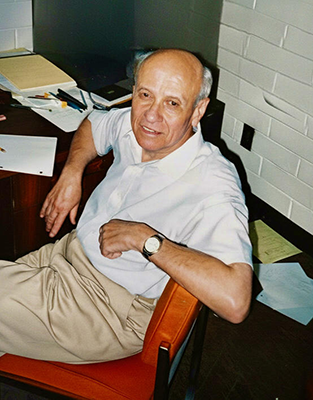
Honoring the legacy of Emmanuel Rashba
The passing of Professor Emmanuel Rashba in early 2025 was an irreparable loss to the physics community. For many decades prior, his numerous significant contributions have been driving solid state physics to surprising new places, realizations, and applications. To pay tribute to his many enduring, groundbreaking ideas, Physical Review B presents a special Collection with contributions by some of his disciples, collaborators, and connoisseurs of his mastery in top-shelf solid state research. Papers belonging to the collection will be published through 2026. It was initiated by Mark Dykman and Alexander Efros and colleagues. An Editorial from them and the contributed articles are linked below.
