Highlights

Cancelation of coherent synchrotron radiation kicks in chicane bunch compressors

Fancong Zeng, Yi Jiao, Weihang Liu, and Cheng-Ying Tsai

Phys. Rev. Accel. Beams 28, 070701 (2025) - Published 22 July, 2025

As a prerequisite to achieve the desired high peak current in free electron lasers, multi-stage symmetric C-chicane compressors are essentially required and widely utilized. However, during the bunch compression process, coherent synchrotron radiation (CSR) effects may lead to evident transverse emittance dilution and eventually prevent achieving a higher peak current. In this paper, we present a general model of a four-bend chicane and conduct an explicit point-kick analysis of the coherent synchrotron radiation (CSR) effects. These yield two novel steady state CSR-immune chicanes that feature non-symmetric C-shape and S-shape layouts, respectively.

Tunable, unmountable, permanent-magnet-based accelerator magnet

Dániel Barna and Gábor Anda

Phys. Rev. Accel. Beams 28, 072401 (2025) - Published 7 July, 2025

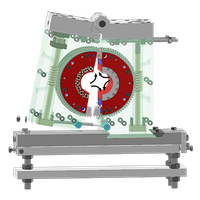
A novel permanent magnet-based accelerator magnet is presented, featuring nested, independently rotatable Halbach rings that provide fully tunable multipole fields with no energy consumption. Its openable, modular design allows easy installation around existing beamlines and seamless conversion between dipole, quadrupole, or higher-order configurations. With precise control over field strength and orientation, including polarity reversal, this compact, maintenance-free device offers a versatile and scalable solution for modern accelerator optics.

Kick-and-cancel injection scheme for the Diamond-II storage ring

A. Lueangaramwong, R. T. Fielder, A. Morgan, J. Kallestrup, I. P. S. Martin, J. D. Hares, A. K. L. Dymoke-Bradshaw, and P. A. Kellett

Phys. Rev. Accel. Beams 28, 060701 (2025) - Published 2 June, 2025

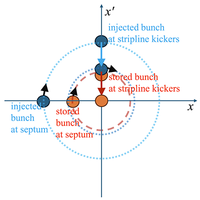
A novel quasitransparent top-up injection scheme is expected to significantly improve the transparency of the injection process and reduce the recovery time for the targeted bunch, along with minimizing transverse wakefield effects and any interactions with the transverse multibunch feedback and harmonic cavity. Short stripline kickers and kicker power supplies are thus developed to provide a double pulse with a few-microsecond pulse spacing as the requirement of this scheme.

Experimental demonstration of dark current mitigation by an over-inserted plug in a normal conducting very-high-frequency gun

Xing-Heng Wang, Guan Shu, Hou-Jun Qian, Xu-Dong Li, Zi-Peng Liu, Zeng-Gong Jiang, Hao Meng, Cao-Cao Xing, Qin Zhou, and Hai-Xiao Deng

Phys. Rev. Accel. Beams 28, 043401 (2025) - Published 3 April, 2025

Very high frequency (VHF) band normal conducting guns are used as electron sources for high-repetition-rate free electron lasers, including LCLS-II in the US and SHINE in China. Substantial dark current can lead to unwanted radiation losses in these guns. It is demonstrated that by slightly over-inserting a cathode plug into the gun, the dark current can be reduced from the microampere (μA) range to the nanoampere (nA) scale, without impacting beam performance. This straightforward approach could serve as a universal strategy for dark current suppression across various types of RF guns, extending beyond VHF guns.

BAGELS for simultaneous polarization, orbit, and optics control in electron storage rings

M. G. Signorelli and G. H. Hoffstaetter

Phys. Rev. Accel. Beams 28, 031002 (2025) - Published 18 March, 2025

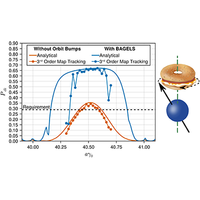
We present a novel method to minimize radiative depolarization in electron storage rings. Groups of vertical orbit bumps are constructed that achieve simultaneous polarization, orbit, and optics control, motivating the name “Best Adjustment Groups for ELectron Spin” (BAGELS). Applied in simulations of the 18 GeV Electron Storage Ring of the Electron-Ion Collider, BAGELS increases the asymptotic polarization by nearly 2x in the 1 interaction point case and over 3x in the 2-IP case. BAGELS is also used to construct knobs for global coupling correction and for generating a vertical beam size match at the IP, with minimal impacts on the polarization, orbit, and optics.

Local chromatic correction optics for Future Circular Collider e+e−

Pantaleo Raimondi, Simone Maria Liuzzo, Laurent Farvacque, Simon White, and Michael Hofer

Phys. Rev. Accel. Beams 28, 021002 (2025) - Published 13 February, 2025

Local Chromatic Correction optics are proposed for the Future Circular e+ − e− Collider. These new optics assume an identical layout of the magnets at all operation. The arcs design is a step forward from the classic FODO lattice that achieves near cancellation up to the fourth order of chromatic and geometric aberrations. Straight sections and final focus benefit from the application of transparency conditions. The final focus design includes additional specific sextupoles and decapoles for the optimization of the dynamics off-energy. Decapoles are very effective to mitigate the reduction of dynamic aperture due to synchrotron radiation.

Beam breakup instability studies of powerful energy recovery linac for experiments

S. Setiniyaz, R. Apsimon, P. H. Williams, C. Barbagallo, S. A. Bogacz, R. M. Bodenstein, and K. Deitrick

Phys. Rev. Accel. Beams 28, 011003 (2025) - Published 23 January, 2025

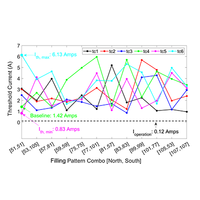
Filling patterns and bunch timings play a critical role in the beam breakup instability in multipass energy recovery linacs.

Beam stacking experiment at a fixed field alternating gradient accelerator

T. Uesugi, Y. Ishi, Y. Kuriyama, Y. Mori, C. Jolly, D. J. Kelliher, J.-B. Lagrange, A. P. Letchford, S. Machida, D. W. Posthuma de Boer, C. T. Rogers, E. Yamakawa, and M. Topp-Mugglestone

Phys. Rev. Accel. Beams 28, 012803 (2025) - Published 16 January, 2025

Beam stacking experiments in an FFA to reduce space charge effect.

High-density gas target at the LHCb experiment

O. Boente Garcia et al.

Phys. Rev. Accel. Beams 27, 111001 (2024) - Published 8 November, 2024

A high-density gas target in the LHC opens new opportunities for physics measurements with protons and heavy ions.

Effects of space charge force on the beam-beam mode coupling instability

Kazuhito Ohmi and Yuan Zhang

Phys. Rev. Accel. Beams 27, 101001 (2024) - Published 18 October, 2024

In e+e- colliders beam-beam mode coupling instability can be stabilized with space charge.

Dual-energy electron storage ring

B. Dhital, Y. S. Derbenev, A. Hutton, H. Zhang, G. A. Krafft, Y. Zhang, F. Lin, and V. S. Morozov

Phys. Rev. Accel. Beams 27, 090101 (2024) - Published 18 September, 2024

A novel accelerator configuration could provide for efficient electron cooling of hadron beams, drive a dual-color Compton light source, or help measure the electric dipole moment of the electron.

Efficient six-dimensional phase space reconstructions from experimental measurements using generative machine learning

Ryan Roussel, Juan Pablo Gonzalez-Aguilera, Eric Wisniewski, Alexander Ody, Wanming Liu, John Power, Young-Kee Kim, and Auralee Edelen

Phys. Rev. Accel. Beams 27, 094601 (2024) - Published 11 September, 2024

Reconstruction of a beam six-dimensional phase space using neural networks.

First experimental evidence of a beam-beam long-range compensation using wires in the Large Hadron Collider

A. Poyet, A. Bertarelli, F. Carra, S. D. Fartoukh, N. Fuster-Martínez, N. Karastathis, Y. Papaphilippou, M. Pojer, S. Redaelli, A. Rossi, K. Skoufaris, M. Solfaroli Camillocci, and G. Sterbini

Phys. Rev. Accel. Beams 27, 071003 (2024) - Published 23 July, 2024

Current-carrying wires in the Large Hadron Collider mimic long-rang beam-beam interactions to reduce the effect of real long-range beam-beam interactions.

Machine-learning-based pressure-anomaly detection system for SuperKEKB accelerator

Yusuke Suetsugu

Phys. Rev. Accel. Beams 27, 063201 (2024) - Published 20 June, 2024

Early pressure anomaly detection through machine learning improves SuperKEKB operation.

Acceleration of uranium beam to record power of 10.4 kW and observation of new isotopes at Facility for Rare Isotope Beams

P. N. Ostroumov et al.

Phys. Rev. Accel. Beams 27, 060101 (2024) - Published 17 June, 2024

Working at its design limits, the Facility for Rare Isotope Beams accelerates uranium ions, with lowest charge-to-mass ratio and highest power density, and produces new isotopes.

Vacuum chambers for Swiss Light Source arcs

R. Ganter, P. Braschoss, H.-H. Braun, J. Buchmann, A. Citterio, M. Dehler, N. Gaiffi, N. Kirchgeorg, M. Magjar, C. Rosenberg, D. Stephan, L. Schulz, R. Sieber, X. Wang, and A. Zandonella

Phys. Rev. Accel. Beams 27, 053201 (2024) - Published 10 May, 2024

Solutions to the challenges of vacuum chambers for diffraction limited storage rings are presented for the upgrade of the Swiss Light Source: From design to assembly.

Design, integration, and commissioning of the first linac for image guided hadron therapy prototype

Alberto Degiovanni et al.

Phys. Rev. Accel. Beams 27, 054701 (2024) - Published 9 May, 2024

A commercial linac prototype demonstrates key features for medical applications.

Design of a dual-mode transverse deflecting structure using neural network and multiobjective algorithms

H. Gong, W. Fang, J. Tan, X. Huang, C. Wang, Y. Xu, and Z. Zhao

Phys. Rev. Accel. Beams 27, 042001 (2024) - Published 15 April, 2024

A transverse deflecting structure operating in two rf modes can provide time-varying linear polarization at ultrafast speed.

Terahertz-driven acceleration of subrelativistic electron beams using tapered rectangular dielectric-lined waveguides

Laurence J. R. Nix, Joseph T. Bradbury, Christopher T. Shaw, Morgan T. Hibberd, Darren M. Graham, Robert B. Appleby, Graeme Burt, Rosa Letizia, and Steven P. Jamison

Phys. Rev. Accel. Beams 27, 041302 (2024) - Published 11 April, 2024

Tapered dielectric-lined waveguide allows a low energy, subrelativistic, electron beam to be accelerated to higher energy with a THz pulse.

Specification and design for full energy beam exploitation of the compact linear accelerator for research and applications

E. W. Snedden, D. Angal-Kalinin, A. R. Bainbridge, A. D. Brynes, S. R. Buckley, D. J. Dunning, J. R. Henderson, J. K. Jones, K. J. Middleman, T. J. Overton, T. H. Pacey, A. E. Pollard, Y. M. Saveliev, B. J. A. Shepherd, P. H. Williams, M. I. Colling, B. D. Fell, and G. Marshall

Phys. Rev. Accel. Beams 27, 041602 (2024) - Published 3 April, 2024
A new beamline will provide access to ultrashort, low emittance electron bunches, which can be combined with high-power laser pulses.

Sign In to Your Journals Account

Filter

Section

Filter

Article Lookup

Enter a citation