

- Open Access
Correlating Local Morphology and Charge Dynamics via Kelvin Probe Force Microscopy to Explain Photoelectrode Performance
PRX Energy 4, 023010 – Published 9 June, 2025
DOI: https://doi.org/10.1103/PRXEnergy.4.023010
Abstract
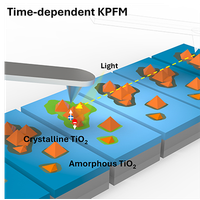
Photoelectrochemical (PEC) cells have emerged as a promising and sustainable route for the production of valuable chemicals and have attracted significant attention over the last few decades. However, photoelectrodes, essential components of PEC devices, are limited by solar-to-hydrogen conversion efficiencies significantly below the theoretical values, as well as by low stability under working conditions. An important hurdle toward achieving high efficiency is the limited number of available tools that can directly probe the interplay between the local morphology and charge carrier transport dynamics within the photoelectrode top layer. This layer has different functions: providing photocatalytic active sites and protecting underlying layers. Therefore, the development of a powerful technique to reveal the influence of morphology on transport dynamics is crucial. In this work, we show how to precisely correlate local morphology with optoelectronic properties via the investigation of photoinduced charge transport processes, by time-dependent Kelvin probe force microscopy (KPFM) measurements. Our approach allows the extraction of time-dependent photovoltage for each pixel of a KPFM scan. We used crystalline-amorphous mixed phase as a well-established model system to apply and validate our method. Through local correlations between structure-morphology and optoelectronic properties, our results reveal more efficient photoinduced charge separation on the regions corresponding to the crystalline phase, which exhibit faster transport, and generate a significantly higher surface photovoltage signal (approximately 440 mV) upon UV illumination (super-band-gap illumination). This finding supports the considerable role of microstructure in charge carrier dynamics, and the ability of our analytical method to resolve it. The analysis technique outlined here should find broad applicability, enabling in-depth insight into the effect of local microstructure, and contributing to the design and development of more efficient photoelectrodes by tailoring of the microstructure at the nanoscale.
Physics Subject Headings (PhySH)
Popular Summary
Photoelectrochemical (PEC) cells are promising for sustainably producing valuable chemicals, but are limited by efficiency and stability under working conditions. A major challenge is understanding how microscopic structures within photoelectrodes affect their ability to convert solar energy. Here, the authors introduce a method using time-resolved Kelvin Probe Force Microscopy (KPFM) to correlate local morphology with optoelectronic properties. The technique is applied to a crystalline-amorphous titanium dioxide system, revealing that crystalline regions promote faster charge transport and higher surface voltages than amorphous ones. These insights demonstrate the considerable role of microstructure on performance. The analysis technique presented here can guide the design of more efficient, stable photoelectrodes by optimizing material structure.
Article Text
Supplemental Material
References (53)
- R. v. d. Krol and M. Grätzel, Photoelectrochemical Hydrogen Production (Springer, New York, 2012).
- M. G. Walter, E. L. Warren, J. R. McKone, S. W. Boettcher, Q. Mi, E. A. Santori, and N. S. Lewis, Solar water splitting cells, Chem. Rev. 110, 6446 (2010).
- Advances in Photoelectrochemical Water Splitting: Theory, Experiment and Systems Analysis (Royal Society of Chemistry, London, 2018).
- V. Kumaravel, J. Bartlett, and S. C. Pillai, Photoelectrochemical conversion of carbon dioxide () into fuels and value-added products, ACS Energy Lett. 5, 486 (2020).
- S. Xu and E. A. Carter, Theoretical insights into heterogeneous (photo)electrochemical reduction, Chem. Rev. 119, 6631 (2019).
- A. Fujishima and K. Honda, Electrochemical photolysis of water at a semiconductor electrode, Nature 238, 37 (1972).
- H. Song, S. Luo, H. Huang, B. Deng, and J. Ye, Solar-driven hydrogen production: Recent advances, challenges, and future perspectives, ACS Energy Lett. 7, 1043 (2022).
- D. Li, K. Yang, J. Lian, J. Yan, and S. Liu, Powering the world with solar fuels from photoelectrochemical reduction: Basic principles and recent advances, Adv. Energy Mater. 12, 2201070 (2022).
- A. Verma and R. G. Pala, Practical semiconductor physics perspective of materials photoelectrochemistry, Curr. Opin. Electrochem. 36, 101160 (2022).
- R. Sathre, J. B. Greenblatt, K. Walczak, I. D. Sharp, J. C. Stevens, J. W. Ager, and F. A. Houle, Opportunities to improve the net energy performance of photoelectrochemical water-splitting technology, Energy Environ. Sci. 9, 803 (2016).
- G. Zeng, T. A. Pham, S. Vanka, G. Liu, C. Song, J. K. Cooper, Z. Mi, T. Ogitsu, and F. M. Toma, Development of a photoelectrochemically self-improving photocathode for efficient and durable H2 production, Nat. Mater. 20, 1130 (2021).
- S. Vanka, G. Zeng, T. G. Deutsch, F. M. Toma, and Z. Mi, Long-term stability metrics of photoelectrochemical water splitting, Front. Energy Res. 10, 840140 (2022).
- W. Yang, R. R. Prabhakar, J. Tan, S. D. Tilley, and J. Moon, Strategies for enhancing the photocurrent, photovoltage, and stability of photoelectrodes for photoelectrochemical water splitting, Chem. Soc. Rev. 48, 4979 (2019).
- Tobias A. Kistler, Guosong Zeng, James L. Young, Lien-Chun Weng, Chase Aldridge, Keenan Wyatt, Myles A. Steiner, Oscar Solorzano Jr., Frances A. Houle, Francesca M. Toma, Adam Z. Weber, Todd G. Deutsch, and Nemanja Danilovic, Emergent degradation phenomena demonstrated on resilient, flexible, and scalable integrated photoelectrochemical cells, Adv. Energy Mater. 10, 2002706 (2020).
- F. Fuchs, F. Caffy, R. Demadrille, T. Mélin, and B. Grévin, High-resolution Kelvin probe force microscopy imaging of interface dipoles and photogenerated charges in organic donor–acceptor photovoltaic blends, ACS Nano 10, 739 (2016).
- J. Zhu, F. Fan, R. Chen, H. An, Z. Feng, and C. Li, Direct imaging of highly anisotropic photogenerated charge separations on different facets of a single photocatalyst, Angew. Chem., Int. Ed. 54, 9111 (2015).
- Z. Schumacher, Y. Miyahara, A. Spielhofer, and P. Grutter, Measurement of surface photovoltage by atomic force microscopy under pulsed illumination, Phys. Rev. Appl. 5, 44018 (2016).
- Z. Schumacher, A. Spielhofer, Y. Miyahara, and P. Grutter, The limit of time resolution in frequency modulation atomic force microscopy by a pump-probe approach, Appl. Phys. Lett. 110, 53111 (2017).
- L. Kronik and Y. Shapira, Surface photovoltage phenomena: Theory, experiment, and applications, Surf. Sci. Rep. 37, 1 (1999).
- E. Escasain, E. Lopez-Elvira, A. M. Baro, J. Colchero, and E. Palacios-Lidon, Nanoscale surface photovoltage of organic semiconductors with two pass Kelvin probe microscopy, Nanotechnology 22, 375704 (2011).
- Marti Checa, Addis S. Fuhr, Changhyo Sun, Rama Vasudevan, Maxim Ziatdinov, Ilia Ivanov, Seok Joon Yun, Kai Xiao, Alp Sehirlioglu, Yunseok Kim, Pankaj Sharma, Kyle P. Kelley, Neus Domingo, Stephen Jesse, and Liam Collins, High-speed mapping of surface charge dynamics using sparse scanning Kelvin probe force microscopy, Nat. Commun. 14, 7196 (2023).
- R. Chen, F. Fan, and C. Li, Unraveling charge-separation mechanisms in photocatalyst particles by spatially resolved surface photovoltage techniques, Angew. Chem., Int. Ed. 61, e202117567 (2022).
- L. R. Sheppard, T. Dittrich, and M. K. Nowotny, the impact of niobium surface segregation on charge separation in niobium-doped titanium dioxide, J. Phys. Chem. C 116, 20923 (2012).
- J. Zheng, Y. Lyu, R. Wang, C. Xie, H. Zhou, S. P. Jiang, and S. Wang, Crystalline protective layer with graded oxygen defects for efficient and stable silicon-based photocathode, Nat. Commun. 9, 1 (2018).
- Mohammad A. Alim, Tadeusz Bak, Armand J. Atanacio, Mihail Ionescu, Brendan Kennedy, William S. Price, Johan Du Plessis, Maryam Pourmahdavi, Meifang Zhou, Allan Torres, and Janusz Nowotny, Photocatalytic properties of -doped , Ionics 23, 3517 (2017).
- S. Hu, M. R. Shaner, J. A. Beardslee, M. Lichterman, B. S. Brunschwig, and N. S. Lewis, Amorphous coatings stabilize , , and photoanodes for efficient water oxidation, Science 344, 1005 (2014).
- S. Hu, M. H. Richter, M. F. Lichterman, J. Beardslee, T. Mayer, B. S. Brunschwig, and N. S. Lewis, Electrical, photoelectrochemical, and photoelectron spectroscopic investigation of the interfacial transport and energetics of amorphous heterojunctions, J. Phys. Chem. C 120, 3117 (2016).
- B. Seger, D. S. Tilley, T. Pedersen, P. C. K. Vesborg, O. Hansen, M. Grätzel, and I. Chorkendorff, Silicon protected with atomic layer deposited : durability studies of photocathodic evolution, RSC Adv. 3, 25902 (2013).
- S. Fengler, H. Kriegel, M. Schieda, H. Gutzmann, T. Klassen, M. Wollgarten, and T. Dittrich, Charge transfer in -ALD) at the amorphous/anatase transition: A transient surface photovoltage spectroscopy study, ACS Appl. Mater. Interfaces 12, 3140 (2020).
- S. T. Nishanthi, S. Iyyapushpam, B. Sundarakannan, E. Subramanian, and D. Pathinettam Padiyan, Significance of crystallinity on the photoelectrochemical and photocatalytic activity of nanotube arrays, Appl. Surf. Sci. 313, 449 (2014).
- J. Eichhorn, C. Kastl, J. K. Cooper, D. Ziegler, A. M. Schwartzberg, I. D. Sharp, and F. M. Toma, Nanoscale imaging of charge carrier transport in water splitting photoanodes, Nat. Commun. 9, 2597 (2018).
- Janusz Nowotny, Mohammad Abdul Alim, Tadeusz Bak, Mohammad Asri Idris, Mihail Ionescu, Kathryn Prince, Mohd Zainizan Sahdan, Kamaruzzaman Sopian, Mohd Asri Mat Teridie, and Wolfgang Sigmund, Defect chemistry and defect engineering of -based semiconductors for solar energy conversion, Chem. Soc. Rev. 44, 8424 (2015).
- T. Dittrich and S. Fengler, Surface Photovoltage Analysis of Photoactive Materials (World Scientific, New Jersey London Singapore, 2020).
- A. Henning, G. Günzburger, R. Jöhr, Y. Rosenwaks, B. Bozic-Weber, C. E. Housecroft, E. C. Constable, E. Meyer, and T. Glatzel, Kelvin probe force microscopy of nanocrystalline photoelectrodes, Beilstein J. Nanotechnol. 4, 418 (2013).
- P. Eaton and P. West, Atomic Force Microscopy (Oxford University Press, New York, 2010).
- R. Chen, F. Fan, T. Dittrich, and C. Li, Imaging photogenerated charge carriers on surfaces and interfaces of photocatalysts with surface photovoltage microscopy, Chem. Soc. Rev. 47, 8238 (2018).
- M.-C. Wu, H.-C. Liao, Y.-C. Cho, G. Tóth, Y.-F. Chen, W.-F. Su, and K. Kordás, Photo-Kelvin probe force microscopy for photocatalytic performance characterization of single filament of nanofiber photocatalysts, J. Mater. Chem. A 1, 5715 (2013).
- M.-C. Wu, et al., Photocatalytic activity of nitrogen-doped -based nanowires: A photo-assisted Kelvin probe force microscopy study, J. Nanopart. Res. 16, 2143 (2013).
- T. Su, C. Yang, F. Niu, Y. Hua, Q. Xu, K. Hu, and L. Zhang, Spatial separation of photogenerated charges on the anisotropic facets of cuprous oxide, Inorg. Chem. Front. 10, 3550 (2023).
- D. K. Schroder, Surface voltage and surface photovoltage: History, theory and applications, Meas. Sci. Technol. 12, R16 (2001).
- C. Ros, T. Andreu, M. D. Hernández-Alonso, G. Penelas-Pérez, J. Arbiol, and J. R. Morante, Charge transfer characterization of ALD-grown protective layers in silicon photocathodes, ACS Appl. Mater. Interfaces 9, 17932 (2017).
- B. Mei, T. Pedersen, P. Malacrida, D. Bae, R. Frydendal, O. Hansen, P. C. K. Vesborg, B. Seger, and I. Chorkendorff, Crystalline : A generic and effective electron-conducting protection layer for photoanodes and -cathodes, J. Phys. Chem. C 119, 15019 (2015).
- M. K. Nowotny, P. Bogdanoff, T. Dittrich, S. Fiechter, A. Fujishima, and H. Tributsch, Observations of p-type semiconductivity in titanium dioxide at room temperature, Mater. Lett. 64, 928 (2010).
- See Supplemental Material at http://link.aps.org/supplemental/10.1103/PRXEnergy.4.023010 for additional microsctructural characterization, as well further detailed analysis of the photovoltage transients, and a full description of the data analysis method, including analysis of KP data, and algorithms implemented for extraction of transients from a series of continuously acquired KPFM images.
- S. Sadewasser and T. Glatzel, Kelvin Probe Force Microscopy: Measuring and Compensating Electrostatic Forces (Springer, Heidelberg, 2011).
- L. Kou, Y. J. Li, T. Kamijyo, Y. Naitoh, and Y. Sugawara, Investigation of the surface potential of (110) by frequency-modulation Kelvin probe force microscopy, Nanotechnology 27, 505704 (2016).
- N. Turetta, F. Sedona, A. Liscio, M. Sambi, and P. Samorì, Surface Contamination in ambient conditions: Unravelling the dynamics of the work function in air, Adv. Mater. Interfaces 8, 2100068 (2021).
- Christoph Kastl, Roland J. Koch, Christopher T. Chen, Johanna Eichhorn, Søren Ulstrup, Aaron Bostwick, Chris Jozwiak, Tevye R. Kuykendall, Nicholas J. Borys, Francesca M. Toma, Shaul Aloni, Alexander Weber-Bargioni, Eli Rotenberg, and Adam M. Schwartzberg, Effects of defects on band structure and excitons in revealed by nanoscale photoemission spectroscopy, ACS Nano 13, 1284 (2019).
- B. Zhao, Z. Gan, M. Johnson, E. Najafidehaghani, T. Rejek, A. George, R. H. Fink, A. Turchanin, and M. Halik, 2D van der Waals heterojunction of organic and inorganic monolayers for high responsivity phototransistors, Adv. Funct. Mater. 31, 2105444 (2021).
- L. X. Chen and J. Yano, Deciphering photoinduced catalytic reaction mechanisms in natural and artificial photosynthetic systems on multiple temporal and spatial scales using X-ray probes, Chem. Rev. 124, 5421 (2024).
- A. Litke, Y. Su, I. Tranca, T. Weber, E. J. M. Hensen, and J. P. Hofmann, Role of adsorbed water on charge carrier dynamics in photoexcited , J. Phys. Chem. C 121, 7514 (2017).
- Rosaria Verduci, Fabrizio Creazzo, Francesco Tavella, Salvatore Abate, Claudio Ampelli, Sandra Luber, Siglinda Perathoner, Giuseppe Cassone, Gabriele Centi, and Giovanna D’Angelo, Water structure in the first layers on : A key factor for boosting solar-driven water-splitting performances, J. Am. Chem. Soc. 146, 18061 (2024).
- https://doi.org/10.5281/zenodo.15235591

