

- Open Access
Lattice Compatibility and Energy Barriers in Intercalation Compounds
PRX Energy 4, 043002 – Published 15 October, 2025
DOI: https://doi.org/10.1103/w6lw-cwbp
Abstract
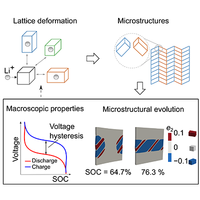
We present a continuum model for symmetry-breaking phase transformations in intercalation compounds, based on Ericksen’s multiwell energy formulation. The model predicts the nucleation and growth of crystallographic microstructures in —a representative intercalation compound—with twin boundary orientations and volume fractions that closely match experimental observations. Our chemomechanically coupled model not only generates geometrically accurate microstructures through energy minimization, but also reveals a subtle interplay between twinned domains and electrochemomechanical behavior. A key finding is that intercalation compounds satisfying specific compatibility conditions (e.g., or ) show lower elastic energy barriers, require smaller driving forces, and display narrower voltage hysteresis loops. Furthermore, we show that twinned domains act as conduits for fast diffusion. These results establish quantitative design guidelines for intercalation compounds, which focuses on tailoring lattice deformations (rather than suppressing them) and reducing energy barriers to mitigate structural degradation and enhance the electrochemical performance of battery electrodes.
Physics Subject Headings (PhySH)
Popular Summary
Intercalation compounds, commonly used as electrodes in rechargeable batteries and as electrochemical actuators, undergo abrupt lattice distortions when a chemical species (e.g., atom or ion) is inserted into or removed from the host structure. These distortions accelerate structural degradation and impair the electrochemical performance of intercalation compounds. Today, most design strategies aim to eliminate such distortions entirely--a criterion referred to as the zero-strain condition. In contrast, the authors propose a less restrictive approach that focuses on tailoring lattice compatibility and minimizing elastic energy barriers to reduce structural decay and improve the electrochemical performance of intercalation compounds. To this end, the authors develop a new continuum model for intercalation compounds, reveal nsights into the interplay between twinned microstructures and electrochemomechanical performance, and establish material design rules to extend the lifespans of battery materials.
Article Text
Supplemental Material
References (94)
- M. S. Whittingham, Chemistry of intercalation compounds: Metal guests in chalcogenide hosts, Prog. Solid State Chem. 12, 41 (1978).
- M. Rajapakse, B. Karki, U. O. Abu, S. Pishgar, M. R. K. Musa, S. S. Riyadh, M. Yu, G. Sumanasekera, and J. B. Jasinski, Intercalation as a versatile tool for fabrication, property tuning, and phase transitions in 2D materials, npj 2D Mater. Appl. 5, 30 (2021).
- R. Koerver, I. Aygün, T. Leichtweiß, C. Dietrich, W. Zhang, J. O. Binder, P. Hartmann, W. G. Zeier, and J. Janek, Capacity fade in solid-state batteries: Interphase formation and chemomechanical processes in nickel-rich layered oxide cathodes and lithium thiophosphate solid electrolytes, Chem. Mater. 29, 5574 (2017).
- A. Van der Ven, K. A. See, and L. Pilon, Hysteresis in electrochemical systems, Battery Energy 1, 20210017 (2022).
- D. A. Santos, S. Rezaei, D. Zhang, Y. Luo, B. Lin, A. R. Balakrishna, B.-X. Xu, and S. Banerjee, Chemistry–mechanics–geometry coupling in positive electrode materials: A scale-bridging perspective for mitigating degradation in lithium-ion batteries through materials design, Chem. Sci. 14, 458 (2023).
- J. A. Lewis, J. Tippens, F. J. Q. Cortes, and M. T. McDowell, Chemo-mechanical challenges in solid-state batteries, Trends Chem. 1, 845 (2019).
- A. Renuka Balakrishna, Crystallographic design of intercalation materials, J. Electrochem. Energy Convers. Storage 19, 040802 (2022).
- R. Zhang, C. Wang, P. Zou, R. Lin, L. Ma, L. Yin, T. Li, W. Xu, H. Jia, Q. Li et al., Compositionally complex doping for zero-strain zero-cobalt layered cathodes, Nature 610, 67 (2022).
- P. Schofield, Y. Luo, D. Zhang, W. Zaheer, D. Santos, G. Agbeworvi, J. D. Ponis, J. V. Handy, J. L. Andrews, E. J. Braham et al., Doping-induced pre-transformation to extend solid-solution regimes in -ion batteries, ACS Energy Lett. 7, 3286 (2022).
- P. Xiong, F. Zhang, X. Zhang, S. Wang, H. Liu, B. Sun, J. Zhang, Y. Sun, R. Ma, Y. Bando et al., Strain engineering of two-dimensional multilayered heterostructures for beyond-lithium-based rechargeable batteries, Nat. Commun. 11, 3297 (2020).
- J. Yang, X. Xiao, W. Gong, L. Zhao, G. Li, K. Jiang, R. Ma, M. H. Rummeli, F. Li, T. Sasaki et al., Size-independent fast ion intercalation in two-dimensional titania nanosheets for alkali-metal-ion batteries, Angew. Chem. 131, 8832 (2019).
- D. Zhang, J. Sheth, B. W. Sheldon, and A. R. Balakrishna, Film strains enhance the reversible cycling of intercalation electrodes, J. Mech. Phys. Solids 155, 104551 (2021).
- J. Cho, Y. J. Kim, T.-J. Kim, and B. Park, Zero-strain intercalation cathode for rechargeable -ion cell, Angew. Chem., Int. Ed. 40, 3367 (2001).
- L. Wang, T. Liu, T. Wu, and J. Lu, Strain-retardant coherent perovskite phase stabilized -rich cathode, Nature 611, 61 (2022).
- T. Ohzuku, A. Ueda, and N. Yamamoto, Zero-strain insertion material of for rechargeable lithium cells, J. Electrochem. Soc. 142, 1431 (1995).
- H.-M. Hau, T. Mishra, C. Ophus, T.-Y. Huang, K. Bustilo, Y. Sun, X. Yang, T. Holstun, X. Zhao, S. Wang et al., Earth-abundant -ion cathode materials with nanoengineered microstructures, Nat. Nanotechnol. 19, 1831 (2024).
- P. Bonnick, L. Blanc, S. H. Vajargah, C.-W. Lee, X. Sun, M. Balasubramanian, and L. F. Nazar, Insights into intercalation in a zero-strain material: Thiospinel , Chem. Mater. 30, 4683 (2018).
- L. Yang, G. Liang, H. Cao, S. Ma, X. Liu, X. Li, G. Chen, W. You, C. Lin, and R. Che, A new sodium calcium cyclotetravanadate framework: “Zero-strain” during large-capacity lithium intercalation, Adv. Funct. Mater. 32, 2105026 (2022).
- X. Zhao, and G. Ceder, Zero-strain cathode materials for -ion batteries, Joule 6, 2683 (2022).
- X. Zhao, Y. Tian, Z. Lun, Z. Cai, T. Chen, B. Ouyang, and G. Ceder, Design principles for zero-strain -ion cathodes, Joule 6, 1654 (2022).
- K. Bhattacharya, Microstructure of Martensite: Why it Forms and How it Gives Rise to the Shape-Memory Effect (Oxford University Press, 2003), Vol. 2.
- J. M. Ball, and R. D. James, Fine phase mixtures as minimizers of energy, Arch. Ration. Mech. Anal. 100, 13 (1987).
- C. Chu, and R. James, Analysis of microstructures in -14.0%-3.9% by energy minimization, J. Phys. IV 5, C8 (1995).
- A. Renuka Balakrishna, J. E. Huber, and I. Münch, Nanoscale periodic domain patterns in tetragonal ferroelectrics: A phase-field study, Phys. Rev. B 93, 174120 (2016).
- A. Renuka Balakrishna, and R. D. James, Design of soft magnetic materials, npj Comput. Mater. 8, 4 (2022).
- X. Chen, V. Srivastava, V. Dabade, and R. D. James, Study of the cofactor conditions: conditions of supercompatibility between phases, J. Mech. Phys. Solids 61, 2566 (2013).
- H. Knüpfer, R. V. Kohn, and F. Otto, Nucleation barriers for the cubic-to-tetragonal phase transformation, Commun. Pure Appl. Math. 66, 867 (2013).
- C. Chluba, W. Ge, R. Lima de Miranda, J. Strobel, L. Kienle, E. Quandt, and M. Wuttig, Ultralow-fatigue shape memory alloy films, Science 348, 1004 (2015).
- R. Zarnetta, R. Takahashi, M. L. Young, A. Savan, Y. Furuya, S. Thienhaus, B. Maaß, M. Rahim, J. Frenzel, H. Brunken et al., Identification of quaternary shape memory alloys with near-zero thermal hysteresis and unprecedented functional stability, Adv. Funct. Mater. 20, 1917 (2010).
- Y. Song, X. Chen, V. Dabade, T. W. Shield, and R. D. James, Enhanced reversibility and unusual microstructure of a phase-transforming material, Nature 502, 85 (2013).
- M. Wegner, H. Gu, R. D. James, and E. Quandt, Correlation between phase compatibility and efficient energy conversion in -doped barium titanate, Sci. Rep. 10, 3496 (2020).
- Y. Liang, S. Lee, H. Yu, H. Zhang, Y. Liang, P. Y. Zavalij, X. Chen, R. D. James, L. A. Bendersky, A. V. Davydov et al., Tuning the hysteresis of a metal-insulator transition via lattice compatibility, Nat. Commun. 11, 3539 (2020).
- J. Liu, Y. Gong, Y. You, X. You, B. Huang, X. Miao, G. Xu, F. Xu, and E. Brück, Giant reversible magnetocaloric effect in MnNiGe-based materials: Minimizing thermal hysteresis via crystallographic compatibility modulation, Acta Mater. 174, 450 (2019).
- A. R. Balakrishna, Compatible microstructures in magnetic materials, Phys. Rev. Mater. 6, 074402 (2022).
- T. Erichsen, B. Pfeiffer, V. Roddatis, and C. A. Volkert, Tracking the diffusion-controlled lithiation reaction of by in situ TEM, ACS Appl. Energy Mater. 3, 5405 (2020).
- K. Mizushima, P. Jones, P. Wiseman, and J. B. Goodenough, (): A new cathode material for batteries of high energy density, Solid State Ionics 3, 171 (1981).
- A. K. Padhi, K. S. Nanjundaswamy, and J. B. Goodenough, Phospho-olivines as positive-electrode materials for rechargeable lithium batteries, J. Electrochem. Soc. 144, 1188 (1997).
- F. Luo, C. Wei, C. Zhang, H. Gao, J. Niu, W. Ma, Z. Peng, Y. Bai, and Z. Zhang, Operando x-ray diffraction analysis of the degradation mechanisms of a spinel cathode in different voltage windows, J. Energy Chem. 44, 138 (2020).
- A. M. Abakumov, A. A. Tsirlin, I. Bakaimi, G. Van Tendeloo, and A. Lappas, Multiple twinning as a structure directing mechanism in layered rock-salt-type oxides: polymorphism, redox potentials, and magnetism, Chem. Mater. 26, 3306 (2014).
- D. Zhang, and A. R. Balakrishna, Designing shape-memory-like microstructures in intercalation materials, Acta Mater. 252, 118879 (2023).
- T. Zhang, D. Zhang, and A. R. Balakrishna, Coupling diffusion and finite deformation in phase transformation materials, J. Mech. Phys. Solids 183, 105501 (2024).
- M. Tang, J. F. Belak, and M. R. Dorr, Anisotropic phase boundary morphology in nanoscale olivine electrode particles, J. Phys. Chem. C 115, 4922 (2011).
- R. J. Clément, Z. Lun, and G. Ceder, Cation-disordered rocksalt transition metal oxides and oxyfluorides for high energy Lithium-ion cathodes, Energy Environ. Sci. 13, 345 (2020).
- J. Choa, and M. M. Thackeray, Structural changes of spinel electrodes during electrochemical cycling, J. Electrochem. Soc. 146, 3577 (1999).
- H. Moriwake, A. Kuwabara, C. A. Fisher, R. Huang, T. Hitosugi, Y. H. Ikuhara, H. Oki, and Y. Ikuhara, First-principles calculations of lithium-ion migration at a coherent grain boundary in a cathode material, , Adv. Mater. 25, 618 (2013).
- Y. Shin, and A. Manthiram, Factors influencing the capacity fade of spinel lithium manganese oxides, J. Electrochem. Soc. 151, A204 (2004).
- W. Wang, Y. Gang, Z. Hu, Z. Yan, W. Li, Y. Li, Q.-F. Gu, Z. Wang, S.-L. Chou, H.-K. Liu et al., Reversible structural evolution of sodium-rich rhombohedral Prussian blue for sodium-ion batteries, Nat. Commun. 11, 980 (2020).
- Z. Zhang, M. Avdeev, H. Chen, W. Yin, W. H. Kan, and G. He, Lithiated Prussian blue analogues as positive electrode active materials for stable non-aqueous lithium-ion batteries, Nat. Commun. 13, 7790 (2022).
- J. Ericksen, On the Cauchy—Born rule, Math. Mech. Solids 13, 199 (2008).
- X. Chen, Y. Song, N. Tamura, and R. D. James, Determination of the stretch tensor for structural transformations, J. Mech. Phys. Solids 93, 34 (2016).
- See Supplemental Material at http://link.aps.org/supplemental/10.1103/w6lw-cwbp for further details on symbols, structural data and geometric solutions, and numerical implementations.
- Z. Zhang, R. D. James, and S. Müller, Energy barriers and hysteresis in martensitic phase transformations, Acta Mater. 57, 4332 (2009).
- A. R. Balakrishna, and R. D. James, A tool to predict coercivity in magnetic materials, Acta Mater. 208, 116697 (2021).
- K. Dubey, P. Devi, A. K. Singh, and S. Singh, Improved crystallographic compatibility and magnetocaloric reversibility in PT substituted magnetic shape memory Heusler alloy, J. Magn. Magn. Mater. 507, 166818 (2020).
- V. Srivastava, Y. Song, K. Bhatti, and R. James, The direct conversion of heat to electricity using multiferroic alloys, Adv. Energy Mater. 1, 97 (2011).
- H. Gu, L. Bumke, C. Chluba, E. Quandt, and R. D. James, Phase engineering and supercompatibility of shape memory alloys, Mater. Today 21, 265 (2018).
- Note, materials undergoing a cubic-to-tetragonal phase transformation with a stretch tensor can form volume-preserving (or self-accommodating) microstructures when . Other symmetry-lowering phase transformations require satisfying additional constraints as detailed in Chapter 9 of Ref. [21].
- D. Chang, H. Huo, K. E. Johnston, M. Ménétrier, L. Monconduit, C. P. Grey, and A. Van der Ven, Elucidating the origins of phase transformation hysteresis during electrochemical cycling of – electrodes, J. Mater. Chem. A 3, 18928 (2015).
- D. Kim, S.-H. Kang, M. Slater, S. Rood, J. T. Vaughey, N. Karan, M. Balasubramanian, and C. S. Johnson, Enabling sodium batteries using lithium-substituted sodium layered transition metal oxide cathodes, Adv. Energy Mater. 1, 333 (2011).
- N. Nadkarni, T. Zhou, D. Fraggedakis, T. Gao, and M. Z. Bazant, Modeling the metal–insulator phase transition in for energy and information storage, Adv. Funct. Mater. 29, 1902821 (2019).
- P. Ombrini, M. Z. Bazant, M. Wagemaker, and A. Vasileiadis, Thermodynamics of multi-sublattice battery active materials: from an extended regular solution theory to a phase-field model of , npj Comput. Mater. 9, 148 (2023).
- C. V. Di Leo, E. Rejovitzky, and L. Anand, A Cahn–Hilliard-type phase-field theory for species diffusion coupled with large elastic deformations: Application to phase-separating -ion electrode materials, J. Mech. Phys. Solids 70, 1 (2014).
- M. Pitteri, and G. Zanzotto, Continuum Models for Phase Transitions and Twinning in Crystals (Chapman and Hall/CRC, 2002).
- Compounds in which host lattices undergo displacive transformations.
- G. R. Barsch, and J. A. Krumhansl, Twin boundaries in ferroelastic media without interface dislocations, Phys. Rev. Lett. 53, 1069 (1984).
- O. Redlich, and A. Kister, Algebraic representation of thermodynamic properties and the classification of solutions, Ind. Eng. Chem. 40, 345 (1948).
- M. M. Thackeray, W. I. David, P. G. Bruce, and J. B. Goodenough, Lithium insertion into manganese spinels, Mater. Res. Bull. 18, 461 (1983).
- S. Lee, J. Park, A. M. Sastry, and W. Lu, Molecular dynamics simulations of SOC-dependent elasticity of spinels in -ion batteries, J. Electrochem. Soc. 160, A968 (2013).
- Y. Lin, Y. Yang, H. Ma, Y. Cui, and W. L. Mao, Compressional behavior of bulk and nanorod under nonhydrostatic stress, J Phys. Chem. C 115, 9844 (2011).
- M. Eckhoff, F. Schönewald, M. Risch, C. A. Volkert, P. E. Blöchl, and J. Behler, Closing the gap between theory and experiment for lithium manganese oxide spinels using a high-dimensional neural network potential, Phys. Rev. B 102, 174102 (2020).
- A. Van der Ven, C. Marianetti, D. Morgan, and G. Ceder, Phase transformations and volume changes in spinel , Solid State Ionics 135, 21 (2000).
- J. Y. Shu, W. E. King, and N. A. Fleck, Finite elements for materials with strain gradient effects, Int. J. Numer. Methods Eng. 44, 373 (1999).
- R. Wang, X. Chen, Z. Huang, J. Yang, F. Liu, M. Chu, T. Liu, C. Wang, W. Zhu, S. Li et al., Twin boundary defect engineering improves lithium-ion diffusion for fast-charging spinel cathode materials, Nat. Commun. 12, 3085 (2021).
- Z. Guo, H. Jiang, X. Sun, X. Li, Z. Liu, J. Zhang, J. Luo, J. Zhang, X.-S. Tao, J. Ding et al., Ultrafast non-equilibrium phase transition induced twin boundaries of spinel lithium manganate, Adv. Energy Mater. 14, 2302484 (2024).
- A. Nie, L.-Y. Gan, Y. Cheng, Q. Li, Y. Yuan, F. Mashayek, H. Wang, R. Klie, U. Schwingenschlogl, and R. Shahbazian-Yassar, Twin boundary-assisted lithium ion transport, Nano Lett. 15, 610 (2015).
- S. Anand, T. P. Mishra, P. Zhong, Y. Choi, K. Jun, T. Holstun, and G. Ceder, Origin of enhanced performance when -rich rocksalt cathodes transform to -DRX, arXiv:2502.19140.
- Cofactor conditions are another set of compatibility constraints that are necessary for improved material reversibility [26]. For cubic-to-tetragonal transformation, these strong compatibility conditions are only valid for volume fractions or (equivalent to the condition). However, for other symmetry-lowering transformations (e.g., cubic-to-monoclinic) these cofactor conditions can serve as additional design parameters, which when satisfied generates twin microstructures at any arbitrary volume fraction contributing to enhanced reversibility [30].
- The second type of tetragonal variant is stabilized and grows to form a compatible interface with the reference phase, when the periodic boundary conditions are applied on the top and bottom edges of the computational domain; this is equivalent to rotating the computational domain by , see Fig. S2 of the Supplemental Material [51].
- M. D. Radin, J. Alvarado, Y. S. Meng, and A. Van der Ven, Role of crystal symmetry in the reversibility of stacking-sequence changes in layered intercalation electrodes, Nano Lett. 17, 7789 (2017).
- Note, in our 2D computations these hydrostatic stresses are minimized in microstructures with zero area change in the plane of the computational domain, see dashed line in Fig. 11.
- The interface is an exactly compatible interface, however, in our diffuse-interface modeling we note finite stresses ( GPa) during phase change, see Fig. 9. These stresses correspond to the energy penalty for gradients of the composition order parameter and the strain order parameter in our continuum framework.
- We can further minimize this elastic energy barrier by designing lattice deformations that not only satisfy the criterion, but also the volume-preserving () deformation [94]. For the case of cubic-to-tetragonal transformation, this would reduce to a rigid lattice constraint with zero distortion.
- D. A. Cogswell, and M. Z. Bazant, Coherency strain and the kinetics of phase separation in nanoparticles, ACS Nano 6, 2215 (2012).
- J. Lim, Y. Li, D. H. Alsem, H. So, S. C. Lee, P. Bai, D. A. Cogswell, X. Liu, N. Jin, Y.-s. Yu et al., Origin and hysteresis of lithium compositional spatiodynamics within battery primary particles, Science 353, 566 (2016).
- I. Temprano, J. Carrasco, M. Bugnet, I. T. Lucas, J. Zhou, R. S. Weatherup, C. A. O’Keefe, Z. Ruff, J. Xu, N. Folastre et al., Advanced methods for characterizing battery interfaces: Towards a comprehensive understanding of interfacial evolution in modern batteries, Energy Storage Mater. 73, 103794 (2024).
- B. Puchala, J. C. Thomas, A. R. Natarajan, J. G. Goiri, S. S. Behara, J. L. Kaufman, and A. Van der Ven, CASM—a software package for first-principles based study of multicomponent crystalline solids, Comput. Mater. Sci. 217, 111897 (2023).
- N. H. Bashian, S. Zhou, M. Zuba, A. M. Ganose, J. W. Stiles, A. Ee, D. S. Ashby, D. O. Scanlon, L. F. Piper, B. Dunn et al., Correlated polyhedral rotations in the absence of polarons during electrochemical insertion of lithium in , ACS Energy Lett. 3, 2513 (2018).
- G. Amatucci, J. Tarascon, and L. Klein, , the end member of the solid solution, J. Electrochem. Soc. 143, 1114 (1996).
- J. Lu, and Y. Li, Perovskite-type -ion solid electrolytes: a review, J. Mater. Sci.: Mater. Electron. 32, 9736 (2021).
- K. Tůma, S. Stupkiewicz, and H. Petryk, Size effects in martensitic microstructures: Finite-strain phase field model versus sharp-interface approach, J. Mech. Phys. Solids 95, 284 (2016).
- J. Jetter, H. Gu, H. Zhang, M. Wuttig, X. Chen, J. R. Greer, R. D. James, and E. Quandt, Tuning crystallographic compatibility to enhance shape memory in ceramics, Phys. Rev. Mater. 3, 093603 (2019).
- H. Guan, N. Ahani, C. García-Cervera, and A. Renuka Balakrishna, Hysteresis and energy barriers in soft magnets, Phys. Rev. Mater. 9, 044407 (2025).
- D. Tiwari, and A. R. Balakrishna, A micromechanical model for light-interactive molecular crystals, J. Mech. Phys. Solids 203, 106195 (2025).
- K. Bhattacharya, S. Conti, G. Zanzotto, and J. Zimmer, Crystal symmetry and the reversibility of martensitic transformations, Nature 428, 55 (2004).

