

- Open Access
Multifidelity Machine Learning Interatomic Potentials for Charged Point Defects
PRX Energy 5, 043001 – Published 8 October, 2026
DOI: https://doi.org/10.1103/tzwd-cl3y
Abstract
Machine learning interatomic potentials (MLIPs) can now reproduce the energy, forces, and stresses of bulk materials with high accuracy compared to first-principles calculations. The description of imperfections, where coordination environments and electron counts deviate from those found in pristine reference structures, remains a challenge. We find that the current generation of foundation MLIPs does not describe the defect physics of the photovoltaic absorber . We introduce global defect charge embeddings that distinguish the bonding characteristics of different charge states. We further employ a multifidelity approach that combines low-cost (semilocal exchange-correlation functional) reference data with high-quality (nonlocal hybrid functional) energies and forces that describe well the subtleties of the defect energy landscape. The resulting defect-capable force fields can find stable structural configurations and predict defect thermodynamics in quantitative agreement with direct quantum mechanical calculations, at a fraction of the computational cost.
Physics Subject Headings (PhySH)
Popular Summary
While machine-learning interatomic potentials have advanced computational materials science, most remain blind to charge state. Local structural descriptors cannot distinguish electronically distinct configurations of the same defect, collapsing multiple potential energy surfaces onto one. Here, the authors close this gap using a global charge embedding. Applied to the emerging photovoltaic absorber , this approach accurately predicts ground-state configurations and defect thermodynamics across multiple charge states within a single unified potential. A multifidelity training strategy further achieves hybrid-functional accuracy from only high-fidelity data, while uncovering lower-energy defect configurations missed by conventional density functional theory screening. This work opens charged defect systems to the speed and scale of modern machine-learning workflows.
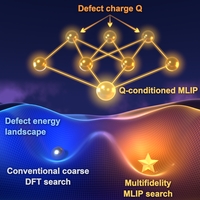
Article Text
Supplemental Material
References (77)
- A. Walsh and A. Zunger, Instilling defect tolerance in new compounds, Nat. Mater. 16, 964 (2017).
- A. Van der Ven, Z. Deng, S. Banerjee, and S. P. Ong, Rechargeable alkali-ion battery materials: Theory and computation, Chem. Rev. 120, 6977 (2020).
- C. Freysoldt, B. Grabowski, T. Hickel, J. Neugebauer, G. Kresse, A. Janotti, and C. G. Van de Walle, First-principles calculations for point defects in solids, Rev. Mod. Phys. 86, 253 (2014).
- I. Mosquera-Lois and S. R. Kavanagh, In search of hidden defects, Matter 4, 2602 (2021).
- S. R. Kavanagh, D. O. Scanlon, A. Walsh, and C. Freysoldt, Impact of metastable defect structures on carrier recombination in solar cells, Faraday Discuss. 239, 339 (2022).
- X. Wang, S. R. Kavanagh, D. O. Scanlon, and A. Walsh, Four-electron negative- vacancy defects in antimony selenide, Phys. Rev. B 108, 134102 (2023).
- F. El-Mellouhi, N. Mousseau, and P. Ordejón, Sampling the diffusion paths of a neutral vacancy in silicon with quantum mechanical calculations, Phys. Rev. B 70, 205202 (2004).
- A. G. Squires, L. Ganeshkumar, C. N. Savory, S. R. Kavanagh, and D. O. Scanlon, Oxygen dimerization as a defect-driven process in bulk , ACS Energy Lett. 9, 4180 (2024).
- I. Mosquera-Lois, S. R. Kavanagh, A. Walsh, and D. O. Scanlon, ShakeNBreak: Navigating the defect configurational landscape, J. Open Source Softw. 7, 4817 (2022).
- C. J. Pickard and R. J. Needs, Ab initio random structure searching, J. Phys. Condens. Matter 23, 053201 (2011).
- X. Wang, S. R. Kavanagh, and A. Walsh, Sulfur vacancies limit the open-circuit voltage of solar cells, ACS Energy Lett. 10, 161 (2025).
- I. Batatia, C. Lin, J. Hart, E. Kasoar, A. M. Elena, S. W. Norwood, T. Wolf, and G. Csányi, Cross learning between electronic structure theories for unifying molecular, surface, and inorganic crystal foundation force fields, arXiv:2510.25380.
- I. Batatia, P. Benner, Y. Chiang, A. M. Elena, D. P. Kovács, J. Riebesell, X. R. Advincula, M. Asta, M. Avaylon, W. J. Baldwin et al., A foundation model for atomistic materials chemistry, J. Chem. Phys. 163, 184110 (2025).
- Y. Lysogorskiy, A. Bochkarev, and R. Drautz, Graph atomic cluster expansion for foundational machine learning interatomic potentials, npj Comput. Mater. 12, 114 (2026).
- H. Yang, C. Hu, Y. Zhou, X. Liu, Y. Shi, J. Li, G. Li, Z. Chen, S. Chen, C. Zeni et al., MatterSim: A deep learning atomistic model across elements, temperatures and pressures, arXiv:2405.04967.
- A. Jain, S. P. Ong, G. Hautier, W. Chen, W. D. Richards, S. Dacek, S. Cholia, D. Gunter, D. Skinner, G. Ceder et al., Commentary: The materials project: A materials genome approach to accelerating materials innovation, APL Mater. 1, 011002 (2013).
- L. Barros-Luque, M. Shuaibi, X. Fu, B. M. Wood, M. Dzamba, M. Gao, A. Rizvi, M. Uyttendaele, C. L. Zitnick, and Z. W. Ulissi, The Open Materials 2024 (OMat24) inorganic materials dataset and models, Nat. Comput. Sci. 6, 642 (2026).
- J. Schmidt, T. F. T. Cerqueira, A. H. Romero, A. Loew, F. Jäger, H.-C. Wang, S. Botti, and M. A. L. Marques, Improving machine-learning models in materials science through large datasets, Mater. Today Phys. 48, 101560 (2024).
- A. Loew, D. Sun, H.-C. Wang, S. Botti, and M. A. L. Marques, Universal machine learning interatomic potentials are ready for phonons, npj Comput. Mater. 11, 178 (2025).
- E. Prodan and W. Kohn, Nearsightedness of electronic matter, Proc. Natl. Acad. Sci. U.S.A. 102, 11635 (2005).
- J. Behler and M. Parrinello, Generalized neural-network representation of high-dimensional potential-energy surfaces, Phys. Rev. Lett. 98, 146401 (2007).
- I. Batatia, D. P. Kovács, G. N. C. Simm, C. Ortner, and G. Csányi, MACE: Higher order equivariant message passing neural networks for fast and accurate force fields, Adv. Neural Inf. Process. Syst. 35, 11423 (2022).
- A. Mannodi-Kanakkithodi, X. Xiang, L. Jacoby, R. Biegaj, S. T. Dunham, D. R. Gamelin, and M. K. Y. Chan, Universal machine learning framework for defect predictions in zinc blende semiconductors, Patterns 3, 100450 (2022).
- I. Mosquera-Lois, S. R. Kavanagh, A. M. Ganose, and A. Walsh, Machine-learning structural reconstructions for accelerated point defect calculations, npj Comput. Mater. 10, 121 (2024).
- S. R. Kavanagh, Identifying split vacancy defects with machine-learned foundation models and electrostatics, J. Phys. Energy 7, 045002 (2025).
- J. Zhou, X. Li, M. Huang, and S. Chen, One-defect one-potential strategy for accurate machine learning prediction of phonons in defect-containing supercells, Phys. Rev. B 112, 235205 (2025).
- Z. Yang, X. Liu, X. Zhang, P. Huang, K. S. Novoselov, and L. Shen, Modeling crystal defects using defect informed neural networks, npj Comput. Mater. 11, 229 (2025).
- M. E. Turiansky, J. L. Lyons, and N. Bernstein, Machine learning phonon spectra for fast and accurate optical lineshapes of defects, ACS Nano 20, 7454 (2026).
- I. Mosquera-Lois, J. Klarbring, and A. Walsh, Point defect formation at finite temperatures with machine learning force fields, Chem. Sci. 16, 8878 (2025).
- I. Mosquera-Lois and A. Walsh, Dynamic vacancy levels in obey equilibrium defect thermodynamics, PRX Energy 4, 043008 (2025).
- M. H. Rahman, M. Biswas, and A. Mannodi-Kanakkithodi, DeFecT-FF: A machine learning force field framework for high throughput defect modeling in CdTe-based solar cells, Phys. Chem. Chem. Phys. 28, 10718 (2026).
- B. Cheng, Latent Ewald summation for machine learning of long-range interactions, npj Comput. Mater. 11, 80 (2025).
- T. W. Ko, J. A. Finkler, S. Goedecker, and J. Behler, A fourth-generation high-dimensional neural network potential with accurate electrostatics including non-local charge transfer, Nat. Commun. 12, 398 (2021).
- M. Vondrák, W. J. Baldwin, G. Csányi, K. Reuter, and J. T. Margraf, Integrating charge equilibration with equivariant machine-learning interatomic potentials, J. Chem. Theory Comput. 22, 6874 (2026).
- I. Batatia, W. J. Baldwin, D. Kuryla, J. Hart, E. Kasoar, A. M. Elena, H. Moore, M. J. Gawkowski, B. X. Shi, V. Kapil et al., MACE-POLAR-1: A polarisable electrostatic foundation model for molecular chemistry, arXiv:2602.19411.
- W. J. Baldwin, I. Batatia, M. Vondrák, J. T. Margraf, and G. Csányi, Design space of self–consistent electrostatic machine learning interatomic potentials, arXiv:2603.14700.
- B. Wang, S. L. Li, and D. G. Truhlar, Modeling the partial atomic charges in inorganometallic molecules and solids and charge redistribution in lithium-ion cathodes, J. Chem. Theory Comput. 10, 5640 (2014).
- A. Y. Toukmaji and J. A. Board Jr., Ewald summation techniques in perspective: A survey, Comput. Phys. Commun. 95, 73 (1996).
- B. M. Wood, M. Dzamba, X. Fu, M. Gao, M. Shuaibi, L. Barroso-Luque, K. Abdelmaqsoud, V. Gharakhanyan, J. Kitchin, D. S. Levine et al., UMA: A family of universal models for atoms, Adv. Neural Inf. Process. Syst. 38, 129391 (2025).
- K. Shimizu, Y. Dou, E. F. Arguelles, T. Moriya, E. Minamitani, and S. Watanabe, Using neural network potentials to study defect formation and phonon properties of nitrogen vacancies with multiple charge states in GaN, Phys. Rev. B 106, 054108 (2022).
- S. Kiyohara, C. Shibui, S. Bae, and Y. Kumagai, Machine-learning prediction of charged-defect formation energies from crystal structures, Phys. Rev. Lett. 135, 246101 (2025).
- A. Mavlonov, T. Razykov, F. Raziq, J. Gan, J. Chantana, Y. Kawano, T. Nishimura, H. Wei, A. Zakutayev, T. Minemoto et al., A review of photovoltaic absorber materials and thin-film solar cells, Sol. Energy 201, 227 (2020).
- X. Wang, S. R. Kavanagh, D. O. Scanlon, and A. Walsh, Upper efficiency limit of solar cells, Joule 8, 2105 (2024).
- See Supplemental Material at http://link.aps.org/supplemental/10.1103/tzwd-cl3y for detailed methodology and additional results on foundation model benchmarking, charge-embedded models, and multi-fidelity training, which includes Refs. [45–65].
- W. Kohn and L. J. Sham, Self-consistent equations including exchange and correlation effects, Phys. Rev. 140, A1133 (1965).
- R. M. Dreizler and E. K. Gross, Density functional theory of relativistic systems, in Density Functional Theory (Springer, Berlin, Heidelberg, 1990), pp. 245–271.
- G. Kresse and J. Furthmüller, Efficient iterative schemes for ab initio total-energy calculations using a plane-wave basis set, Phys. Rev. B 54, 11169 (1996).
- G. Kresse and D. Joubert, From ultrasoft pseudopotentials to the projector augmented-wave method, Phys. Rev. B 59, 1758 (1999).
- S. Grimme, Accurate description of van der Waals complexes by density functional theory including empirical corrections, J. Comput. Chem. 25, 1463 (2004).
- X. Wang, Z. Li, S. R. Kavanagh, A. M. Ganose, and A. Walsh, Lone pair driven anisotropy in antimony chalcogenide semiconductors, Phys. Chem. Chem. Phys. 24, 7195 (2022).
- J. P. Perdew, K. Burke, and M. Ernzerhof, Generalized gradient approximation made simple, Phys. Rev. Lett. 77, 3865 (1996).
- J. Heyd, G. E. Scuseria, and M. Ernzerhof, Hybrid functionals based on a screened Coulomb potential, J. Chem. Phys. 118, 8207 (2003).
- X. Liu, X. Xiao, Y. Yang, D. Xue, D. Li, C. Chen, S. Lu, L. Gao, Y. He, M. C. Beard et al., Enhanced solar cell performance through theory-guided defect control, Prog. Photovolt. 25, 861 (2017).
- C. N. Savory and D. O. Scanlon, The complex defect chemistry of antimony selenide, J. Mater. Chem. A 7, 10739 (2019).
- A. Stoliaroff, A. Lecomte, O. Rubel, S. Jobic, X. H. Zhang, C. Latouche, and X. Rocquefelte, Deciphering the role of key defects in , a promising candidate for chalcogenide-based solar cells, ACS Appl. Energy Mater. 3, 2496 (2020).
- S. R. Kavanagh, A. G. Squires, A. Nicolson, I. Mosquera-Lois, A. M. Ganose, B. Zhu, K. Brlec, A. Walsh, and D. O. Scanlon, Doped: Python toolkit for robust and repeatable charged defect supercell calculations, J. Open Source Softw. 9, 6433 (2024).
- I. Batatia, S. Batzner, D. P. Kovács, A. Musaelian, G. N. C. Simm, R. Drautz, C. Ortner, B. Kozinsky, and G. Csányi, The design space of E(3)-equivariant atom-centred interatomic potentials, Nat. Mach. Intell. 7, 56 (2025).
- D. P. Kingma and J. Ba, Adam: A method for stochastic optimization, in International Conference on Learning Representations (Computational and Biological Learning Society, San Diego, CA, USA, 2015).
- P. J. Huber, Robust estimation of a location parameter, in Breakthroughs in Statistics: Methodology and Distribution (Springer, New York, 1992), pp. 492–518.
- P. Izmailov, D. Podoprikhin, T. Garipov, D. P. Vetrov, and A. G. Wilson, Averaging weights leads to wider optima and better generalization, in Proceedings of the Conference on Uncertainty in Artificial Intelligence (AUAI Press, Corvallis, OR, USA, 2018), pp. 876–885.
- R. Fletcher, Practical Methods of Optimization (John Wiley & Sons, New York, 1987).
- A. H. Larsen, J. J. Mortensen, J. Blomqvist, I. E. Castelli, R. Christensen, M. Dułak, J. Friis, M. N. Groves, B. Hammer, C. Hargus et al., The atomic simulation environment—a Python library for working with atoms, J. Phys.: Condens. Matter 29, 273002 (2017).
- H. W. Kuhn, The Hungarian method for the assignment problem, Nav. Res. Logist. Q. 2, 83 (1955).
- Y. Kumagai and F. Oba, Electrostatics-based finite-size corrections for first-principles point defect calculations, Phys. Rev. B 89, 195205 (2014).
- D. S. Levine, M. Shuaibi, E. W. C. Spotte-Smith, M. G. Taylor, M. R. Hasyim, K. Michel, I. Batatia, G. Csányi, M. Dzamba, P. Eastman et al., The open molecules 2025 (OMol25) dataset, evaluations, and models, arXiv:2505.08762.
- Z. Fan, B. Tang, E. Berger, E. Berger, E. Fransson, K. Xu, Z. Yan, Z. Liu, Z. Song, H. Dong et al., qNEP: A highly efficient neuroevolution potential with dynamic charges for large-scale atomistic simulations, J. Chem. Theory Comput. 22, 4787 (2026).
- P. Mori-Sánchez, A. J. Cohen, and W. Yang, Localization and delocalization errors in density functional theory and implications for band-gap prediction, Phys. Rev. Lett. 100, 146401 (2008).
- A. G. Squires, S. R. Kavanagh, A. Walsh, and D. O. Scanlon, Guidelines for robust and reproducible point defect simulations in crystals, Nat. Rev. Mater. 11, 469 (2026).
- T. W. Ko, R. Liu, A. R. Mishra, Z. Yu, J. Qi, and S. P. Ong, A linear-scaling, charge-aware foundation potential for atomistic simulations, arXiv:2511.07249.
- I. Mosquera-Lois, S. R. Kavanagh, A. Walsh, and D. O. Scanlon, Identifying the ground state structures of point defects in solids, npj Comput. Mater. 9, 25 (2023).
- A. Alkauskas, Q. Yan, and C. G. Van de Walle, First-principles theory of nonradiative carrier capture via multiphonon emission, Phys. Rev. B 90, 075202 (2014).
- T. Hainer, E. Berger, E. Berger, O. Hildeberg, P. Erhart, and J. Wiktor, Thermal stabilization of defect charge states and finite-temperature charge transition levels, arXiv:2512.15463.
- C. Linderälv, N. Österbacka, J. Wiktor, and P. Erhart, Optical line shapes of color centers in solids from classical autocorrelation functions, npj Comput. Mater. 11, 101 (2025).
- V. Tyagi, M. Pols, G. Brocks, and S. Tao, Tracing ion migration in halide perovskites with machine learned force fields, J. Phys. Chem. Lett. 16, 5153 (2025).
- http://www.archer2.ac.uk.
- X. Wang, I. Mosquera-Lois, and A. Walsh, Supporting data for “multi-fidelity machine learning interatomic potentials for charged point defects” (2026), 10.5281/zenodo.22756145.
- https://github.com/ACEsuit/mace.

