

- Open Access
Physics-Informed Analytical Models for Interpretable and Deployable Hydrogen Storage Prediction in MOFs
PRX Energy 4, 043009 – Published 3 December, 2025
DOI: https://doi.org/10.1103/glnw-drn4
Abstract
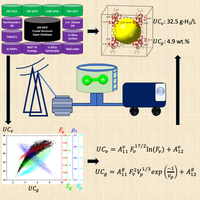
Storing hydrogen safely and compactly is a central challenge for clean transportation, grid support, and industrial decarbonization. Metal-organic frameworks (MOFs) are compelling candidates because of their ultrahigh internal surface areas and large pore volumes, yet the design space is effectively infinite, making exhaustive synthesis and simulation impractical. We introduce a physics-informed analytical modeling approach that uses deterministic sparsity-promoting symbolic regression with explicit physical constraints to produce a family of closed-form equations for fast, interpretable, and deployable prediction of usable hydrogen storage in MOFs. On a curated dataset of 88 400 MOFs, the method discovers compact, physically consistent structure-property relationships using as few as one property (void fraction for volumetric capacity) or two properties (void fraction and pore volume for gravimetric capacity) selected from seven descriptors: single-crystal density, gravimetric surface area, volumetric surface area, void fraction, pore volume, largest cavity diameter, and pore-limiting diameter. Equations using one to three properties achieve design-grade accuracy ( > 0.99 for gravimetric capacity and > 0.95 for volumetric capacity), while additional descriptors provide marginal gains for high-capacity edge cases, matching black-box machine learning performance and providing mechanistic insights into why some MOFs excel and others do not. Because evaluation is simulation-free and effectively costless, the models integrate directly into high-throughput screening, active learning workflows, and generative design to prioritize syntheses and avoid dead ends, establishing a generalizable path to interpretable and deployable surrogates for adsorption-based energy materials.
Physics Subject Headings (PhySH)
Popular Summary
Hydrogen is a promising clean energy carrier, but storing it safely and efficiently remains a major challenge for practical use in vehicles and grid systems. Metal-organic frameworks (MOFs), a class of highly porous materials, show great potential for hydrogen storage, but the chemical design space is effectively infinite, making exhaustive synthesis and simulation impractical for identifying the best candidates. In this study, the authors develop a simple, interpretable family of models that use only basic structural properties to predict how much hydrogen a MOF can store under practical operating conditions. These models are built with symbolic regression, a machine-learning technique that yields compact equations grounded in physical principles. Unlike blackbox algorithms, this approach provides clear insight into why certain materials perform better. The result is a practical tool that enables rapid screening and design of hydrogen-storage materials, accelerating discovery and supporting the transition to a sustainable energy future.
Article Text
Supplemental Material
References (94)
- G. Glenk and S. Reichelstein, Economics of converting renewable power to hydrogen, Nat. Energy 4, 216 (2019).
- S. van Renssen, The hydrogen solution?, Nat. Clim. Change 10, 799 (2020).
- N. Mac Dowell, N. Sunny, N. Brandon, H. Herzog, A. Y. Ku, W. Maas, A. Ramirez, D. M. Reiner, G. N. Sant, and N. Shah, The hydrogen economy: A pragmatic path forward, Joule 5, 2524 (2021).
- A. Majumdar, J. M. Deutch, R. S. Prasher, and T. P. Griffin, A framework for a hydrogen economy, Joule 5, 1905 (2021).
- A. Ahmed, S. Seth, J. Purewal, A. G. Wong-Foy, M. Veenstra, A. J. Matzger, and D. J. Siegel, Exceptional hydrogen storage achieved by screening nearly half a million metal-organic frameworks, Nat. Commun. 10, 1568 (2019).
- M. D. Allendorf, et al., An assessment of strategies for the development of solid-state adsorbents for vehicular hydrogen storage, Energy Environ. Sci. 11, 2784 (2018).
- A. Ahmed and D. J. Siegel, Predicting hydrogen storage in MOFs via machine learning, Patterns 2, 100291 (2021).
- A. Ahmed, Y. Liu, J. Purewal, L. D. Tran, M. Veenstra, A. Wong-Foy, A. Matzger, and D. Siegel, Balancing gravimetric and volumetric hydrogen density in MOFs, Energy Environ. Sci. 10, 2459 (2017).
- M. A. Pellow, C. J. M. Emmott, C. J. Barnhart, and S. M. Benson, Hydrogen or batteries for grid storage? A net energy analysis, Energy Environ. Sci. 8, 1938 (2015).
- M. D. Allendorf, V. Stavila, J. L. Snider, M. Witman, M. E. Bowden, K. Brooks, B. L. Tran, and T. Autrey, Challenges to developing materials for the transport and storage of hydrogen, Nat. Chem. 14, 1214 (2022).
- I. A. Hassan, H. S. Ramadan, M. A. Saleh, and D. Hissel, Hydrogen storage technologies for stationary and mobile applications: Review, analysis and perspectives, Renewable Sustainable Energy Rev. 149, 111311 (2021).
- C. Moran, P. Deane, S. Yousefian, and R. F. D. Monaghan, The hydrogen storage challenge: Does storage method and size affect the cost and operational flexibility of hydrogen supply chains?, Int. J. Hydrogen Energy 52, 1090 (2024).
- D. D. Papadias and R. K. Ahluwalia, Bulk storage of hydrogen, Int. J. Hydrogen Energy 46, 34527 (2021).
- Z. Chen, K. O. Kirlikovali, K. B. Idrees, M. C. Wasson, and O. K. Farha, Porous materials for hydrogen storage, Chemistry 8, 693 (2022).
- Z. Chen, Penghao Li, Ryther Anderson, Xingjie Wang, Xuan Zhang, Lee Robison, Louis R. Redfern, Shinya Moribe, Timur Islamoglu, Diego A. Gómez-Gualdrón, Taner Yildirim, J. Fraser Stoddart, and Omar K. Farha, Balancing volumetric and gravimetric uptake in highly porous materials for clean energy, Science 368, 297 (2020).
- N. L. Rosi, J. Eckert, M. Eddaoudi, D. T. Vodak, J. Kim, M. O’Keeffe, and O. M. Yaghi, Hydrogen storage in microporous metal-organic frameworks, Science 300, 1127 (2003).
- L. J. Murray, M. Dinc, and J. R. Long, Hydrogen storage in metal-organic frameworks, Chem. Soc. Rev. 38, 1294 (2009).
- M. P. Suh, H. J. Park, T. K. Prasad, and D. W. Lim, Hydrogen storage in metal-organic frameworks, Chem. Rev. 112, 782 (2012).
- M. Dincǎ and J. R. Long, Hydrogen storage in microporous metal–organic frameworks with exposed metal sites, Angew. Chem., Int. Ed. 47, 6766 (2008).
- J. L. C. Rowsell and O. M. Yaghi, Strategies for hydrogen storage in metal-organic frameworks, Angew. Chem., Int. Ed. 44, 4670 (2005).
- A. Schoedel, Z. Ji, and O. M. Yaghi, The role of metal–organic frameworks in a carbon-neutral energy cycle, Nat. Energy 1, 16034 (2016).
- A. G. Wong-Foy, A. J. Matzger, and O. M. Yaghi, Exceptional saturation uptake in microporous metal-organic frameworks, J. Am. Chem. Soc. 128, 3494 (2006).
- D. Chakraborty, A. Yurdusen, G. Mouchaham, F. Nouar, and C. Serre, Large-scale production of metal–organic frameworks, Adv. Funct. Mater. 34, 2309089 (2024).
- DOE Technical Targets for Onboard Hydrogen Storage for Light-Duty Vehicles, https://energy.gov/eere/fuelcells/doe-technical-targets-onboard-hydrogen-storage-light-duty-vehicles.
- X. Zhang, R. Lin, J. Wang, B. Wang, B. Liang, T. Yildirim, J. Zhang, W. Zhou, and B. Chen, Optimization of the pore structures of MOFs for record high hydrogen volumetric working capacity, Adv. Mater. 32, 1907995 (2020).
- D. A. Gomez-Gualdron, T. C. Wang, P. García-Holley, R. M. Sawelewa, E. Argueta, R. Q. Snurr, J. T. Hupp, T. Yildirim, and O. K. Farha, Understanding volumetric and gravimetric hydrogen adsorption trade-off in metal−organic frameworks, ACS Appl. Mater. Interfaces 9, 33419 (2017).
- D. Zhao, X. Wang, L. Yue, Y. He, and B. Chen, Porous metal–organic frameworks for hydrogen storage, Chem. Commun. 58, 11059 (2022).
- B. Mouriño, S. Majumdar, X. Jin, F. McIlwaine, J. van Herck, A. Ortega-Guerrero, S. Garcia, and B. Smit, Exploring the chemical design space of metal-organic frameworks for photocatalysis, Chem. Sci. 16, 11434 (2025).
- S. M. Moosavi, A. Nandy, K. M. Jablonka, D. Ongari, J. P. Janet, P. G. Boyd, Y. Lee, B. Smit, and H. J. Kulik, Understanding the diversity of the metal-organic framework ecosystem, Nat. Commun. 11, 4068 (2020).
- J. Kim, D. Nam, H. J. Cho, E. Cho, D. Sivanesan, C. Cho, J. Lee, J. Kim, and W. Choe, Up–down approach for expanding the chemical space of metal–organic frameworks, Nat. Synth. 3, 1518 (2024).
- T.-W. Liu, Q. Nguyen, A. Bousso Dieng, D. A. G. Omez-Gualdrón, and G. Gualdrón, Diversity-driven, efficient exploration of a MOF design space to optimize MOF properties, Chem. Sci. 15, 18903 (2024).
- K. Liu, Z. Chen, T. Islamoglu, S. J. Lee, H. Chen, T. Yildirim, O. K. Farha, and R. Q. Snurr, Exploring the chemical space of metal-organic frameworks with rht topology for high capacity hydrogen storage, J. Phys. Chem. C 128, 7435 (2024).
- S. Lee, B. Kim, H. Cho, H. Lee, S. Y. Lee, E. S. Cho, and J. Kim, Computational screening of trillions of metal–organic frameworks for high-performance methane storage, ACS Appl. Mater. Interfaces 13, 23647 (2021).
- S. Majumdar, S. M. Moosavi, K. M. Jablonka, D. Ongari, and B. Smit, Diversifying databases of metal organic frameworks for high-throughput computational screening, ACS Appl. Mater. Interfaces 13, 61004 (2021).
- R. B. Getman, Y.-S. Bae, C. E. Wilmer, and R. Q. Snurr, Review and analysis of molecular simulations of methane, hydrogen, and acetylene storage in metal–organic frameworks, Chem. Rev. 112, 703 (2012).
- Y. J. Colón, D. Fairen-Jimenez, C. E. Wilmer, and R. Q. Snurr, High-throughput screening of porous crystalline materials for hydrogen storage capacity near room temperature, J. Phys. Chem. C 118, 5383 (2014).
- A. W. Thornton, Cory M. Simon, Jihan Kim, Ohmin Kwon, Kathryn S. Deeg, Kristina Konstas, Steven J. Pas, Matthew R. Hill, David A. Winkler, Maciej Haranczyk, and Berend Smit, Materials genome in action: Identifying the performance limits of physical hydrogen storage, Chem. Mater. 29, 2844 (2017).
- G. Anderson, B. Schweitzer, R. Anderson, and D. A. Gómez-Gualdrón, Attainable volumetric targets for adsorption-based hydrogen storage in porous crystals: Molecular simulation and machine learning, J. Phys. Chem. C 123, 120 (2019).
- P. García-Holley, Benjamin Schweitzer, Timur Islamoglu, Yangyang Liu, Lu Lin, Stephanie Rodriguez, Mitchell H. Weston, Joseph T. Hupp, Diego A. Gómez-Gualdrón, Taner Yildirim, and Omar K. Farha, Benchmark study of hydrogen storage in metal–organic frameworks under temperature and pressure swing conditions, ACS Energy Lett. 3, 748 (2018).
- L. T. Glasby and P. Z. Moghadam, Hydrogen storage in MOFs: Machine learning for finding a needle in a haystack, Patterns 2, 100305 (2021).
- B. J. Bucior, N. S. Bobbitt, T. Islamoglu, S. Goswami, A. Gopalan, T. Yildirim, O. K. Farha, N. Bagheri, and R. Q. Snurr, Energy-based descriptors to rapidly predict hydrogen storage in metal-organic frameworks, Mol. Syst. Des. Eng. 4, 162 (2019).
- G. Borboudakis, T. Stergiannakos, M. Frysali, E. Klontzas, I. Tsamardinos, and G. E. Froudakis, Chemically intuited, large-scale screening of MOFs by machine learning techniques, npj Comput. Mater. 3, 40 (2017).
- Z. Wang, Y. Zhou, T. Zhou, and K. Sundmacher, Identification of optimal metal-organic frameworks by machine learning: Structure decomposition, feature integration, and predictive modeling, Comput. Chem. Eng. 160, 107739 (2022).
- A. A. Yamde, V. G. Lade, A. B. Bindwal, M. S. Tiwari, and R. P. Birmod, Machine learning approaches for the prediction of hydrogen uptake in metal-organic-frameworks: A comprehensive review, Int. J. Hydrogen Energy 98, 1131 (2025).
- H. Qiu, Y. Xia, C. Xiang, F. Xu, L. Sun, and Y. Zou, Prediction of hydrogen storage in metal-organic frameworks using CatBoost-based approach, Int. J. Hydrogen Energy 79, 952 (2024).
- S. Ghude and C. Chowdhury, Exploring hydrogen storage capacity in metal-organic frameworks: A Bayesian optimization approach, Chem. - Eur. J. 29, e202301840 (2023).
- C. Altintas, O. F. Altundal, S. Keskin, and R. Yildirim, Machine learning meets with metal organic frameworks for gas storage and separation, J. Chem. Inf. Model. 61, 2131 (2021).
- S. Meduri and J. Nandanavanam, Prediction of hydrogen uptake of metal organic frameworks using explainable machine learning, Energy AI 12, 100230 (2023).
- M. Seyyedattar, S. Zendehboudi, A. Ghamartale, and M. Afshar, Advancing hydrogen storage predictions in metal-organic frameworks: A comparative study of LightGBM and random forest models with data enhancement, Int. J. Hydrogen Energy 69, 158 (2024).
- C. Altintas and S. Keskin, On the shoulders of high-throughput computational screening and machine learning: Design and discovery of MOFs for storage and purification, Mater. Today Energy 38, 101426 (2023).
- Y. Cao, H. A. Dhahad, S. G. Zare, N. Farouk, A. E. Anqi, A. Issakhov, and A. Raise, Potential application of metal-organic frameworks (MOFs) for hydrogen storage: Simulation by artificial intelligent techniques, Int. J. Hydrogen Energy 46, 36336 (2021).
- X. Wang, H. M. Breunig, and P. Peng, Broad range material-to-system screening of metal–organic frameworks for hydrogen storage using machine learning, Appl. Energy 383, 125346 (2025).
- X. Lu, Z. Xie, X. Wu, M. Li, and W. Cai, Hydrogen storage metal-organic framework classification models based on crystal graph convolutional neural networks, Chem. Eng. Sci. 259, 117813 (2022).
- R. M. Giappa, E. Tylianakis, M. Di Gennaro, K. Gkagkas, and G. E. Froudakis, A combination of multi-scale calculations with machine learning for investigating hydrogen storage in metal organic frameworks, Int. J. Hydrogen Energy 46, 27612 (2021).
- K. Salehi, M. Rahmani, and S. Atashrouz, Machine learning assisted predictions for hydrogen storage in metal-organic frameworks, Int. J. Hydrogen Energy 48, 33260 (2023).
- R. J. Sadus, Molecular Simulation of Fluids: Theory, Algorithms, and Object-Orientation (Elsevier, Amsterdam, 1999).
- T. L. Hill, An Introduction to Statistical Thermodynamics (Dover Publications, New York, USA, 1986).
- Z. Li, K. Shi, D. Dubbeldam, M. Dewing, C. Knight, Á Vázquez-Mayagoitia, and R. Q. Snurr, Efficient implementation of Monte Carlo algorithms on graphical processing units for simulation of adsorption in porous materials, J. Chem. Theory Comput. 20, 10649 (2024).
- D. Dubbeldam, S. Calero, D. E. Ellis, and R. Q. Snurr, raspa: Molecular simulation software for adsorption and diffusion in flexible nanoporous materials, Mol. Simul. 42, 81 (2016).
- A. K. Rappe, C. J. Casewit, K. S. Colwell, W. A. Goddard, and W. M. Skiff, UFF, a full periodic table force field for molecular mechanics and molecular dynamics simulations, J. Am. Chem. Soc. 114, 10024 (1992).
- S. L. Mayo, B. D. Olafson, and W. A. Goddard III, DREIDING: A generic force field for molecular simulations, J. Phys. Chem. 94, 8897 (1990).
- M. G. Martin and J. I. Siepmann, Transferable potentials for phase equilibria. 1. United-atom description of n-alkanes, J. Phys. Chem. B 102, 2569 (1998).
- T. Hastie, R. Tibshirani, and J. Friedman, The Elements of Statistical Learning (Springer New York, New York, NY, 2009).
- B. Panella, M. Hirscher, and S. Roth, Hydrogen adsorption in different carbon nanostructures, Carbon N. Y. 43, 2209 (2005).
- K. J. Gross, Recommended Best Practices for the Characterization of Storage Properties of Hydrogen Storage Materials (Dec. 31, 2015). https://doi.org/10.23722/1718912
- R. Chahine and T. K. Bose, Low-pressure adsorption storage of hydrogen, Int. J. Hydrogen Energy 19, 161 (1994).
- M. G. Nijkamp, J. E. M. J. Raaymakers, A. J. Van Dillen, and K. P. De Jong, Hydrogen storage using physisorption-materials demands, Appl. Phys. A 72, 619 (2001).
- A. Züttel, P. Sudan, P. Mauron, and P. Wenger, Model for the hydrogen adsorption on carbon nanostructures, Appl. Phys. A 78, 941 (2004).
- Theo Jaffrelot Inizan, Sherry Yang, Aaron Kaplan, Yen-hsu Lin, Jian Yin, Saber Mirzaei, Mona Abdelgaid, Ali H. Alawadhi, KwangHwan Cho, Zhiling Zheng, Ekin Dogus Cubuk, Christian Borgs, Jennifer T. Chayes, Kristin A. Persson, and Omar M. Yaghi, System of agentic AI for the discovery of metal-organic frameworks (2025). https://doi.org/10.48550/arXiv.2504.14110.
- R. Ouyang, S. Curtarolo, E. Ahmetcik, M. Scheffler, and L. M. Ghiringhelli, SISSO: A compressed-sensing method for identifying the best low-dimensional descriptor in an immensity of offered candidates, Phys. Rev. Mater. 2, 83802 (2018).
- T. A. R. Purcell, M. Scheffler, and L. M. Ghiringhelli, Recent advances in the SISSO method and their implementation in the SISSO++ code, J. Chem. Phys. 159, 114110 (2023).
- A. Ahmed, Machine-learning-enhanced symbolic regression for methane storage prediction in covalent organic frameworks, Phys. Rev. Mater. 8, 115408 (2024).
- Commercial Eureqa Software Sold by DataRobot: https://www.datarobot.com/nutonian/
- M. Virgolin, T. Alderliesten, C. Witteveen, and P. A. N. Bosman, Improving model-based genetic programming for symbolic regression of small expressions, Evol. Comput. 29, 211 (2021).
- M. Cranmer, Interpretable machine learning for science with PySR and SymbolicRegression.jl (2023). https://doi.org/10.48550/arXiv.2305.01582.
- A. Tonda, Review of PySR: high-performance symbolic regression in python and julia, Genet. Program. Evolvable Mach. 26, 1 (2024).
- gplearn: https://gplearn.readthedocs.io/en/stable/changelog.html.
- S. L. Brunton, J. L. Proctor, and J. N. Kutz, Discovering governing equations from data by sparse identification of nonlinear dynamical systems, Proc. Natl. Acad. Sci. U. S. A. 113, 3932 (2016).
- R. Tibshirani, Regression shrinkage and selection via the lasso, J. R. Stat. Soc. Ser. B 58, 267 (1996).
- S. M. Udrescu and M. Tegmark, AI Feynman: A physics-inspired method for symbolic regression, Sci. Adv. 6, eaay2631 (2020).
- J. Liu, W. Li, L. Yu, M. Wu, W. Li, Y. Li, and M. Hao, Mathematical expression exploration with graph representation and generative graph neural network, Neural Netw. 187, 107405 (2025).
- L. Podina, B. Eastman, and M. Kohandel, in Proceedings of the 40th International Conference on Machine Learning, PMLR (2023), Vol. 202, p. 27948.
- LaSR: Symbolic Regression with a Learned Concept Library. https://doi.org/10.48550/arXiv.2409.09359.
- Y. Li, W. Li, L. Yu, M. Wu, J. Liu, W. Li, M. Hao, S. Wei, and Y. Deng, Generative pre-trained transformer for symbolic regression base in-context reinforcement learning. (2024). https://arxiv.org/html/2404.06330v1.
- B. K. Petersen, M. L. Larma, T. N. Mundhenk, C. P. Santiago, S. K. Kim, and J. T. Kim, in International Conference on Learning Representations (ICLR). (2021). https://openreview.net/forum?id=m5Qsh0kBQG.
- C. J. Bartel, C. Sutton, B. R. Goldsmith, R. Ouyang, C. B. Musgrave, L. M. Ghiringhelli, and M. Scheffler, New tolerance factor to predict the stability of perovskite oxides and halides, Sci. Adv. 5, 2375 (2019).
- L. M. Ghiringhelli, J. Vybiral, E. Ahmetcik, R. Ouyang, S. V. Levchenko, C. Draxl, and M. Scheffler, Learning physical descriptors for materials science by compressed sensing, New J. Phys. 19, 023017 (2017).
- R. Ouyang, E. Ahmetcik, L. M. Ghiringhelli, and M. Scheffler, in APS March Meeting 2017, Abstract Id. B1.004 (2017).
- A. Ahmed, Input dataset used to develop the analytical equations in “physics-informed analytical models for interpretable and deployable hydrogen storage prediction in MOFs,” https://zenodo.org/records/17108560.
- A. Ahmed and D. J. Siegel, HyMARC Datahub, https://datahub.hymarc.org/dataset/computational-prediction-of-hydrogen-storage-capacities-in-mofs.
- A. W. van der Vaart, Asymptotic Statistics (Cambridge University Press, New York, USA, 1998).
- P. Billingsley, Probability and Measure, Wiley Series in Probability and Statistics, (John Wiley & Sons, Inc., New York, USA, 1995) 3rd ed.
- See Supplemental Material at http://link.aps.org/supplemental/10.1103/glnw-drn4 for detailed correlation analyses (Spearman and Pearson correlation matrices and pairwise scatter plots for all structural descriptors), real-world validation performance metrics on experimental MOF datasets, and comparative complexity analysis of symbolic regression methods including equation structure comparisons between SISSO and PySR approaches. No additional references are cited in the Supplemental Material.
- T. F. Willems, C. H. Rycroft, M. Kazi, J. C. Meza, and M. Haranczyk, Algorithms and tools for high-throughput geometry-based analysis of crystalline porous materials, Microporous Mesoporous Mater. 149, 134 (2012).

