Babak Fotouhi and Mehrdad Khani Shirkoohi
Phys. Rev. E 93, 012301 (2016) – Published 6 January, 2016

In support of global efforts to address the COVID-19 pandemic, the American Physical Society (APS) has committed to making potentially relevant, peer-reviewed articles from our Physical Review journals more discoverable, accessible, and usable.
We have identified a collection of articles potentially relevant to researchers, health professionals, and others working on the COVID-19 pandemic, and are making this collection free to read for the duration of the crisis. The scope of the collection includes any articles that mention coronavirus, as well as those classified as relevant to epidemiology and epidemic spreading models. We will continue to add to the collection as additional potentially relevant articles are identified, and as new articles with potential relevance are published.
For broader information regarding all APS activities, check the Society’s COVID-19 website regularly.
The internet is filled with memes that have “gone viral.” A study of meme popularity uses an analytically tractable model that sheds light on the fundamental drivers of meme popularity in social networks.
Multilayer networks can be used to describe many phenomena such as the flow of information and the spread of disease. A new mathematical description of these networks in the context of disease transmission reveals behaviors such as multiple transmission rates and localization of disease in a network layer.
Using a two-step extension of a well-known epidemic model with multiple seeds, the authors observe two different spreading behaviors. Depending on the concentration of initially infected seeds, the epidemic transition can be a hybrid one showing both continuous and discontinuous behavior, or a continuous one.
A new network model reveals that social mixing and mobility can determine the areas of a city that are critical in provoking an epidemic outbreak.
A new model of contagious spreading on temporal networks focuses on the interactions between individuals to derive criteria essential for risk assessment.
The authors show how the accuracy of mean-field estimates of the epidemic threshold in real and synthetic complex networks are related to their spectral properties. The results allow to gauge the predictive effectiveness of the different theories, enabling the selection of the minimal representative approach in order to obtain the desired accuracy in predictions for real-world topologies.
The authors study a general epidemic model with arbitrary recovery rate distribution and show that heterogeneity in the dynamical parameters can be as significant as the more studied structural heterogeneity. Specifically, the paper uncovers that the critical point tends to be smaller than typically expected, which can be linked to the variance of the recovery rates.
A new analysis predicts the speed at which an infectious disease spreads to specific individuals in a network.
During the spread of an epidemic, highly connected individuals can maintain infection throughout the population by reinfecting each other even when not in direct contact.
The paper studies the interaction between dynamical systems and percolation models, with views towards the study of diseases that have time-dependent infection rates. The work introduces F(t)-bootstrap percolation where a vertex is infected if the number of its neighbors which are infected at time t is the value of a certain percolation function, F(t). This model serves to describe scenarios such as the propagation of diseases that become resilient to treatments over time and assess vaccination programs
The authors show that social contagion dynamics display a complex phase space, characterized by first and second order transitions, bistability, and hysteresis. The authors also extend the concept of latent heat to social contexts, which could provide insights into oscillatory social behaviors
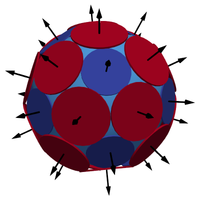
Numerical simulations reveal details of thermal melting, buckling and collapse transitions of viral capsids.
High-speed visualization identifies the formation mechanism of microscopic saliva droplets during the phonation of plosive consonants: as moist lips open, there is a sequence of film formation and rupture into vertically attached filaments, which subsequently extend over centimeter-scales and destabilize into droplets due to the fast airflow of speech. The formation process ties this aerosolization mechanism to drop formation in wind instruments and to meter-long, speech-driven transport important to asymptomatic transmission of airborne pathogens.
An examination of the concentration of a pathogen exhaled while speaking in a poorly ventilated space suggests that the probability of infection is relatively high for a few minutes of contact time at a separation of 1 meter separation distance and double that time at a separation of 2 meters.
The authors study how pathogens can be exposed to damaging hydrodynamic stressors during the aerosolization process.
Researchers use nonequilibrium statistical physics methods to guide the design of vaccines that are effective against many strains of a virus, a holy grail of immunology.
Ambient conditions surrounding respiratory droplets determine their growth or shrinkage. In cold and humid weather, the droplets can grow due to the supersaturation of the vapor puff. This phenomenon can be explained by our model.
Motivated by the current pandemic we analyze the use of cloth masks as effective alternatives to medical masks for the general public. In this paper, we establish a quantitative framework for estimating the filtration efficacy of cloth masks by deriving analytical estimates for the pressure drop across woven heterogeneous fabrics. We then introduce a filtration quality factor to compare the intrinsic filtration capabilities of diverse materials for submicron aerosols. Finally, we present a decision map to illustrate the trade-offs between filtration efficiency and breathability and to provide practical guidance on the selection of cloth masks.
We present a study of wetted facemasks to evaluate their capability in blocking respiratory droplets. We show that the increase in wetness progressively weakens the penetration capability of the impacted droplets. Such behavior is observed for hydrophobic and hydrophilic masks, although the underlying mechanism is different.
In addition to their ability to filter pathogenic droplets, masks also represent a porous barrier to exhaled and inhaled air flow. In this study, we characterize the aerodynamic effect of a mask by tracking the air exhaled by a person through a mask. We show how a mask confines the exhaled flows within tens of centimeters in front of a person breathing or speaking.
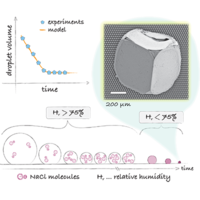
Recent studies have shown that enveloped viruses contained in airborne respiratory droplets lose infectability fastest at intermediate ambient relative humidities. Studying the evaporation dynamics of respiratory-like droplets in air reveals that, at high humidity, the salt dissolved in respiratory drops inhibits their evaporation indefinitely while at low humidity the drop evaporates leaving a porous solid residue, inside which virions may survive for long times. We conclude that the optimal relative humidity for minimal infectability should coincide with that at which droplets remain liquid and contain high salt concentrations for long periods of time.